
Overview
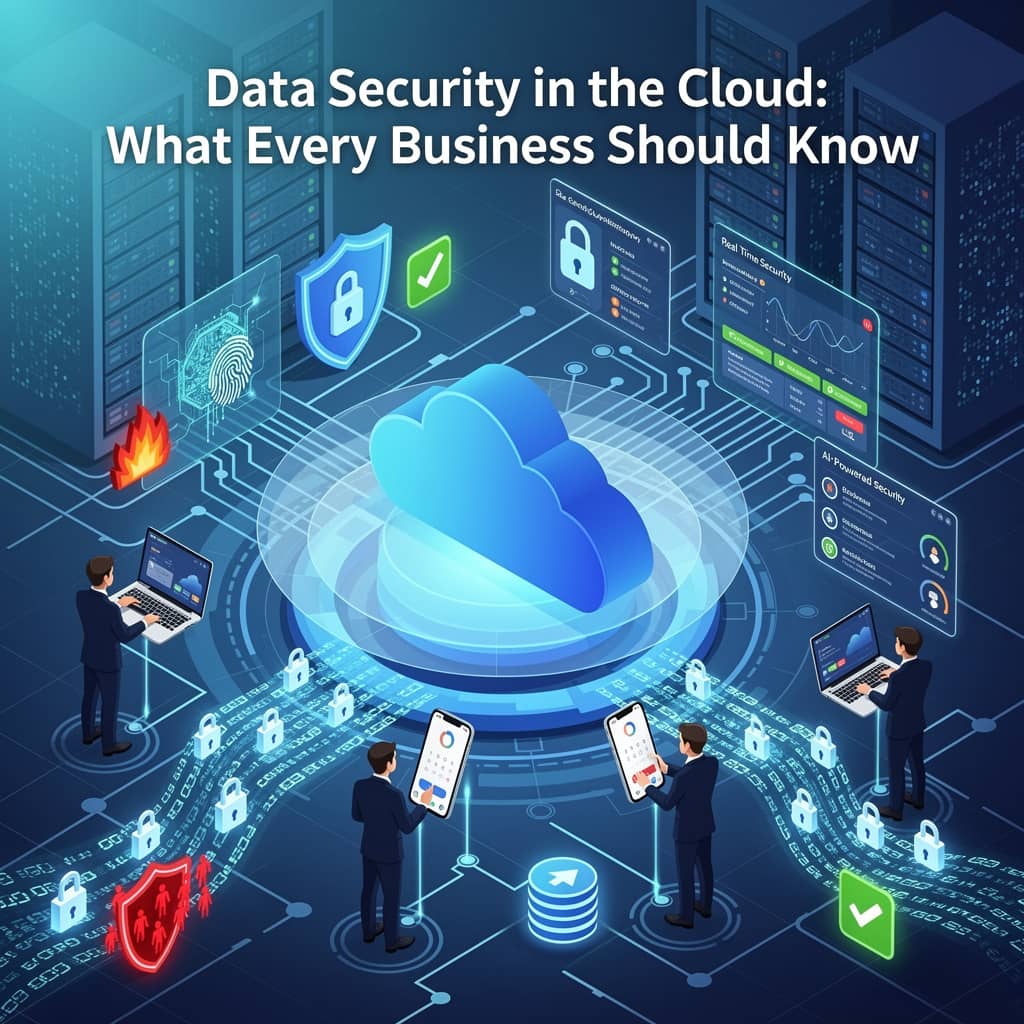
Every day, businesses across India and the world store more of their most sensitive data in the cloud — customer records, financial transactions, employee data, intellectual property, and confidential contracts. The cloud has made businesses faster, leaner, and more collaborative than ever before.
But it has also introduced an entirely new category of risk.
According to global cyber security industry estimates, in 2025 alone, global cyber crime cost businesses an estimated $8 trillion. Data breaches, ransomware attacks, misconfigured cloud storage, and insider threats are no longer rare events — they are daily realities that every organisation must prepare for.
Cloud data security is no longer an IT concern. It is a board-level business priority.
This guide — brought to you by Mega Tech Bot Pvt. Ltd. — explains everything your business needs to know about securing data in the cloud: the risks, the responsibilities, the best practices, and the solutions that keep you protected.
What Is Cloud Data Security?
Cloud data security refers to the policies, technologies, controls, and procedures used to protect data stored, processed, or transmitted via cloud computing environments.
Unlike traditional on-premise data centres — where a business controls its own physical servers and network perimeter — cloud environments involve shared infrastructure managed by third-party providers. This creates unique security challenges around access control, data sovereignty, compliance, and visibility.
Effective cloud security is not a single tool or setting. It is a layered strategy covering encryption,identity & access management services , network security, monitoring, incident response, and regulatory compliance — all working together to protect your most valuable digital assets.
Why Cloud Data Security Is Critical for Businesses in 2026
The threat landscape has never been more complex. Here is why data protection in cloud computing must be a top priority for every business this year:
The Scale of the Threat Is Unprecedented
Cyber criminals are deploying AI-powered attack tools that can identify vulnerabilities, launch phishing campaigns, and crack weak credentials at machine speed. Businesses that relied on basic security measures even two years ago are now dangerously exposed
Cloud Misconfigurations Are the #1 Cause of Data Breaches
Research consistently shows that the majority of cloud data breaches are not the result of sophisticated hacking — they happen because of misconfigured storage buckets, overly permissive access policies, and unpatched cloud services. Human error is the biggest vulnerability in cloud security.
Regulatory Penalties Are Escalating
India's Digital Personal Data Protection Act (DPDP Act 2023) imposes significant financial penalties on organisations that fail to protect personal data. Globally, GDPR fines continue to run into millions of euros. Compliance is not optional — and non-compliance is expensive.
Remote and Hybrid Work Has Expanded the Attack Surface
With employees accessing cloud systems from home networks, personal devices, and public wi-fi, the traditional network perimeter has dissolved. Every endpoint is now a potential entry point for attackers.
Business Continuity Depends on It
A ransomware attack on your cloud environment can bring operations to a complete standstill. Without proper cloud security, cloud backup & disaster recovery solutions , recovery can take weeks and cost crores.
The Shared Responsibility Model: Who Is Responsible for What?
One of the most misunderstood aspects of cloud data security is the Shared Responsibility Model. Many businesses assume that because they are using AWS, Azure, Google Cloud, or another provider, their data is fully protected. This is a dangerous misconception.
Cloud providers are responsible for securing the infrastructure — the physical data centres, networking hardware, and core platform services. But businesses are responsible for everything they put on that infrastructure — the data, the applications, the user access controls, and the configurations.
In simple terms:
Cloud Provider's Responsibility: Security of the cloud (hardware, facilities, core services)
Your Responsibility: Security in the cloud (your data, your users, your applications, your settings)
Understanding this distinction is the foundation of a sound cloud security strategy. If your team is not actively managing access policies, encrypting sensitive data, and monitoring cloud activity — no provider can protect you.
Key Cloud Data Security Risks Every Business Faces
1. Data Breaches
Unauthorised access to sensitive business or customer data — often through compromised credentials, phishing, or misconfigured permissions.
2. Insider Threats
Employees, contractors, or partners with legitimate cloud access who misuse it — accidentally or deliberately. Insider threats account for a significant proportion of cloud security incidents globally.
3. Ransomware & Malware
Attackers encrypt your cloud-stored data and demand payment for the decryption key. Modern ransomware specifically targets cloud backups to eliminate recovery options.
4. Account Hijacking
Attackers compromise admin or user accounts through credential stuffing, phishing, or brute-force attacks — gaining full control of cloud resources and data.
5. Insecure APIs
Cloud services communicate via APIs. Poorly secured APIs are a common entry point for attackers to intercept data or manipulate cloud functions.
6. Compliance Violations
Storing regulated data (personal information, financial records, health data) in cloud environments without proper controls can trigger regulatory violations — even without a breach.
7. Data Loss
Accidental deletion, hardware failure, or a provider outage without adequate backup can result in permanent data loss — disrupting operations and damaging customer trust.
Businesses That Need Strong Cloud Security the Most
Financial institutions
Healthcare organizations
SaaS companies
E-commerce businesses
Educational institutions
Remote-first companies
Businesses handling customer personal data
Any organization storing sensitive information in cloud environments should prioritize proactive cloud security measures.
Cloud Data Security Best Practices for Businesses
1. Implement Strong Identity & Access Management (IAM)
The principle of least privilege should govern every cloud environment. Every user, application, and service should have access only to what it absolutely needs — nothing more. Use multi-factor authentication (MFA) for all accounts, especially admin-level access. Regularly audit and revoke unnecessary permissions.
Businesses should implement identity & access management frameworks that centralize authentication, permission management, and user accountability.
2. Encrypt Everything — At Rest and In Transit
All sensitive data stored in the cloud should be encrypted at rest using AES-256 or equivalent standards. All data transmitted between users, applications, and cloud services must be encrypted in transit using TLS. Manage your own encryption keys where possible — do not rely solely on provider-managed keys.
3. Conduct Regular Security Audits and Penetration Testing
Proactively identify vulnerabilities before attackers do. Regular cloud security audits review configurations, access policies, and compliance posture. Penetration testing simulates real-world attacks to expose weaknesses in your cloud environment.
Routine cloud security assessments help businesses identify hidden vulnerabilities before they become major security incidents.
4. Enable Continuous Monitoring and Threat Detection
Real-time monitoring of cloud activity — logins, data access, configuration changes, network traffic — is essential for early threat detection. Deploy Security Information and Event Management (SIEM) tools and set up automated alerts for suspicious activity.
Advanced managed SIEM & SOC monitoring services can significantly improve incident response speed and threat visibility.
5. Maintain Robust Backup and Disaster Recovery Plans
Back up critical data regularly to geographically separate cloud regions or secondary providers. Test your recovery procedures — a backup you have never tested is a backup you cannot trust. Documented disaster recovery plans ensure business continuity even in the worst-case scenario.
6. Secure Your APIs
Implement API authentication, rate limiting, and input validation. Regularly audit third-party integrations that access your cloud environment. Retire unused APIs that represent unnecessary attack surfaces.
7. Ensure Regulatory Compliance
Map your cloud data storage and processing against applicable regulations — India's DPDP Act, GDPR if you handle European data, PCI-DSS for payment data, or HIPAA for health records. Use compliance dashboards offered by cloud providers and supplement them with specialist tools.
Businesses handling regulated data should adopt DPDP compliance solutions and regular compliance auditing processes.
8. Train Your People
Technology alone cannot protect your business. Regular cyber security awareness training for all staff — on phishing recognition, password hygiene, secure remote access, and incident reporting — is one of the highest-ROI security investments any organisation can make.
How Mega Tech Bot Pvt. Ltd. Helps Businesses Stay Secure in the Cloud
At Mega Tech Bot Pvt. Ltd., we understand that cloud security is not a one-size-fits-all problem. Every business has unique infrastructure, unique data, and unique risk exposure. That is why we deliver tailored cloud security solutions designed around your specific needs.
Our services include comprehensive cloud security assessments that identify misconfigurations, access vulnerabilities, and compliance gaps before they become incidents. We design and implement Identity & Access Management frameworks, encryption strategies, and network security architectures that protect your cloud environment at every layer.
For businesses navigating India's evolving DPDP Act compliance requirements, our team provides expert guidance on data classification, consent management, and breach response planning — ensuring you meet your regulatory obligations without disrupting operations.
Our 24/7 cloud monitoring and managed security services give your business continuous visibility and rapid incident response capability — so threats are detected and neutralised before they cause damage.
Whether you are migrating to the cloud for the first time, securing an existing multi-cloud environment, or recovering from a security incident — Mega Tech Bot Pvt. Ltd. is the trusted partner that Indian businesses rely on to keep their data safe.
Cloud Security Checklist for Businesses
Use this quick checklist to assess your current cloud security posture:
Multi-factor authentication enabled for all cloud accounts
Least-privilege access policies applied and regularly reviewed
All sensitive data encrypted at rest and in transit
Cloud configurations audited against security benchmarks (CIS, NIST)
Continuous monitoring and alerting enabled
Data backed up to a separate location with tested recovery procedures
Staff trained on phishing and social engineering awareness
APIs inventoried, authenticated, and rate-limited
Incident response plan documented and tested
Compliance posture mapped against DPDP Act / GDPR / PCI-DSS as applicable
Frequently Asked Questions
Q: Is the cloud less secure than on-premise storage?
Not inherently. Leading cloud providers invest more in physical and infrastructure security than most businesses could afford on their own. The risk comes from how businesses configure and manage their cloud environments — not the cloud itself.
Q: What is the biggest cloud security mistake businesses make?
Misconfiguration. Leaving storage buckets publicly accessible, granting excessive permissions, or failing to enable MFA are the most common — and most preventable — causes of cloud data breaches.
Q: How does India's DPDP Act affect cloud data security?
The Digital Personal Data Protection Act requires businesses to implement appropriate technical and organisational measures to protect personal data, notify authorities of breaches within specified timelines, and ensure data is not processed beyond its stated purpose. Non-compliance carries significant financial penalties.
Q: How often should a business review its cloud security?
At minimum, a formal cloud security review should happen quarterly. High-risk or regulated industries should conduct continuous monitoring with monthly configuration audits.
Q: Can small businesses afford enterprise-grade cloud security?
Yes. Cloud-native security tools and managed security services have made enterprise-grade protection accessible at every budget level. The cost of a security breach almost always far exceeds the cost of prevention.
Conclusion: Cloud Security Is a Business Investment, Not an IT Expense
The question for businesses in 2026 is no longer whether they should take cloud data security seriously. The question is whether they can afford not to.
Data breaches destroy customer trust, trigger regulatory penalties, disrupt operations, and damage reputations that took years to build. The organisations that thrive in a cloud-first world are those that treat security not as a cost to be minimised but as a foundation to be invested in.
In today’s digital economy, customer trust is built on how securely businesses handle data.
Mega Tech Bot Pvt. Ltd. exists to make that investment count — with expert-led, business-aligned cloud security solutions that protect your data, your customers, and your future.
Talk to a Cloud Security Expert at Mega Tech Bot Pvt. Ltd. Today
Get a free cloud security assessment and discover exactly where your business stands — before an attacker finds out first.
Also Read
Cloud Computing for Businesses: Benefits, Costs & Myths Debunked