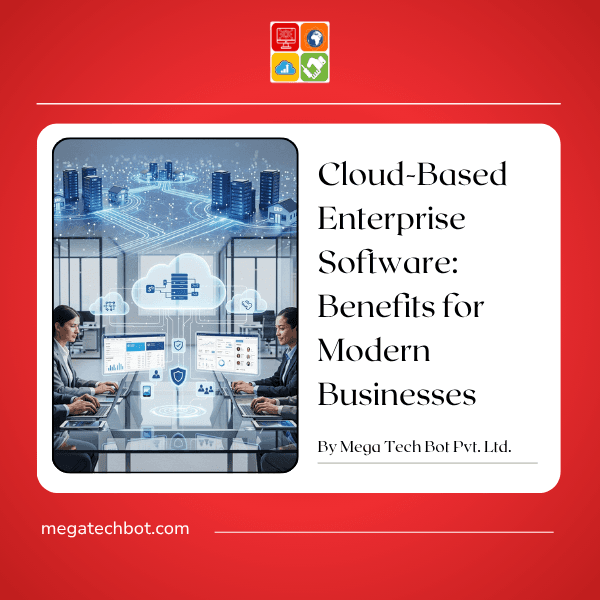
Overview
Digital transformation is no longer a future goal—it has become a business necessity. Organisations of every size are embracing cloud technologies to improve efficiency, reduce operational costs, and stay competitive in an increasingly connected world.
Traditional on-premise software often requires expensive hardware, lengthy installations, frequent maintenance, and limited accessibility. These challenges can slow growth and reduce productivity.
This is where cloud-based enterprise software offers a significant advantage.
Cloud enterprise solutions enable businesses to access applications, data, and business processes securely over the internet from anywhere in the world. Whether you're managing finance, human resources, customer relationships, inventory, or operations, cloud software centralises your business on one scalable platform.
At Mega Tech Bot Pvt. Ltd., we develop secure, scalable, and custom cloud-based enterprise software that helps organisations automate operations, improve collaboration, and accelerate business growth.
In this comprehensive guide, you'll learn what cloud-based enterprise software is, how it works, its key benefits, industry applications, implementation strategies, and why cloud technology has become the preferred choice for modern businesses.
What Is Cloud-Based Enterprise Software?
Cloud-based enterprise software is business software that is hosted on remote cloud servers instead of being installed on local computers or company-owned servers.
Users access the software through:
Web browsers
Mobile applications
Desktop applications
Secure cloud portals
Unlike traditional software, cloud applications don't require businesses to maintain expensive IT infrastructure or perform manual software updates.
Everything is managed through secure cloud environments.
Examples include:
Enterprise Resource Planning (ERP)
Customer Relationship Management (CRM)
Human Resource Management (HRM)
Accounting Software
Inventory Management Systems
Project Management Software
Collaboration Platforms
Document Management Systems
How Cloud-Based Enterprise Software Works
Cloud enterprise software stores business data on secure cloud infrastructure.
Here's a simplified workflow:
Employees log in securely.
Business data is stored in encrypted cloud databases.
Teams access real-time information from any authorised device.
Changes made by one department instantly update across the organisation.
Automatic backups protect business information.
Software updates are deployed without disrupting business operations.
The result is a connected, always-available business ecosystem.
Why Businesses Are Moving to the Cloud
Traditional business software creates several operational challenges:
High hardware costs
Complex installations
Limited remote access
Manual software updates
Difficult scalability
Data silos
Disaster recovery concerns
IT maintenance overhead
Cloud-based enterprise software eliminates many of these issues while improving flexibility and performance.
Top Benefits of Cloud-Based Enterprise Software
1. Access Your Business from Anywhere
One of the biggest advantages of cloud software is remote accessibility.
Employees can securely work from:
Office
Home
Client locations
Warehouses
Manufacturing facilities
While travelling
All they need is an internet connection and authorised login credentials.
This flexibility supports hybrid work models and improves business continuity.
2. Lower Infrastructure Costs
Traditional enterprise software often requires:
Dedicated servers
Networking equipment
Server rooms
Backup systems
IT maintenance
Hardware upgrades
Cloud software significantly reduces these capital expenses by using managed cloud infrastructure.
Businesses can redirect savings towards innovation and growth.
3. Easy Scalability
As businesses expand, software requirements also increase.
Cloud enterprise software allows organisations to:
Add new users
Increase storage
Deploy new modules
Open new branches
Expand globally
without replacing the entire system.
Scalability ensures technology grows alongside the business.
4. Automatic Software Updates
Keeping software up to date is essential for performance and security.
Cloud providers automatically deliver:
Security patches
Feature enhancements
Performance improvements
Compliance updates
Bug fixes
Businesses always use the latest version without downtime or manual installations.
5. Improved Data Security
Business data is one of the most valuable organisational assets.
Modern cloud platforms provide:
End-to-end encryption
Multi-factor authentication
Role-based access control
Continuous monitoring
Secure backups
Disaster recovery
Audit logs
These measures help protect sensitive business information from cyber threats and accidental loss.
6. Better Team Collaboration
Cloud software enables employees to work with shared, real-time information.
Benefits include:
Simultaneous collaboration
Shared dashboards
Instant updates
File sharing
Task management
Workflow approvals
Team communication
Departments no longer rely on outdated spreadsheets or disconnected systems.
7. Faster Decision-Making
Cloud platforms provide real-time dashboards and analytics.
Business leaders can monitor:
Sales performance
Financial health
Inventory levels
Employee productivity
Customer activity
Operational KPIs
Instant visibility enables quicker, data-driven decisions.
8. Business Continuity and Disaster Recovery
Unexpected events such as hardware failures, natural disasters, or cyberattacks can disrupt operations.
Cloud-based systems minimise downtime through:
Automated backups
Redundant infrastructure
Data replication
High availability
Rapid recovery processes
This ensures businesses continue operating even during unforeseen disruptions.
Key Features of Cloud-Based Enterprise Software
Modern enterprise cloud solutions typically include:
Centralised Data Management
A single source of truth for all business information.
Role-Based User Access
Grant employees access only to the information they need.
Real-Time Reporting
Generate reports instantly using live business data.
Workflow Automation
Automate repetitive tasks such as approvals, invoicing, notifications, and document routing.
Mobile Compatibility
Access business applications through smartphones and tablets.
API Integrations
Connect with:
Payment gateways
CRM systems
ERP platforms
HR software
Accounting tools
E-commerce platforms
Third-party business applications
Cloud Storage
Securely store documents, invoices, contracts, reports, and business records.
Analytics Dashboard
Visualise key performance indicators (KPIs) using interactive charts and reports.
Cloud-Based Enterprise Software vs Traditional Software
Feature | Cloud-Based Software | Traditional On-Premise Software |
Installation | Online | Local servers |
Remote Access | Yes | Limited |
Maintenance | Provider-managed | In-house IT |
Updates | Automatic | Manual |
Scalability | High | Hardware-dependent |
Initial Cost | Lower | Higher |
Backup | Automatic | Manual |
Disaster Recovery | Built-in | Requires separate infrastructure |
Collaboration | Real-time | Often limited |
Deployment Speed | Fast | Slower |
For most growing businesses, cloud-based solutions provide greater flexibility and lower long-term ownership costs.
Industries That Benefit from Cloud Enterprise Software
Cloud technology supports organisations across multiple sectors.
Manufacturing
Production planning
Inventory management
Supply chain visibility
Equipment monitoring
Healthcare
Patient records
Appointment scheduling
Billing systems
Compliance management
Education
Student information systems
Online learning
Fee management
Attendance tracking
Retail
Multi-store management
Inventory synchronisation
Customer loyalty
Sales reporting
Logistics
Fleet tracking
Warehouse management
Delivery scheduling
Route optimisation
Hospitality
Reservation systems
Restaurant management
Customer service
Inventory control
Finance
Accounting automation
Financial reporting
Budget planning
Compliance monitoring
Common Business Challenges Solved by Cloud Software
Many businesses struggle with:
Manual data entry
Slow reporting
Disconnected departments
Limited remote access
Data duplication
High IT maintenance costs
Poor collaboration
Inconsistent customer information
Cloud-based enterprise software centralises operations, automates workflows, and improves visibility across the organisation.
Best Practices for Cloud Software Implementation
Assess Business Requirements
Identify operational challenges, growth plans, and departments that will benefit most from cloud adoption.
Choose the Right Deployment Model
Depending on security and compliance needs, organisations may select:
Public cloud
Private cloud
Hybrid cloud
Prepare Your Data
Before migration:
Remove duplicate records
Correct inaccurate data
Standardise formats
Archive obsolete information
Train Employees
Provide hands-on training to encourage adoption and reduce resistance to change.
Implement in Phases
Begin with core business functions before expanding to additional departments.
Monitor Performance
Track system performance, user adoption, and operational improvements after implementation.
Emerging Trends in Cloud Enterprise Software
Cloud technologies continue to evolve with innovations such as:
Artificial Intelligence (AI)
AI automates repetitive work, predicts trends, and improves decision-making.
Machine Learning
Systems learn from historical data to optimise operations.
Robotic Process Automation (RPA)
Software robots automate routine administrative tasks.
Internet of Things (IoT)
Connected devices provide real-time operational data.
Advanced Business Intelligence
Interactive dashboards offer predictive insights instead of only historical reporting.
Low-Code Development
Businesses can customise workflows and applications with minimal coding.
Why Choose Mega Tech Bot Pvt. Ltd.?
At Mega Tech Bot Pvt. Ltd., we help organisations modernise their operations through customised cloud-based enterprise software tailored to their business goals.
Our expertise includes:
Custom Enterprise Software Development
Cloud ERP Solutions
Cloud CRM Development
HR Management Systems
Inventory Management Software
Workflow Automation
Business Intelligence Dashboards
Cloud Migration Services
API Integrations
Mobile Business Applications
AI-Powered Business Solutions
Secure Cloud Infrastructure
Our solutions are designed to be scalable, secure, and user-friendly, enabling businesses to streamline operations while preparing for future growth.
Frequently Asked Questions (FAQs)
What is cloud-based enterprise software?
Cloud-based enterprise software is business software hosted on remote cloud servers that users access over the internet instead of installing on local computers or company-owned servers.
What are the main benefits of cloud-based enterprise software?
The main benefits include lower infrastructure costs, remote accessibility, automatic updates, improved security, better collaboration, scalability, and real-time reporting.
Is cloud software secure?
Yes. Reputable cloud solutions use encryption, multi-factor authentication, access controls, continuous monitoring, secure backups, and compliance measures to protect business data.
Can small businesses use cloud enterprise software?
Absolutely. Cloud solutions are scalable and suitable for startups, SMEs, and large enterprises because businesses only use the resources they need and can expand over time.
What is the difference between cloud ERP and traditional ERP?
Cloud ERP is hosted online, accessible from anywhere, automatically updated, and requires less infrastructure. Traditional ERP is installed on local servers and often involves higher upfront costs and ongoing maintenance.
How long does cloud software implementation take?
Implementation timelines vary depending on business size, data migration, customisation, and integrations. Small deployments may take a few weeks, while enterprise-wide implementations can take several months.
Conclusion
Cloud-based enterprise software has become a cornerstone of modern business transformation. By replacing outdated on-premise systems with secure, scalable, and internet-accessible solutions, organisations can improve operational efficiency, reduce costs, enhance collaboration, and make faster, data-driven decisions.
From finance and HR to inventory, customer management, and workflow automation, cloud technology empowers teams to work smarter and respond quickly to changing market demands. Its flexibility, security, and scalability make it an ideal choice for businesses seeking sustainable growth in an increasingly digital economy.
Whether you're a startup looking to build a strong technological foundation or an established enterprise planning a digital transformation, investing in cloud-based enterprise software can deliver lasting competitive advantages.
At Mega Tech Bot Pvt. Ltd., we specialise in designing and developing custom cloud solutions that align with your unique business requirements. Our experienced team helps organisations implement secure, future-ready software that drives productivity, innovation, and long-term success.
If you're ready to modernise your operations with cloud technology, Mega Tech Bot Pvt. Ltd. is your trusted technology partner.
Contact Us Now
Also Read
Top Software Development Trends That Will Dominate 2026