Overview
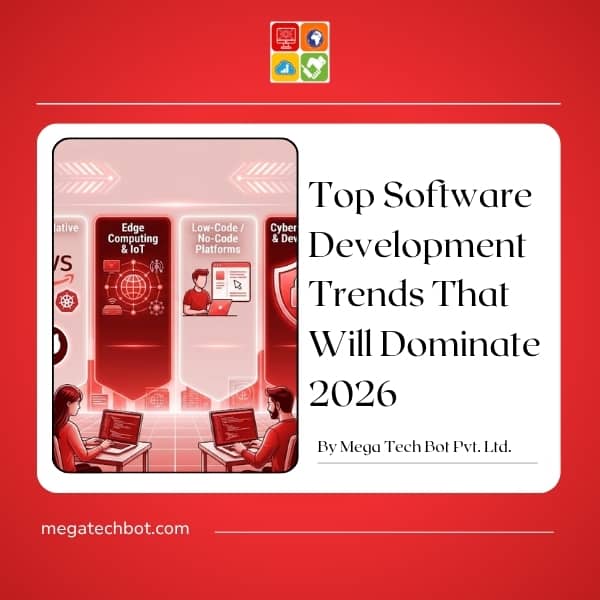
Top Software Development Trends That Will Dominate 2026
Technology is evolving faster than ever before. Businesses that once relied on traditional software are now embracing Artificial Intelligence (AI), automation, cloud computing, cybersecurity, and data-driven decision-making to stay competitive. As we move deeper into 2026, software is no longer just a tool—it has become the backbone of modern business operations.
From startups to multinational enterprises, organizations are investing in smarter, scalable, and future-ready software solutions that improve efficiency, reduce costs, and enhance customer experiences.
According to industry analysts, global spending on digital transformation continues to grow as businesses prioritize automation, AI integration, and cloud-native applications. Companies that fail to adapt risk falling behind competitors who leverage modern technologies to innovate faster.
At Mega Tech Bot Pvt. Ltd., we help businesses embrace these technological advancements by developing custom software, ERP solutions, AI-powered applications, mobile apps, cloud solutions, and enterprise systems designed for the future.
In this article, we'll explore the top software development trends that will dominate 2026 and explain why businesses should prepare today.
Common Challenges Businesses Face During Digital Transformation
Many organizations understand the importance of digital transformation but struggle to identify the right technology strategy. As business operations become more complex, relying on outdated software often creates operational bottlenecks and slows growth.
Common challenges include:
Legacy software that cannot scale with business growth
Manual processes that reduce productivity
Difficulty integrating multiple business systems
Increasing cybersecurity risks
Rising customer expectations for digital experiences
Lack of real-time business insights
High software maintenance costs
Difficulty adopting AI and automation technologies
Modern software development addresses these challenges by combining cloud computing, AI, automation, cybersecurity, and scalable architecture into future-ready business solutions.
Why Software Development Is Changing Rapidly
Several factors are driving this transformation:
Increasing adoption of Artificial Intelligence
Growing cybersecurity threats
Cloud-first business strategies
Rising customer expectations
Automation replacing repetitive work
Demand for real-time analytics
Faster software delivery cycles
Remote and hybrid work environments
These changes are reshaping how software is planned, developed, deployed, and maintained.
1. Artificial Intelligence Will Become a Standard Feature
Artificial Intelligence is no longer a luxury.
In 2026, AI is becoming an expected feature in business software rather than an optional add-on.
Businesses are integrating AI into:
CRM systems
ERP software
HR management
Customer support
Restaurant management software
School ERP systems
Inventory management
Finance software
Predictive analytics platforms
Instead of merely storing data, modern software now analyzes information, predicts outcomes, and recommends actions.
AI is enabling software to:
Predict customer behavior
Detect fraud
Forecast sales
Automate customer service
Improve inventory planning
Recommend products
Generate reports automatically
Personalize user experiences
For example, restaurant software can now predict ingredient demand based on historical sales, weather conditions, holidays, and local events.
Similarly, educational ERP systems can identify students who may need additional academic support using performance analytics.
AI-powered software is transforming every industry.
2. Generative AI Will Revolutionize Software Development
One of the biggest trends of 2026 is the widespread adoption of Generative AI.
Developers are increasingly using AI assistants to:
Generate code
Debug applications
Write documentation
Create APIs
Test software
Review security vulnerabilities
Automate repetitive coding tasks
This doesn't replace software developers—it makes them significantly more productive.
Businesses benefit through:
Faster development cycles
Lower development costs
Reduced coding errors
Improved software quality
Faster project delivery
Generative AI also enables businesses to create intelligent chatbots, AI-powered search engines, virtual assistants, automated content generation tools, and personalized customer experiences.
Real-World Example: AI in Retail Operations
Imagine a retail company managing hundreds of products across multiple locations. Traditionally, managers relied on manual sales reports to forecast inventory requirements. AI-powered software can now analyze historical sales, seasonal demand, customer purchasing patterns, and regional trends to recommend optimal stock levels automatically.
This reduces inventory shortages, minimizes overstocking, and helps businesses make faster, data-driven decisions.
3. Cloud-Native Development Will Dominate Enterprise Software
Cloud computing has become the foundation of modern software.
Instead of building software for a single server, companies now develop applications specifically designed for cloud platforms.
Cloud-native applications offer:
High availability
Automatic scalability
Better performance
Lower infrastructure costs
Faster deployment
Simplified maintenance
Businesses increasingly prefer cloud-based ERP, CRM, HRM, POS, inventory management, and financial software because they provide access from anywhere while ensuring data security and business continuity.
For organizations expanding across multiple cities or countries, cloud-native architecture has become essential.
Real-World Example: Multi-Branch Business Expansion
Consider a company opening offices in different cities. With traditional on-premise software, each branch requires separate infrastructure and complex data synchronization. Cloud-native applications allow employees across all locations to access the same system securely in real time, making collaboration, reporting, and management significantly more efficient.
4. Cybersecurity Will Be Built into Software from Day One
Cyberattacks are becoming more sophisticated every year.
In response, cybersecurity is no longer an afterthought—it is integrated into every stage of software development.
Modern development teams now follow secure development practices such as:
Secure coding standards
Multi-factor authentication
End-to-end encryption
Role-based access control
Continuous vulnerability testing
Automated security scanning
Compliance monitoring
Businesses handling customer information, payment data, healthcare records, or educational data must prioritize security to maintain trust and comply with regulations.
Investing in secure software development reduces risks associated with data breaches and operational disruptions.
5. Low-Code and No-Code Platforms Will Accelerate Innovation
Low-code and no-code development platforms are enabling businesses to create applications much faster than traditional development methods.
These platforms allow users to build workflows, dashboards, forms, and business applications with minimal coding.
Benefits include:
Faster development
Lower costs
Reduced dependency on developers
Rapid prototyping
Improved collaboration between IT and business teams
However, while low-code tools are excellent for simple applications, complex enterprise systems still require experienced software developers to ensure scalability, security, and performance.
This is why many organizations combine low-code platforms with custom software development for maximum flexibility.
6. Hyper automation Will Transform Business Operations
Automation has evolved far beyond simple workflows. In 2026, Hyper automation is emerging as one of the most impactful software development trends, combining Artificial Intelligence (AI), Robotic Process Automation (RPA), Machine Learning (ML), APIs, and business process management to automate complex business operations.
Unlike traditional automation, hyper automation can handle decision-making, data analysis, and end-to-end workflows with minimal human intervention.
Businesses are using hyper automation to:
Process invoices automatically
Manage payroll and HR operations
Automate customer onboarding
Handle inventory updates in real time
Streamline procurement processes
Generate financial reports
Process insurance claims
Automate document verification
The benefits include:
Reduced operational costs
Faster processing times
Fewer manual errors
Improved productivity
Better compliance
Higher customer satisfaction
Organizations that invest in hyper automation can focus more on innovation and strategic growth while repetitive tasks are managed by intelligent software.
Real-World Example: Automating Back-Office Operations
Many organizations spend hours every week processing invoices, approving leave requests, updating inventory, and preparing reports. Hyperautomation enables these repetitive tasks to be completed automatically, allowing employees to focus on customer service, innovation, and strategic planning instead of routine administrative work.
7. Internet of Things (IoT) Integration Will Continue to Grow
The Internet of Things (IoT) is reshaping industries by connecting physical devices with intelligent software. From smart factories and healthcare systems to restaurants and educational institutions, IoT enables real-time monitoring, automation, and data-driven decision-making.
In 2026, software applications are increasingly designed to communicate seamlessly with IoT devices such as:
Smart sensors
GPS trackers
RFID readers
Biometric devices
Smart cameras
Industrial machines
Wearable devices
Smart home systems
For example:
Manufacturing companies can monitor machine performance and predict maintenance needs.
Restaurants can track refrigeration temperatures and inventory levels automatically.
Schools can integrate biometric attendance systems with ERP software for real-time attendance records.
Logistics companies can monitor vehicle locations and optimize delivery routes.
IoT-powered software helps businesses reduce downtime, improve operational efficiency, and gain valuable insights from connected devices.
8. DevSecOps Will Become the New Standard
As cyber threats continue to rise, security can no longer be added at the end of the software development lifecycle. DevSecOps integrates security into every stage of development, ensuring applications are secure from the very beginning.
Instead of treating development, operations, and security as separate functions, DevSecOps encourages continuous collaboration.
Key DevSecOps practices include:
Automated security testing
Continuous code scanning
Vulnerability assessments
Secure CI/CD pipelines
Dependency management
Compliance monitoring
Infrastructure as Code (IaC) security
Benefits for businesses include:
Faster software releases
Reduced security risks
Lower remediation costs
Improved compliance
Stronger customer trust
Organizations adopting DevSecOps can build secure, reliable, and scalable applications while maintaining rapid development cycles.
9. Edge Computing Will Enhance Speed and Performance
As businesses generate massive volumes of data, sending everything to centralized cloud servers can introduce latency. Edge computing addresses this challenge by processing data closer to where it is generated.
Instead of relying solely on distant data centers, edge computing enables devices to process information locally, resulting in faster response times.
Industries benefiting from edge computing include:
Manufacturing
Healthcare
Smart cities
Autonomous vehicles
Retail
Hospitality
Agriculture
Logistics
Common use cases include:
Real-time video analytics
Smart surveillance systems
Autonomous equipment
Industrial automation
Remote healthcare monitoring
Smart retail solutions
By reducing latency and bandwidth usage, edge computing improves application performance and supports mission-critical operations.
10. Sustainable and Green Software Development Will Gain Importance
Sustainability is becoming a priority for businesses worldwide, and software development is no exception. Green software development focuses on creating applications that consume fewer computing resources, reduce energy usage, and minimize environmental impact.
Modern development teams are optimizing software by:
Writing efficient code
Reducing unnecessary processing
Optimizing cloud infrastructure
Improving database performance
Minimizing server usage
Using energy-efficient architectures
Benefits include:
Lower infrastructure costs
Reduced carbon footprint
Better application performance
Improved scalability
Enhanced corporate sustainability initiatives
As environmental responsibility becomes a business priority, green software development will play a significant role in future digital transformation strategies.
How Businesses Can Prepare for These Trends
Keeping up with emerging technologies requires a proactive approach. Businesses should:
Invest in AI-powered software solutions
Adopt cloud-native architectures
Prioritize cybersecurity from the start
Automate repetitive workflows
Integrate IoT where applicable
Implement DevSecOps practices
Leverage data analytics for informed decisions
Partner with experienced software development companies
Continuously train teams on emerging technologies
Organizations that embrace these trends today will be better positioned to innovate, improve customer experiences, and achieve long-term growth.
Why Choose Mega Tech Bot Pvt. Ltd.?
At Mega Tech Bot Pvt. Ltd., we specialize in building innovative, scalable, and secure software solutions that help businesses stay ahead in a rapidly evolving digital landscape.
Our expertise includes:
Custom Software Development
Enterprise Resource Planning (ERP)
Mobile Application Development
Cloud-Based Solutions
AI-Powered Business Applications
CRM Development
HRM Systems
Inventory Management Software
Restaurant Management Software
School ERP Solutions
API Development & Integration
Business Process Automation
Web Application Development
Software Maintenance & Support
Our development approach emphasizes performance, scalability, security, and user experience, ensuring every solution is future-ready.
Whether you're a startup, SME, educational institution, restaurant chain, healthcare provider, or enterprise organization, we deliver tailored digital solutions designed to meet your unique business goals.
Traditional Software vs Modern Intelligent Software
Traditional Software | Modern Intelligent Software |
Manual Processes | AI Automation |
Fixed Infrastructure | Cloud Native |
Limited Scalability | Elastic Scaling |
Reactive Decisions | Predictive Analytics |
Manual Reporting | Real-Time Dashboards |
Basic Security | DevSecOps & Zero Trust |
Separate Applications | Integrated Business Platforms |
Slow Updates | Continuous Deployment |
Why Businesses Trust Mega Tech Bot Pvt. Ltd.
Businesses choose Mega Tech Bot because we focus on building software that delivers long-term value rather than just completing projects. Our development approach emphasizes scalability, security, performance, and business outcomes.
We provide:
Custom-built software
Cloud-native architecture
AI integration
Enterprise security practices
Agile development methodology
Scalable solutions
API-first architecture
Ongoing maintenance and support
Transparent communication
Future-ready technology stack
The Future of Software Development Beyond 2026
Software development will continue evolving as Artificial Intelligence, autonomous systems, advanced cybersecurity, quantum computing, edge computing, and intelligent automation become more accessible to businesses of all sizes.
Organizations that invest in flexible, scalable, and secure software today will be better prepared to adopt tomorrow's innovations without rebuilding their technology infrastructure from scratch.
Future-ready software is no longer about keeping pace with technology—it is about enabling continuous innovation and long-term business growth.
Frequently Asked Questions (FAQs)
1. What is the biggest software development trend in 2026?
Artificial Intelligence (AI), Generative AI, cloud-native development, hyperautomation, and cybersecurity-first development are among the most influential trends shaping the software industry in 2026.
2. Why is AI important in software development?
AI improves productivity by automating coding tasks, enhancing decision-making, enabling predictive analytics, personalizing user experiences, and reducing manual effort.
3. What is cloud-native software?
Cloud-native software is designed specifically for cloud environments, enabling scalability, reliability, flexibility, and faster deployment compared to traditional applications.
4. How does DevSecOps improve software security?
DevSecOps integrates security practices throughout the software development lifecycle, helping identify vulnerabilities early and reducing cybersecurity risks.
5. Why should businesses invest in custom software?
Custom software is tailored to specific business processes, offering greater flexibility, improved efficiency, better security, and easier scalability than generic off-the-shelf solutions.
6. How can Mega Tech Bot Pvt. Ltd. help businesses?
Mega Tech Bot Pvt. Ltd. provides end-to-end software development services, including AI solutions, ERP systems, cloud applications, mobile apps, automation, and enterprise software tailored to business needs.
Choosing Technology That Solves Real Business Problems
Technology trends are valuable only when they solve practical business challenges. The most successful software projects begin by understanding operational goals, user needs, and long-term scalability rather than simply adopting the latest technologies. Businesses that align software strategy with measurable outcomes are more likely to achieve sustainable digital transformation.
Conclusion
The software development landscape in 2026 is being driven by intelligent technologies, cloud innovation, cybersecurity, automation, and sustainable development practices. Businesses that embrace these trends will not only improve operational efficiency but also gain a competitive advantage in an increasingly digital world.
From AI-powered applications and hyperautomation to IoT integration and edge computing, the future belongs to organizations that invest in scalable, secure, and innovative software solutions.
If your business is ready to modernize its operations, streamline workflows, and accelerate digital transformation, Mega Tech Bot Pvt. Ltd. is here to help. Our team of experienced developers and technology experts builds custom software solutions that empower businesses to innovate, grow, and succeed in the digital era.