Overview
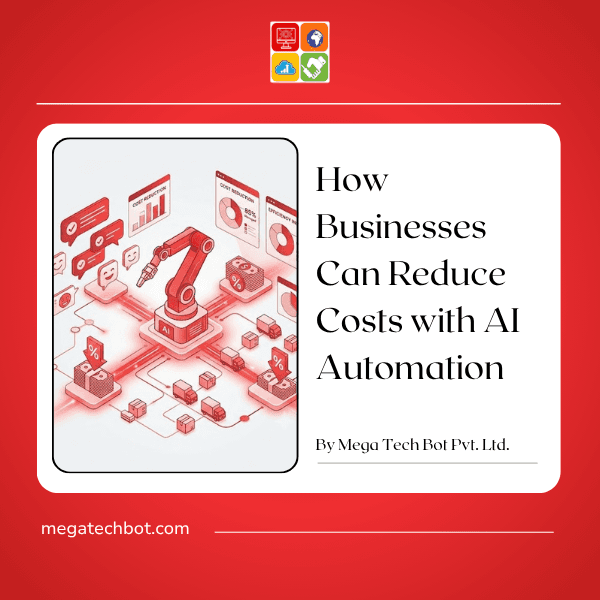
How Businesses Can Reduce Costs with AI Automation
In today's competitive business environment, reducing operational costs without compromising quality has become a top priority. Rising labor expenses, increasing customer expectations, and the demand for faster services are pushing organizations to rethink how they operate.
Artificial Intelligence (AI) automation is no longer limited to large enterprises with massive technology budgets. Businesses of all sizes are now using AI to automate repetitive tasks, streamline workflows, improve decision-making, and optimize resource utilization.
Rather than replacing employees, AI allows teams to focus on high-value work while software handles routine processes. The result is lower operating costs, higher productivity, improved accuracy, and better customer experiences.
Whether you're in manufacturing, healthcare, education, retail, hospitality, finance, or logistics, AI automation can transform the way your business operates.
This guide explores how AI automation reduces costs, where it delivers the highest return on investment (ROI), and how businesses can successfully adopt AI-powered solutions.
What Is AI Automation For Business?
AI automation combines Artificial Intelligence, Machine Learning (ML), and workflow automation to perform tasks that traditionally required manual effort.
Unlike traditional automation, which follows fixed rules, AI systems can analyze data, recognize patterns, make predictions, and improve performance over time.
Examples include:
AI-powered chatbots
Intelligent document processing
Predictive analytics
Automated invoice processing
AI scheduling assistants
Inventory forecasting
Customer support automation
Smart recommendation systems
Fraud detection
Workflow optimization
Businesses that implement AI strategically often see measurable improvements in efficiency and cost savings.
Why AI Automation Has Become a Business Necessity in 2026
In 2026, AI automation has become more than just a technology trend—it has become a business necessity. Organizations across industries are facing increasing pressure to reduce costs, improve efficiency, and deliver better customer experiences while staying competitive in a rapidly evolving digital landscape. As a result, businesses are investing in AI-powered solutions to automate repetitive tasks, optimize workflows, and make smarter, data-driven decisions.
Several factors are driving the rapid adoption of AI automation:
Rising Labor Costs and Skill Shortages
Increasing labor costs and ongoing skill shortages make it difficult for businesses to scale by hiring more employees alone. AI automation helps organizations maximize the productivity of their existing workforce by handling repetitive and time-consuming tasks, allowing employees to focus on strategic and high-value work.
Economic Pressure and Inflation
With inflation and rising operational expenses affecting profit margins, businesses are looking for ways to operate more efficiently. AI automation reduces manual effort, minimizes errors, and streamlines processes, helping organizations lower operating costs without compromising quality or customer service.
Growing Customer Expectations
Today's customers expect fast, personalized, and round-the-clock service. AI-powered chatbots, virtual assistants, and intelligent recommendation systems enable businesses to provide instant responses, personalized experiences, and 24/7 support, improving customer satisfaction while reducing support costs.
Accelerating Digital Transformation
As businesses continue their digital transformation journey, AI automation plays a crucial role in modernizing operations. It integrates with existing business systems such as ERP, CRM, HR, and accounting software to automate workflows, improve collaboration, and enhance operational efficiency across departments.
Increasing Competitive Pressure
Companies that adopt AI automation can respond more quickly to market changes, optimize decision-making, and scale their operations more efficiently than competitors relying on manual processes. To remain competitive, businesses need intelligent automation that supports continuous innovation and growth.
Remote and Hybrid Work Environments
The widespread adoption of remote and hybrid work models has increased the need for automated workflows and cloud-based collaboration. AI helps organizations manage distributed teams by automating approvals, document management, scheduling, reporting, and communication, ensuring consistent productivity regardless of location.
The Explosion of Business Data
Modern businesses generate massive volumes of structured and unstructured data every day. Manually analyzing this information is time-consuming and often impractical. AI can process large datasets, identify patterns, generate actionable insights, and support faster, data-driven decision-making.
As these challenges continue to grow, AI automation has become an essential tool for businesses of all sizes. By improving efficiency, reducing operational costs, enhancing customer experiences, and enabling smarter decision-making, AI empowers organizations to remain agile, competitive, and prepared for the future.
Why Businesses Are Investing in AI Automation
Every business has repetitive processes that consume valuable time and resources.
These include:
Data entry
Customer inquiries
Appointment scheduling
Payroll processing
Inventory tracking
Report generation
Email management
Invoice approvals
Employee onboarding
Order processing
Automating these workflows helps organizations:
Reduce labor costs
Minimize human errors
Improve productivity
Accelerate operations
Deliver consistent customer experiences
Scale without significantly increasing operational expenses
Which Business Processes Are Best Suited for AI Automation?
Not every business process needs AI automation. The greatest benefits come from automating tasks that are repetitive, time-consuming, and data-driven. By identifying the right processes, businesses can achieve faster implementation, higher productivity, and a stronger return on investment (ROI).
The following types of business processes are best suited for AI automation:
Repetitive Tasks
Processes that involve the same actions every day are ideal candidates for automation. AI can perform these tasks consistently without fatigue, reducing manual effort and improving efficiency.
Examples:
Data entry
Appointment scheduling
Email responses
Invoice processing
Report generation
Rule-Based Processes
Tasks that follow predefined rules or standard operating procedures can be automated with AI to ensure consistency and accuracy while reducing human intervention.
Examples:
Purchase approvals
Payroll processing
Leave management
Compliance checks
Document routing
High-Volume Operations
Business processes that handle a large number of transactions or requests every day can quickly overwhelm employees. AI helps manage high workloads efficiently while maintaining speed and accuracy.
Examples:
Customer support requests
Order processing
Payment verification
Inventory updates
CRM record management
Time-Consuming Activities
Some tasks require significant time but add little strategic value. Automating these activities allows employees to focus on innovation, customer relationships, and business growth.
Examples:
Document verification
Meeting scheduling
Data analysis
File organization
Workflow approvals
Error-Prone Processes
Manual processes often lead to mistakes such as duplicate entries, incorrect calculations, and missed deadlines. AI automation reduces these errors by validating data and performing tasks with greater precision.
Examples:
Financial reporting
Billing and invoicing
Inventory tracking
Customer record updates
Compliance documentation
Data-Driven Workflows
Businesses generate vast amounts of data every day. AI can analyze this information in real time, identify patterns, and provide valuable insights that support better decision-making.
Examples:
Sales forecasting
Demand prediction
Customer behavior analysis
Fraud detection
Business performance reporting
By starting with these types of processes, businesses can achieve quick wins, reduce operational costs, and create a solid foundation for broader AI adoption. A phased approach to automation enables organizations to improve efficiency, scale operations, and maximize the long-term value of their AI investment.
1. Automating Repetitive Administrative Tasks
Administrative work often consumes a significant portion of an employee's day.
AI automation can handle tasks such as:
Entering customer information
Updating databases
Scheduling meetings
Organizing documents
Sending reminders
Processing forms
By reducing manual work, employees can focus on innovation, strategy, and customer relationships.
Cost-saving benefit: Lower administrative overhead and improved workforce productivity.
2. AI-Powered Customer Support
Customer service is essential, but maintaining large support teams can be expensive.
AI chatbots and virtual assistants can:
Answer frequently asked questions
Track orders
Resolve common issues
Book appointments
Escalate complex requests to human agents
Provide 24/7 support
This reduces support costs while improving response times and customer satisfaction.
Cost-saving benefit: Fewer repetitive support tickets and reduced staffing requirements for routine inquiries.
3. Smarter Inventory Management
Excess inventory ties up capital, while stock shortages lead to lost sales.
AI helps businesses optimize inventory by:
Predicting demand
Monitoring stock levels
Identifying slow-moving products
Recommending replenishment schedules
Reducing waste
For industries like retail, manufacturing, and hospitality, AI-driven inventory management significantly reduces unnecessary expenses.
Cost-saving benefit: Lower storage costs, reduced wastage, and improved cash flow.
4. Predictive Maintenance
Equipment failures can disrupt operations and lead to costly repairs.
AI analyzes sensor data and historical performance to predict when maintenance is needed before a breakdown occurs.
Industries benefiting include:
Manufacturing
Logistics
Healthcare
Hospitality
Construction
Cost-saving benefit: Reduced downtime, fewer emergency repairs, and longer equipment lifespan.
5. Intelligent Financial Management
Finance teams spend considerable time processing invoices, reconciling accounts, and preparing reports.
AI can automate:
Invoice matching
Expense categorization
Payment reminders
Fraud detection
Budget forecasting
Financial reporting
This improves accuracy while reducing manual effort.
Cost-saving benefit: Faster financial operations and reduced accounting costs.
6. AI for Sales and Marketing
Marketing campaigns become more effective when AI analyzes customer behavior.
AI helps businesses:
Personalize recommendations
Segment audiences
Predict customer preferences
Optimize advertising budgets
Automate email campaigns
Score leads based on purchase intent
Instead of spending more on advertising, businesses achieve better results through smarter targeting.
Cost-saving benefit: Higher marketing ROI and lower customer acquisition costs.
7. Workflow Automation Across Departments
Businesses often lose time when employees manually transfer information between systems.
AI-powered workflow automation connects departments such as:
Sales
HR
Finance
Operations
Customer support
Procurement
Examples include:
Automatic approval workflows
Employee onboarding
Purchase requests
Leave management
Document routing
Cost-saving benefit: Faster operations and fewer process delays.
8. Better Decision-Making Through Data Analytics
Business leaders make better decisions when they have access to accurate, real-time data.
AI analyzes large datasets to identify:
Sales trends
Customer behavior
Operational bottlenecks
Revenue opportunities
Cost-saving areas
Instead of relying on assumptions, organizations make data-driven decisions that improve profitability.
Cost-saving benefit: Reduced financial risks and improved resource allocation.
9. Human Resources Automation
HR departments manage numerous repetitive tasks.
AI simplifies:
Resume screening
Candidate shortlisting
Interview scheduling
Attendance monitoring
Payroll processing
Employee engagement analysis
This reduces administrative workload while improving employee experiences.
Cost-saving benefit: Faster hiring processes and lower HR operational costs.
10. Improved Accuracy and Fewer Errors
Manual processes often lead to:
Duplicate entries
Incorrect calculations
Missed deadlines
Billing mistakes
Inventory discrepancies
AI reduces these errors by automating repetitive work and validating data in real time.
Cost-saving benefit: Lower rework costs, fewer compliance issues, and increased operational reliability.
AI Automation Examples by Department
AI automation can deliver measurable value across every department within an organization. By automating routine tasks and improving data-driven decision-making, businesses can increase productivity, reduce operational costs, and enhance collaboration across teams. Here are some common examples of how different departments use AI automation:
Sales
Sales teams use AI to streamline lead management and improve conversion rates. AI-powered tools can score leads based on buying intent, update CRM records automatically, forecast sales trends, and recommend the next best actions for sales representatives. This allows teams to focus on building relationships and closing deals instead of handling administrative tasks.
Human Resources (HR)
AI simplifies many HR processes, from recruitment to employee management. It can screen resumes, shortlist qualified candidates, schedule interviews, automate employee onboarding, process payroll, and analyze employee engagement. These capabilities reduce administrative workload while improving the hiring experience and workforce efficiency.
Finance
Finance departments benefit from AI by automating repetitive and data-intensive tasks. AI can process invoices, categorize expenses, reconcile accounts, detect fraudulent transactions, generate financial reports, and assist with budget forecasting. This improves accuracy, speeds up financial operations, and supports better financial decision-making.
Marketing
AI enables marketing teams to create more personalized and effective campaigns. It analyzes customer behavior, segments audiences, automates email marketing, recommends relevant content, predicts customer preferences, and optimizes advertising spend. These insights help businesses improve customer engagement while maximizing marketing ROI.
Operations
Operational efficiency improves significantly with AI-powered workflow automation. Businesses can automate approval processes, monitor supply chains, optimize resource allocation, track project progress, and streamline routine operational workflows. This reduces delays, improves coordination, and enhances overall productivity.
Customer Service
AI-powered chatbots and virtual assistants provide instant, 24/7 customer support by answering frequently asked questions, routing support tickets, tracking orders, and resolving common issues. More complex queries can be seamlessly escalated to human agents, resulting in faster response times, lower support costs, and improved customer satisfaction.
Procurement
Procurement teams use AI to automate purchase requests, vendor evaluations, purchase order approvals, contract management, and inventory replenishment. AI also analyzes supplier performance and spending patterns, helping businesses reduce procurement costs and make more informed purchasing decisions.
Management and Business Intelligence
Executives and managers rely on AI-powered business intelligence tools to gain real-time visibility into organizational performance. AI analyzes data from multiple departments to generate interactive dashboards, identify trends, predict business outcomes, and support strategic decision-making. This enables leaders to respond quickly to changing market conditions and drive sustainable business growth.
By implementing AI automation across departments, organizations can eliminate repetitive work, improve collaboration, and create a more agile and data-driven business environment. As AI continues to evolve, cross-functional automation will play an increasingly important role in helping businesses scale efficiently and remain competitive in 2026 and beyond.
Top AI Automation Tools Businesses Use
Businesses today use a wide range of AI automation tools to streamline operations, improve efficiency, and reduce operational costs. Rather than relying on a single solution, organizations often combine different categories of AI tools to automate specific business processes. The right combination depends on an organization's goals, industry, and operational requirements.
1. AI Chatbots and Virtual Assistants
AI chatbots automate customer interactions by answering frequently asked questions, handling routine inquiries, booking appointments, tracking orders, and providing 24/7 customer support. They improve response times while reducing the workload on customer service teams.
2. OCR and Intelligent Document Processing
Optical Character Recognition (OCR) combined with AI enables businesses to extract, classify, and process information from invoices, receipts, contracts, forms, and other business documents. This reduces manual data entry, minimizes errors, and accelerates document processing.
3. Workflow Automation Platforms
Workflow automation tools connect different business applications and automate repetitive tasks across departments. They streamline approval processes, document routing, notifications, task assignments, and data synchronization, resulting in faster and more efficient operations.
4. Predictive Analytics Solutions
Predictive analytics tools use machine learning algorithms to analyze historical and real-time data, helping businesses forecast demand, identify trends, predict customer behavior, assess risks, and make informed strategic decisions.
5. AI-Powered CRM Systems
AI-enhanced Customer Relationship Management (CRM) solutions help sales and marketing teams automate lead scoring, customer segmentation, follow-up reminders, sales forecasting, and personalized communication. These capabilities improve customer engagement and increase sales productivity.
6. AI-Enabled ERP Systems
Modern Enterprise Resource Planning (ERP) systems integrate AI to automate core business functions such as finance, procurement, inventory management, production planning, human resources, and supply chain operations. AI-powered ERP solutions provide real-time insights and improve operational efficiency across the organization.
7. Business Intelligence and Analytics Platforms
AI-powered Business Intelligence (BI) tools transform raw business data into interactive dashboards, reports, and actionable insights. Executives and managers can monitor key performance indicators (KPIs), identify business opportunities, detect operational bottlenecks, and make data-driven decisions more quickly.
8. AI Voice Assistants
AI voice assistants simplify everyday business operations by enabling voice-based interactions for scheduling meetings, retrieving business information, generating reports, managing calendars, and assisting employees with routine tasks. This improves productivity and supports hands-free workplace efficiency.
Choosing the Right AI Automation Tools
Selecting the right AI automation tools depends on your business size, industry, existing technology infrastructure, and long-term objectives. Businesses should prioritize solutions that integrate seamlessly with their current systems, support scalability, maintain strong security standards, and address specific operational challenges. A well-planned AI automation strategy ensures higher productivity, reduced costs, and sustainable business growth.
Industries Benefiting from AI Automation
AI automation delivers value across a wide range of industries:
Manufacturing
Predictive maintenance
Quality control
Production planning
Healthcare
Appointment scheduling
Patient record management
Medical billing
Retail
Inventory forecasting
Personalized recommendations
Customer support
Hospitality
Reservation management
Dynamic pricing
Guest communication
Education
Admissions automation
Attendance tracking
Student performance analytics
Logistics
Route optimization
Fleet management
Shipment tracking
Finance
Fraud detection
Loan processing
Compliance monitoring
Common Myths About AI Automation
Myth 1: AI Replaces All Jobs
AI automates repetitive tasks but also creates opportunities for employees to focus on creative problem-solving, customer engagement, and strategic initiatives.
Myth 2: AI Is Only for Large Enterprises
Cloud-based AI solutions have made automation affordable and accessible for startups and small to medium-sized businesses.
Myth 3: AI Is Too Difficult to Implement
With the right technology partner, businesses can introduce AI gradually, beginning with high-impact processes and expanding over time.
Common Challenges When Implementing AI Automation
While AI automation offers significant benefits, implementing it successfully requires careful planning and execution. Businesses often encounter challenges related to technology, people, and processes during their AI adoption journey. Understanding these challenges and addressing them proactively can help organizations maximize the return on their AI investment.
1. Poor Data Quality
AI systems rely on accurate, consistent, and well-organized data to deliver reliable results. Incomplete, outdated, or inaccurate data can lead to poor predictions and ineffective automation.
How to Overcome It:
Establish strong data management practices by regularly cleaning, validating, and updating business data. Creating standardized data collection processes also improves AI performance over time.
2. Employee Resistance to Change
Employees may be concerned that AI will replace their jobs or significantly change the way they work. This resistance can slow adoption and reduce the effectiveness of AI initiatives.
How to Overcome It:
Communicate the purpose and benefits of AI clearly. Emphasize that AI is designed to automate repetitive tasks and support employees rather than replace them. Providing training and involving employees in the implementation process helps build confidence and acceptance.
3. Integration with Existing Systems
Many businesses already use ERP systems, CRM platforms, accounting software, and other enterprise applications. Integrating AI solutions with these existing systems can be technically challenging if proper planning is not in place.
How to Overcome It:
Choose AI solutions that support API integration and work with your existing technology stack. Working with an experienced AI development partner can simplify integration and minimize operational disruptions.
4. Budget Planning and Implementation Costs
Although AI delivers long-term cost savings, the initial investment in software development, infrastructure, and implementation may seem significant, especially for small and medium-sized businesses.
How to Overcome It:
Start with a pilot project focused on a high-impact business process. A phased implementation approach allows businesses to demonstrate ROI before expanding AI automation across the organization.
5. Data Security and Privacy
AI systems often process sensitive customer, employee, and financial information. Without proper security measures, businesses may face data breaches, regulatory issues, or compliance risks.
How to Overcome It:
Implement robust cybersecurity practices, data encryption, role-based access controls, and regular security audits. Ensure that AI solutions comply with relevant data protection regulations and industry standards.
6. Unrealistic Expectations
Some organizations expect AI to solve every business problem immediately. In reality, successful AI implementation requires continuous monitoring, optimization, and realistic performance expectations.
How to Overcome It:
Define clear business objectives, measurable KPIs, and realistic timelines before implementation. Focus on solving specific business challenges rather than trying to automate every process at once.
7. Lack of Employee Training
Even the most advanced AI solution cannot deliver its full value if employees do not understand how to use it effectively. Limited knowledge and technical skills can reduce user adoption and productivity.
How to Overcome It:
Provide regular training sessions, user documentation, and ongoing technical support. Encouraging continuous learning helps employees adapt to new technologies and maximize the benefits of AI automation.
Building a Successful AI Automation Strategy
Overcoming these challenges requires a strategic approach that combines the right technology, skilled implementation, and employee engagement. By focusing on data quality, seamless integration, security, training, and continuous improvement, businesses can successfully implement AI automation and achieve long-term benefits such as reduced operational costs, improved productivity, enhanced customer experiences, and sustainable business growth.
How to Start Your AI Automation Journey
Successful AI adoption begins with identifying processes that are:
Repetitive
Time-consuming
Error-prone
Data-intensive
High-volume
Next, businesses should:
Analyze current workflows.
Set measurable goals.
Choose scalable AI solutions.
Integrate with existing systems.
Train employees.
Monitor performance and optimize continuously.
A phased implementation approach minimizes disruption while maximizing ROI.
Choosing the Right AI Automation Partner
Selecting the right AI automation partner is one of the most important decisions in a successful digital transformation journey. The right partner not only develops AI solutions but also understands your business objectives, identifies automation opportunities, and delivers scalable solutions that provide long-term value. Before investing in AI automation, businesses should evaluate potential partners based on the following key factors:
Industry Experience
An experienced AI automation partner understands the unique challenges and workflows of different industries. Whether you operate in manufacturing, healthcare, retail, finance, logistics, or hospitality, industry-specific expertise helps ensure that AI solutions are practical, compliant, and aligned with your business needs.
Custom AI Software Development
Every business has unique processes and requirements. Instead of relying solely on off-the-shelf software, choose a partner that offers custom AI software development tailored to your operational goals. Customized solutions provide greater flexibility, better performance, and long-term scalability.
Integration Expertise
AI solutions should integrate seamlessly with your existing technology ecosystem, including ERP systems, CRM platforms, HR software, accounting tools, and other business applications. A reliable AI partner should have strong experience with API integrations to ensure smooth data flow and minimal disruption to daily operations.
Security and Compliance
AI systems often process sensitive business and customer data, making security a top priority. Choose a partner that follows industry best practices for data protection, encryption, secure access controls, and regulatory compliance. This helps safeguard your information and reduces security risks.
Scalable Solutions
As your business grows, your AI automation platform should be able to scale with increasing workloads and evolving business requirements. Look for a partner that designs flexible and scalable solutions capable of supporting future expansion without requiring major system changes.
Ongoing Support and Maintenance
AI automation is not a one-time implementation. Continuous monitoring, performance optimization, software updates, and technical support are essential to ensure long-term success. A dependable AI partner should provide ongoing maintenance and assistance to keep your systems running efficiently.
Advanced AI Capabilities
Evaluate whether the partner has expertise in modern AI technologies such as machine learning, predictive analytics, natural language processing (NLP), intelligent document processing, computer vision, and generative AI. A broad range of AI capabilities enables the development of more innovative and future-ready business solutions.
Cloud-Based Architecture
Cloud-based AI solutions offer greater flexibility, scalability, and accessibility while reducing infrastructure costs. Choosing a partner with expertise in cloud architecture ensures your AI applications can support remote teams, integrate with cloud services, and adapt to changing business needs.
A Strategic Technology Partner
The best AI automation partner acts as a long-term technology advisor rather than just a software vendor. They work closely with your team to understand business challenges, recommend the right automation strategy, measure performance, and continuously improve AI solutions as your organization evolves.
By carefully evaluating industry expertise, customization capabilities, integration experience, security standards, scalability, ongoing support, and cloud expertise, businesses can choose an AI automation partner that delivers measurable results. The right partnership helps reduce operational costs, improve productivity, accelerate digital transformation, and create a strong foundation for sustainable business growth.
Why Choose Mega Tech Bot Pvt. Ltd. for AI Automation?
At Mega Tech Bot Pvt. Ltd., we help businesses transform their operations through intelligent, scalable, and secure AI automation solutions. Our goal is to simplify complex business processes, reduce operational costs, and improve overall productivity by delivering customized AI solutions tailored to your unique business needs.
Business Problem
Many organizations struggle with repetitive manual tasks, disconnected systems, inefficient workflows, and rising operational costs. These challenges often lead to reduced productivity, slower decision-making, higher error rates, and difficulty scaling business operations. As customer expectations continue to grow, traditional processes are no longer sufficient to support sustainable business growth.
Our AI Solution
We design and develop custom AI-powered solutions that automate repetitive processes, streamline workflows, and integrate seamlessly with your existing business systems. Our expertise includes:
Custom AI Software Development tailored to your business requirements.
Intelligent Workflow Automation to eliminate manual processes and improve operational efficiency.
AI-Powered Business Applications that enhance productivity and decision-making.
ERP and CRM Automation for seamless data synchronization and process optimization.
AI Chatbots and Virtual Assistants that provide 24/7 customer support and improve customer engagement.
Predictive Analytics Dashboards that transform business data into actionable insights.
Cloud-Based AI Solutions that are secure, scalable, and accessible from anywhere.
API Integration and Process Automation to connect business applications and automate end-to-end workflows.
Business Intelligence and Reporting tools that support data-driven decision-making.
Business Outcome
By partnering with Mega Tech Bot Pvt. Ltd., businesses can achieve measurable improvements, including:
Reduced operational and administrative costs.
Increased productivity through intelligent workflow automation.
Faster and more informed business decisions with real-time analytics.
Improved customer experiences through AI-powered support and personalization.
Enhanced accuracy by minimizing manual errors.
Seamless integration with existing ERP, CRM, HR, and accounting systems.
Scalable AI solutions that grow with your business.
A stronger foundation for long-term digital transformation and sustainable growth.
Whether you're a startup, a growing business, or a large enterprise, Mega Tech Bot Pvt. Ltd. delivers customized AI automation solutions that help your organization work smarter, operate more efficiently, and stay competitive in an increasingly digital world.
Frequently Asked Questions
1.How does AI automation reduce business costs?
AI automation reduces costs by automating repetitive tasks, minimizing errors, improving productivity, optimizing resource utilization, and enabling employees to focus on higher-value activities.
2. Is AI automation suitable for small businesses?
Yes. Many AI-powered tools and custom solutions are designed specifically for small and medium-sized businesses, making automation more affordable and scalable than ever.
3. Which business processes should be automated first?
Start with repetitive, high-volume processes such as customer support, invoice processing, inventory management, reporting, scheduling, and data entry.
4. Can AI integrate with existing business software?
Yes. AI solutions can integrate with ERP systems, CRM platforms, accounting software, payment gateways, HR systems, and other enterprise applications through APIs.
5. What is the return on investment (ROI) of AI automation?
ROI depends on the business and use case, but organizations commonly experience reduced operational costs, faster workflows, improved customer satisfaction, increased productivity, and better decision-making over time.
6. How long does it take to implement AI automation?
The implementation timeline depends on the complexity of the project and the business processes being automated. Simple AI automation solutions may take a few weeks, while enterprise-level implementations can take several months. A phased approach helps ensure a smooth and successful deployment.
7. Can AI automation integrate with existing ERP or CRM systems?
Yes. Modern AI solutions can integrate seamlessly with ERP systems, CRM platforms, HR software, accounting applications, and other business tools through APIs. This enables businesses to automate workflows without replacing their existing software.
8. Is AI automation secure for businesses?
Yes, when implemented with proper security measures. AI automation solutions use data encryption, access controls, regular security updates, and compliance with industry standards to protect sensitive business and customer information.
9. Which industries benefit the most from AI automation?
AI automation benefits almost every industry, including manufacturing, healthcare, retail, finance, logistics, hospitality, education, and professional services. Any business with repetitive, data-driven, or high-volume processes can improve efficiency through AI.
10. Does AI automation replace employees?
No. AI automation is designed to automate repetitive and time-consuming tasks, allowing employees to focus on strategic, creative, and customer-facing responsibilities. It enhances workforce productivity rather than replacing human expertise.
11. What is the cost of implementing AI automation?
The cost varies depending on the size of the business, project complexity, and customization requirements. Many businesses start with small automation projects and expand gradually as they experience measurable ROI and operational improvements.
12. Can startups and small businesses adopt AI automation?
Absolutely. Cloud-based AI solutions and scalable automation platforms have made AI more affordable than ever. Startups and small businesses can begin by automating key processes such as customer support, invoicing, scheduling, and lead management, then expand as their business grows.
Signs Your Business Is Ready for AI Automation
As businesses grow, manual processes that once worked efficiently can become time-consuming, expensive, and difficult to manage. When daily operations involve repetitive tasks, increasing workloads, and disconnected systems, AI automation can help organizations improve efficiency, reduce costs, and scale operations more effectively.
Identifying the right time to adopt AI automation is important. If your business experiences the following challenges, it may be ready to implement AI-powered solutions:
1. Spending Too Much Time on Manual Work
If employees spend several hours performing repetitive tasks such as data entry, report creation, scheduling, document processing, or routine communication, AI automation can help reduce manual effort and improve productivity.
2. Frequent Data Entry Errors
Manual data handling often leads to duplicate records, incorrect information, billing mistakes, and reporting errors. AI automation improves accuracy by validating data, identifying inconsistencies, and processing information more reliably.
3. Slow Reporting and Decision-Making
Businesses that depend on manually prepared reports may struggle to access real-time insights. AI-powered analytics can process large amounts of data quickly, identify trends, and provide actionable information for faster decision-making.
4. Growing Customer Support Volume
As customer inquiries increase, maintaining fast and consistent support becomes challenging. AI chatbots and virtual assistants can handle common questions, provide instant responses, and route complex issues to the right team members.
5. Multiple Disconnected Business Systems
Using separate systems for CRM, ERP, finance, HR, and operations can create data gaps and inefficient workflows. AI automation can connect these systems, improve data sharing, and create smoother end-to-end processes.
6. High Operational Costs
Increasing administrative expenses, labor costs, and process inefficiencies can reduce profitability. AI automation helps optimize resources, reduce repetitive workloads, and lower unnecessary operational expenses.
7. Delayed Approvals and Workflows
Slow approval processes can impact productivity and business growth. AI-powered workflow automation can streamline approvals, automate notifications, and ensure tasks move efficiently between departments.
8. Difficulty Scaling Business Operations
When business growth depends heavily on manual processes, scaling becomes challenging. AI automation allows organizations to handle larger workloads without increasing operational costs at the same rate.
9. Lack of Real-Time Business Insights
Businesses need accurate information to make competitive decisions. AI solutions can analyze customer data, sales performance, operational metrics, and market trends to provide real-time insights.
10. Employees Are Focused on Low-Value Tasks
When skilled employees spend most of their time on repetitive administrative activities, innovation and strategic work suffer. AI automation allows teams to focus on problem-solving, creativity, and business growth.
Is Your Business Ready for AI Automation?
If your organization faces several of these challenges, AI automation can deliver immediate operational improvements and long-term cost savings. By automating repetitive workflows, improving accuracy, and enabling data-driven decisions, businesses can create more efficient processes and build a stronger foundation for future growth.
AI automation is not just a technology upgrade—it is a strategic investment that helps businesses operate smarter, reduce costs, and remain competitive in the digital economy.
Conclusion
AI automation has evolved from an emerging technology into a practical business advantage. Organizations that automate repetitive processes can significantly reduce operational costs, improve efficiency, and make better use of their workforce.
From customer support and inventory management to finance, HR, and analytics, AI enables businesses to operate smarter while delivering better experiences for customers and employees alike.
The key is to view AI not as a replacement for people but as a powerful tool that enhances productivity, accuracy, and innovation.
At Mega Tech Bot Pvt. Ltd., we help businesses embrace AI with customized automation solutions that align with their goals and industry requirements. Whether you're looking to streamline workflows, improve decision-making, or scale operations, our AI-powered software solutions are designed to deliver measurable results and long-term value.
The future of business is intelligent, automated, and data-driven—and now is the ideal time to begin your AI transformation.
Also Read
10 Signs Your Business Needs Custom Software Instead of Excel