Overview
What if your current software is silently slowing down your business growth?
In 2026, many companies are realizing that off-the-shelf tools are no longer enough to handle modern business complexity. As operations scale, limitations in flexibility, integration, and performance start directly impacting revenue.
This is where custom software development becomes a game-changer.
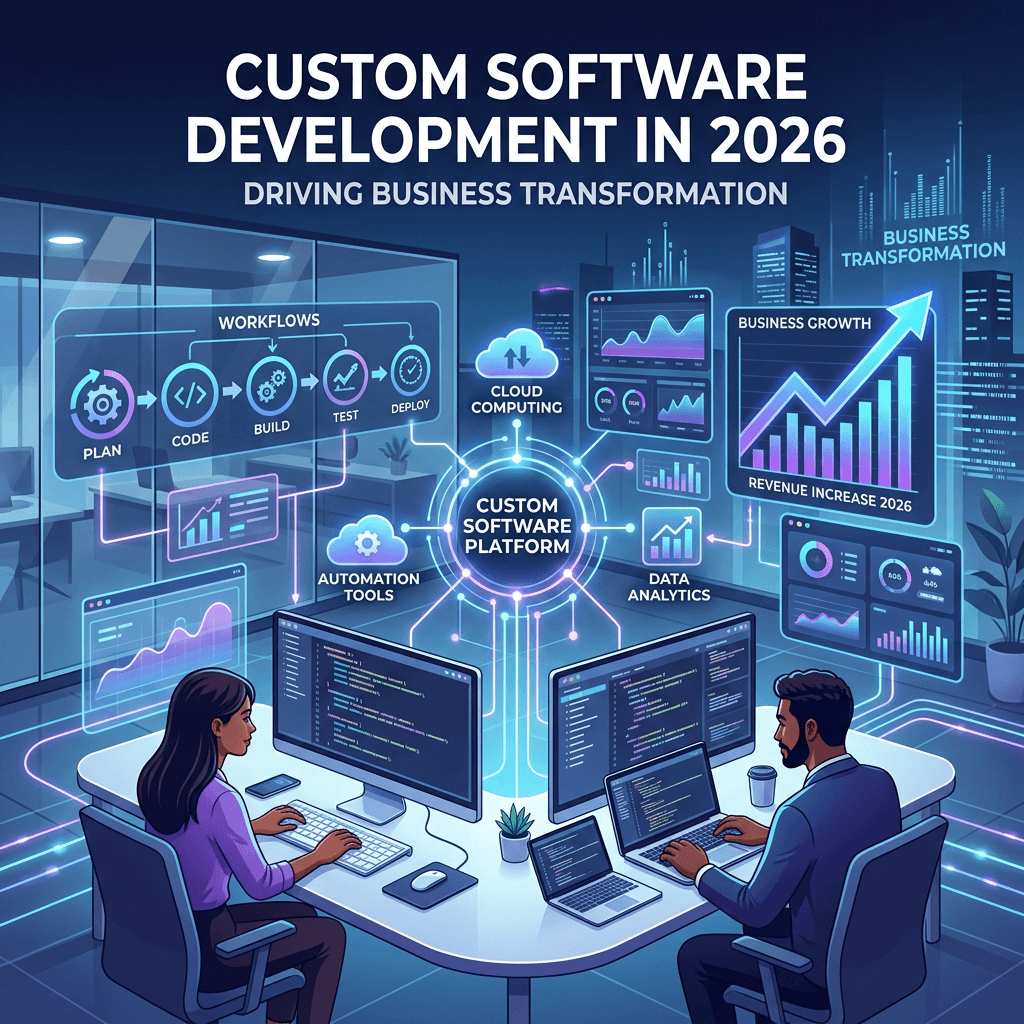
In a rapidly evolving digital landscape, off-the-shelf solutions rarely suffice for unique business processes. Custom software development, tailored to your specific workflows, challenges, and goals, remains a powerful catalyst for efficiency, growth, and competitive advantage in 2026. By partnering with a trusted software development provider like Mega Tech Bot Pvt. Ltd., organizations can unlock scalable, secure, and future-ready solutions that adapt as the market shifts.
The return on investment of custom software is not just in immediate cost savings; it’s in the strategic capabilities it enables. Here’s how custom software development can transform your business this year and beyond.
Aligning Technology with Your Unique Processes
Custom software is built around your exact processes, data models, and rules, reducing the friction that often comes with generic platforms.
By mapping your workflows end-to-end, developers can automate repetitive tasks, enforce policy compliance, and ensure consistency across departments.
The result is a streamlined operation where technology supports what you do best, rather than forcing you to adapt to a one-size-fits-all solution.
Boosting Efficiency and Productivity
Tailored automation eliminates manual steps, reduces human error, and speeds up critical tasks like data entry, reporting, and customer onboarding.
A well-designed custom solution often integrates disparate systems (CRM, ERP, HR, finance), providing a single source of truth and reducing context switching.
This cohesion frees up time for analysts, developers, and frontline teams to focus on high-value work, driving measurable gains in productivity.
Enhancing Customer Experience
Custom software can power personalized customer journeys, from targeted marketing automation to tailored product recommendations and support workflows.
Streamlined interactions—faster responses, accurate order tracking, and proactive issue resolution—translate into higher satisfaction, repeat business, and positive word-of-mouth.
For businesses in Haryana and beyond, local integration with regional payment gateways, shipping partners, and compliance requirements ensures a seamless customer experience.
Strengthening Data Security and Compliance
In 2026, data privacy and regulatory compliance are non-negotiable. Custom software can be designed with security-by-design principles, including role-based access, encryption, and secure API practices.
By controlling the data model and access controls, you reduce the risk of data leaks and ensure adherence to applicable regulations (such as data localization requirements in certain regions).
Regular security testing and ongoing updates become a natural part of the development lifecycle, rather than an afterthought.
Enabling Scalable Growth
As your business expands, your software should scale without requiring a complete replacement. Custom solutions can be modular, microservices-based, or cloud-native, allowing you to add features as needed.
This scalability supports new markets, channels, and product lines, preserving performance and reliability even during peak demand.
A scalable system also future-proofs your investment, making it easier to adapt to evolving tech ecosystems and business needs.
Driving Innovation through Data and Analytics
Custom software can embed advanced analytics, dashboards, and reporting tailored to your KPIs.
With clean, centralized data, leadership gains real-time visibility into operations, customer behavior, and financial performance.
Predictive analytics, machine learning integrations, and scenario planning capabilities become accessible, empowering proactive decision-making rather than reactive firefighting.
Accelerating Time-to-Market
When you own the software stack, new features and improvements can be delivered faster without waiting for vendor release cycles.
Agile development, coupled with a clear product roadmap, enables rapid iterations, user feedback loops, and continual improvement.
This speed is crucial in competitive sectors where first-mover advantages and quick pivots translate into market leadership.
Cost Management and Total Cost of Ownership
While custom software requires upfront investment, long-term ownership costs can be lower compared to licensing, customization, and integration fees for multiple off-the-shelf solutions.
Transparent cost structures, predictable maintenance, and reduced dependency on third-party vendors contribute to healthier cash flow.
A well-planned modernization path—from legacy systems to modular, scalable components—can optimize total cost of ownership over time.
Better Vendor and Partnership Alignment
Working with reputable software development firms, such as Mega Tech Bot Pvt. Ltd., provides access to skilled engineers, robust QA, and proven processes.
A reliable partner brings domain knowledge, security expertise, and a collaborative approach to ensure the final product meets business goals.
For businesses in Haryana seeking the best software development services, selecting a local or regional partner can simplify communication, regulatory alignment, and post-deployment support.
20+ Use Cases Across Industries
Custom software development is not limited to one sector. Here are representative use cases where tailored solutions make a meaningful difference:
E-commerce platforms: personalized shopping experiences, order orchestration, inventory synchronization, and fraud prevention.
Manufacturing: production scheduling, quality control, and supply chain visibility.
Healthcare: patient management systems, telehealth workstreams, and compliant data handling.
Financial services: risk analytics, streamlined back-office processes, and secure payments.
Education: learning management, student information systems, and analytics for outcomes.
Real estate: property management workflows, lease administration, and client portals.
Logistics: route optimization, delivery tracking, and carrier integrations.
Hospitality: guest management, loyalty programs, and revenue optimization.
Choosing the Right Custom Software Partner
Selecting a software development partner is as important as the solution itself. Consider these criteria:
Domain expertise: Look for partners who understand your industry and can translate needs into robust software.
Technical prowess: Assess the tech stack, architecture capabilities (monolith vs. microservices), cloud strategy, and security practices.
Collaboration model: A transparent, communicative team with agile methodologies, regular demos, and clear risk management is essential.
Local presence and support: For businesses in Haryana, a partner with local insight can help navigate regulatory nuances and provide timely on-site or nearshore support if needed.
Proven outcomes: Request case studies or references that demonstrate impact, such as efficiency gains, cost reductions, or revenue growth.
Best Software Development Services in Haryana
If you’re evaluating options for the best software development services in Haryana, look for providers who emphasize:
End-to-end product development: from discovery and UX design to deployment and ongoing maintenance.
Customization and integration: the ability to connect with existing systems and data sources.
Security and compliance: robust security testing, privacy-by-design practices, and regulatory alignment.
Agile delivery: frequent iterations, continuous feedback, and measurable outcomes.
Long-term partnership: a focus on your evolving roadmap and sustained value.
Future-Proofing Your Investment
To maximize the longevity and relevance of your custom software, plan with these strategies:
Modular architecture: design software in decoupled components that can evolve independently.
Cloud-native deployment: leverage scalability, resilience, and managed services.
DevOps culture: automate testing, deployment, and monitoring to maintain reliability.
Continuous improvement: establish feedback loops with users and a regular upgrade cadence.
Security lifecycle: implement ongoing threat modeling, vulnerability management, and incident response planning.
Practical Steps to Getting Started
Define business objectives: articulate pain points, desired outcomes, and key metrics.
Map current processes: document workflows to identify bottlenecks and opportunities for automation.
Prioritize features: create a product backlog with value-driven, high-impact items.
Choose a partner: evaluate vendors on track record, cultural fit, and alignment with your goals.
Start with a pilot: implement a focused module to demonstrate value and refine requirements.
Plan for scale: design with growth in mind, including data architecture and integration strategy.
Establish governance: set clear ownership, change control processes, and success criteria.
Measuring Success
Time-to-value: how quickly the solution delivers measurable improvements.
Efficiency gains: reductions in cycle time, errors, and manual effort.
Customer impact: improvements in satisfaction, retention, and lifetime value.
Financial metrics: ROI, total cost of ownership, and gross margins.
Adoption: user engagement, training effectiveness, and support ticket trends.
Conclusion
In 2026, custom software development remains a transformative approach for businesses seeking agility, efficiency, and competitive differentiation. By tailoring solutions to your unique processes and data, you unlock capabilities that generic software cannot provide. Partner with a trusted provider—such as Mega Tech Bot Pvt. Ltd.—to craft a strategic, scalable, and secure software foundation. When your technology aligns with your business goals, your organization can innovate faster, serve customers more effectively, and sustain growth in an ever-changing market. For businesses in Haryana aiming to access top-tier capabilities, this approach often represents the best software development services path and the best software development in Haryana to help you realize your vision.
Also Read
End-to-End IT Solutions: What It Means & Why It Matters