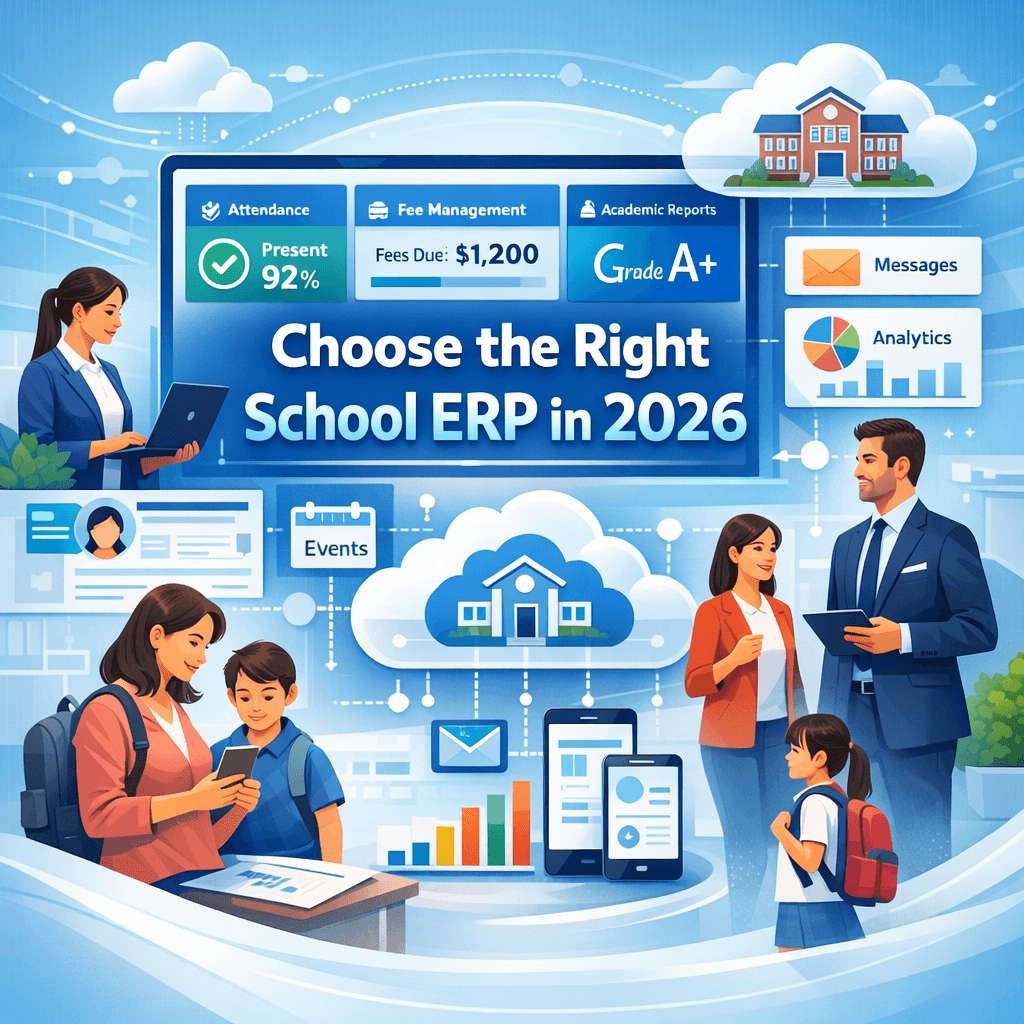

Overview
By Mega Tech Bot Pvt. Ltd. | Next-Generation School ERP & EdTech Solutions
Managing a school in 2026 is not what it was a decade ago. The academic demands are more complex, parent expectations have never been higher, regulatory requirements are tighter, and the volume of data a school generates every single day has grown exponentially.
For school leaders and administrators attempting to manage this complexity with outdated tools — spreadsheets, physical registers, disconnected software, and manual workflows — the daily reality is one of constant firefighting. Errors, delays, miscommunications, and missed opportunities quietly erode the quality of education and the reputation of the institution.
The solution is not more staff or longer hours. It is a school ERP system — a unified, intelligent platform that brings every function of your institution together under one roof, automates the routine, and frees every stakeholder to focus on what matters most.
But not all school ERP systems are created equal. Choosing the wrong one is an expensive, disruptive mistake. Choosing the right one is one of the most consequential decisions a school leader can make.
This is the ultimate guide to choosing a top-tier school ERP system in 2026 — built for school principals, trustees, administrators, and technology decision-makers who want to get this decision right the first time.
Mega Tech Bot Pvt. Ltd. brings decades of combined expertise in EdTech and enterprise software to help institutions navigate this decision with confidence.
What Is a School ERP System — And Why Does It Matter in 2026?
ERP stands for Enterprise Resource Planning. In the corporate world, ERP systems have been the backbone of large organisations for decades — unifying finance, HR, supply chain, and operations on a single platform.
A school ERP system applies this same philosophy to educational institutions. It brings every department — admissions, academics, attendance, fee management, HR, transport, library, communications, and compliance — onto one centralised digital platform where data flows seamlessly, processes run automatically, and every stakeholder has access to accurate, real-time information.
In 2026, the importance of a school ERP system has moved beyond operational convenience. It is now a strategic necessity for three reasons:
1. Data volume and complexity: A school of 1,000 students generates tens of thousands of data points every week — attendance records, assessment scores, fee transactions, communication logs, transport events. No human team can manage this volume accurately without a dedicated system.
2. Stakeholder expectations: Parents expect real-time updates. Teachers expect digital tools that reduce administrative burden. Management expects live dashboards and accurate reports. None of this is deliverable without an ERP system.
3. Competitive differentiation: In an increasingly competitive education market, schools that run efficiently, communicate professionally, and make data-driven decisions attract and retain students — and the best staff — more effectively than those that don't.
The question in 2026 is not whether your school needs a school ERP system. It is whether the one you are considering is truly capable of transforming your institution.
The True Cost of Not Having the Right School ERP
Before exploring what to look for in a school ERP system, it is worth understanding the full cost of operating without one — or with an inadequate one.
Administrative overhead: Without a school ERP, administrators spend the majority of their working hours on manual, repetitive tasks — data entry, report compilation, fee follow-up, attendance tracking, and communication. This is time not spent on strategic priorities.
Data errors and inconsistency: When student data lives in multiple disconnected systems — or worse, in physical registers — discrepancies are inevitable. These errors undermine decision-making, create compliance risks, and erode parent trust when inconsistent information reaches them.
Communication breakdowns: Schools without integrated communication tools rely on circular letters, WhatsApp groups, and phone calls — all of which are unreliable, untracked, and unprofessional.
Financial leakage: Without automated fee management, schools consistently under-collect. Outstanding dues accumulate, manual reconciliation consumes finance staff time, and the school's cash flow suffers.
Compliance risk: Maintaining accurate records for UDISE+, board examinations, government audits, and regulatory inspections is an enormous manual burden without a school ERP — and the risk of submission errors is significant.
The hidden cost compounds daily. Every week of operating without a capable school management software is a week of accumulated inefficiency, missed revenue, and institutional risk.
10 Critical Features to Look for in a Top-Tier School ERP System
Not all school ERP systems offer the same depth of functionality. Here are the ten features that separate genuinely transformative platforms from basic school management tools.
Feature 1: Comprehensive Admissions Management
The admissions process sets the tone for every family's relationship with your school. A top-tier school ERP should deliver end-to-end digital admissions — from the moment a prospective family fills an online enquiry form to the day the student is fully enrolled and onboarded across all school systems.
Real-world scenario: A school receiving 600+ admission enquiries in a single admission season often struggles with manual follow-ups, missed calls, and delayed responses. With an AI-enabled ERP system, every enquiry is automatically captured, scored based on interest level, and assigned to counselors. High-intent parents receive instant follow-ups within minutes, which significantly improves conversion rates and reduces admission leakage.
Look for:
Online application forms accessible from any device
Document upload and digital verification workflows
Automated follow-up communications and reminders
Configurable shortlisting criteria
One-click student onboarding that populates all modules simultaneously upon confirmation
Admissions analytics dashboard tracking conversion rates at each pipeline stage
A school ERP that treats admissions as a strategic function — not just a data entry exercise — will consistently outperform one that simply digitises paper forms.
Feature 2: Real-Time Attendance Management
Attendance management is one of the highest-frequency operations in any school — and one of the most error-prone when done manually.
Real-world scenario: In a school with 1200+ students, teachers previously spent 10–15 minutes per class taking manual attendance, leading to delays and errors. With an ERP system integrated with biometric or mobile attendance, attendance is marked in seconds, and parents receive instant notifications if a child is absent or late. School administrators can also track chronic absenteeism patterns early and intervene before it affects academic performance.
A top-tier school ERP delivers:
Digital attendance marking by teachers on mobile or tablet
Biometric and facial recognition hardware integration for automated capture
Instant parent notifications when a student is absent or arrives late
Period-wise attendance for secondary classes
Chronic absenteeism alerts and minimum attendance threshold warnings
Real-time attendance dashboards for administrators across all classes
Real-time attendance visibility is not just an administrative convenience — it is a student safety imperative.
Feature 3: Intelligent Fee Management & Online Payments
Fee management is the financial engine of every school. The right school ERP transforms it from a labour-intensive manual process into a largely automated, error-free system.
Real-world scenario: A school handling 2000+ students previously relied on manual fee registers and cash counters, leading to delays in reconciliation and missed follow-ups. With an automated ERP system, parents pay fees online anytime via UPI or cards, and the system instantly updates ledgers, generates receipts, and reduces outstanding dues without manual intervention.
Essential capabilities include:
Flexible fee structure configuration — by class, category, instalment, and concession
Online payment integration with UPI, net banking, credit/debit cards, and wallets
Automated fee reminders via SMS, WhatsApp, and push notification
Instant digital receipt generation and delivery
Real-time fee collection dashboards with outstanding dues tracking
Automated reconciliation — every online payment posts directly to the student's ledger
Integration with accounting software such as Tally for seamless financial reporting
Schools that implement automated fee management consistently see measurable improvements in on-time collection rates and significant reductions in finance staff workload.
Feature 4: Academic Management & Performance Analytics
Academic management is the core mission of any school, yet it is often the module most poorly served by basic school ERP systems. A top-tier platform goes far beyond mark entry and report card generation.
Real-world scenario: In a school where teachers previously reviewed exam results manually, identifying weak students took weeks. With ERP analytics, the system automatically highlights students struggling in specific subjects (e.g., Math or Science) and suggests targeted interventions before the next exam cycle.
Look for:
Continuous and comprehensive assessment management
Subject-wise, class-wise, and student-wise performance analytics
Learning gap identification at individual student level
At-risk student early warning systems
AI-powered academic insights and intervention recommendations
Digital report card generation and parent distribution
Benchmarking against historical cohort performance
When academic analytics are integrated with attendance, communication, and counselling modules, the school ERP becomes a genuine student support platform — not just an administrative one.
Feature 5: Timetable & Scheduling Automation
Timetable creation is one of the most complex administrative tasks in a school — and one of the most improved by intelligent ERP software.
Real-world scenario: A school with multiple sections and subject combinations previously required 7–10 days to manually create timetables, often leading to clashes and last-minute changes. With automated ERP scheduling, a conflict-free timetable is generated in minutes with full optimization of teachers and classrooms.
A capable school ERP should offer:
Automated, conflict-free timetable generation
Constraints management for teacher availability, room capacity, and subject requirements
Dynamic substitute teacher scheduling when absences occur
Integration with the attendance and HR modules for seamless staff management
Co-curricular and examination scheduling within the same platform
What once took coordinators days of painstaking manual work should be achievable in minutes with the right school ERP.
Feature 6: Parent & Student Communication Portal
Communication is where many schools fall short — not for lack of effort, but for lack of the right tools. A top-tier school ERP includes a fully integrated communication platform that replaces fragmented WhatsApp groups and unreliable circular letters.
Real-world scenario: Instead of sending generic messages to all parents, a school using ERP communication can send personalized updates — for example, a parent receives an alert only about their child’s attendance drop or fee due reminder, improving engagement and response rate significantly.
Essential communication features:
Dedicated parent mobile app with personalised dashboards per child
Two-way in-app messaging between parents and teachers
Multi-channel notifications — push, SMS, WhatsApp Business API, and email
Broadcast announcements with read-confirmation tracking
PTM scheduling and booking through the app
In-app query and complaint management with SLA tracking
Multilingual communication support for diverse school communities
When parents are consistently well-informed and easily heard, satisfaction scores rise, trust deepens, and student outcomes improve.
Feature 7: HR, Payroll & Staff Management
A school ERP that manages students but neglects staff is only doing half the job. Top-tier platforms include comprehensive HR and payroll modules that eliminate paper-based processes entirely.
Real-world scenario: In many schools, payroll processing used to take 3–5 days every month due to manual calculations. With ERP automation, salaries, deductions, and payslips are generated in minutes with zero calculation errors.
Look for:
Digital leave application and multi-level approval workflows
Automated payroll processing with PF, ESI, TDS, and professional tax compliance
Digital payslip generation and distribution
Staff attendance tracking integrated with payroll
Service record and document management
Performance appraisal workflows
Recruitment and onboarding support
When HR processes run on autopilot, school management teams can focus on the strategic aspects of people management — building culture, developing talent, and retaining great educators.
Feature 8: Transport Management & GPS Tracking
Student safety during transit is a non-negotiable priority. A school ERP without an integrated transport module leaves a significant operational and safety gap.
Real-world scenario: Parents often worry about school bus delays or safety. With GPS-enabled ERP systems, parents can track live bus location, receive ETA alerts, and get instant notifications when the child boards or leaves the bus.
Top-tier transport features include:
Live GPS tracking of all school vehicles accessible by parents on mobile
Geofence alerts for school gate, bus stop, and home zone entry/exit
RFID-based student boarding and alighting confirmation
Driver and vehicle management including licence, insurance, and fitness certificate tracking
AI-powered route optimisation to reduce fuel costs and journey times
Emergency alert capability for drivers to notify school management instantly
In a regulatory environment where schools are increasingly accountable for student safety from door to door, transport management is no longer optional.
Feature 9: Reporting, Analytics & Compliance Management
The value of a school ERP system is ultimately expressed in the quality of decisions it enables. That requires a reporting and analytics layer that is both powerful and accessible.
Real-world scenario: Instead of spending days preparing government reports manually, schools using ERP systems can generate UDISE, board exam, and audit reports instantly with accurate real-time data.
A top-tier school ERP should provide:
Configurable report builder for academic, financial, attendance, and operational data
Real-time dashboards for administrators, principals, and management teams
Automated generation and distribution of regular MIS reports
UDISE+ data preparation and export in required formats
Board examination registration data exports
Audit-ready data trails for government inspections and accreditation processes
Multi-campus consolidated reporting for school groups and chains
When reporting is automated, leadership always has the current, accurate information needed to make faster, better decisions.
Feature 10: Cloud Architecture, Security & Scalability
The technical architecture of a school ERP matters as much as its features. A system built on outdated on-premise infrastructure or with inadequate security controls is a liability, not an asset.
Real-world scenario: Schools that migrate from offline systems to cloud-based ERP gain instant access from anywhere, allowing administrators and principals to monitor operations even remotely without dependency on physical servers.
Evaluate carefully:
Cloud hosting: Is the system hosted on a reliable cloud platform with defined uptime SLAs? Can it be accessed from any device, from any location?
Data security: Is data encrypted in transit and at rest? Are role-based access controls granular enough for your needs?
Compliance: Does the system support compliance with India's Digital Personal Data Protection (DPDP) Act, 2023?
Scalability: Can the system handle your institution's growth — from 500 students to 5,000 — without performance degradation?
Disaster recovery: Are automated backups in place? What is the recovery time objective in the event of data loss?
Uptime and support: What are the provider's uptime commitments and support response times?
A school ERP that fails on any of these technical dimensions creates operational and reputational risk that no set of features can compensate for.
5 Common Mistakes Schools Make When Choosing an ERP System
Having evaluated thousands of school technology decisions, Mega Tech Bot has identified the five most common and costly mistakes schools make when choosing a school ERP system.
Mistake 1 — Choosing on price alone. The cheapest school ERP is almost never the most cost-effective one. Hidden implementation costs, ongoing customisation fees, and the cost of inadequate functionality always outweigh initial savings.
Mistake 2 — Underestimating implementation complexity. A school ERP is not a plug-and-play tool. Successful implementation requires dedicated project management, staff training, data migration, and workflow redesign. Ask prospective vendors for a detailed implementation plan before committing.
Mistake 3 — Ignoring post-implementation support. The quality of ongoing support — response times, update frequency, and the availability of training resources — matters as much as the initial product quality. A school ERP that is poorly supported is one that gradually degrades in usefulness.
Mistake 4 — Choosing a generic ERP over an education-specific one. General-purpose ERP systems adapted for schools rarely match the depth of purpose-built school ERP platforms. Education has unique workflows, regulatory requirements, and stakeholder dynamics that generic tools handle poorly.
Mistake 5 — Failing to involve teachers and staff in the selection process. The people who will use the system daily should have input into the selection. A school ERP that administrators love but teachers resist will never deliver its full potential.
The Mega Tech Bot Approach: School ERP Built for Real Institutional Needs
Mega Tech Bot Pvt. Ltd. has been at the forefront of educational technology development in India, building solutions that address the real operational challenges faced by schools and institutions across the country.
Our approach to school ERP is grounded in three principles:
Depth over breadth: Every module in our school ERP platform is built to handle the full complexity of real school operations — not a simplified, feature-light version designed to look impressive in a demo.
Implementation excellence: We treat every school ERP implementation as a transformation project, not a software installation. Our dedicated implementation teams work alongside school staff to ensure the system is configured, adopted, and delivering value from day one.
Long-term partnership: Our relationship with schools does not end at go-live. Ongoing support, regular platform updates, and continuous improvement based on user feedback are core commitments — not optional add-ons.
Whether you manage a single school of 500 students or a network of institutions across multiple cities, Mega Tech Bot's school ERP solutions are built to scale with your ambition.
How to Evaluate School ERP Vendors: A Practical Checklist
When you are ready to evaluate school ERP vendors, use this checklist to ensure your assessment is thorough:
Evaluation Criterion | Questions to Ask |
Functional completeness | Does it cover all the modules your school needs today and anticipates needing in three years? |
Education-specific design | Is it built specifically for schools, or is it a generic ERP adapted for education? |
Implementation track record | How many schools has the vendor implemented successfully? Can they provide references? |
Mobile experience | Are there dedicated, well-designed apps for parents, students, teachers, and admins? |
Integration capability | Does it integrate with payment gateways, biometric hardware, government portals, and LMS platforms you use? |
AI and automation | What intelligent automation and analytics capabilities does it offer beyond basic task management? |
Support quality | What are the response time SLAs? Is support available during school hours including exam seasons? |
Data security | Is the system DPDP Act compliant? What are the data hosting, encryption, and backup standards? |
Pricing transparency | Is pricing clear and all-inclusive, or are there hidden fees for modules, users, or support? |
Scalability | Can the system grow with your institution without requiring a platform change? |
A vendor who answers every one of these questions confidently and in detail is one worth shortlisting. One who deflects, qualifies excessively, or cannot provide references should be approached with caution.
Making the Decision: A Framework for School Leaders
Choosing a school ERP system is ultimately a strategic decision, not just a technology procurement. Here is a simple framework to guide your decision-making process:
Step 1 — Audit your current state. Document every significant administrative workflow in your school today. Identify the three to five that consume the most time and carry the most error risk. These are your priority use cases.
Step 2 — Define your must-haves. Based on your audit, create a non-negotiable feature list. A school with a large transport operation will weight GPS tracking heavily. A school with multiple campuses will prioritise consolidated reporting. Your must-haves are unique to your institution.
Step 3 — Shortlist on depth, not demos. Request live demonstrations that test your specific must-have use cases, not vendor-prepared demo scripts. A system that handles your real workflows well is more valuable than one that demos beautifully on generic scenarios.
Step 4 — Evaluate implementation plans. Ask each shortlisted vendor for a detailed implementation plan. Look for realistic timelines, clear responsibilities, data migration support, and staff training included as standard.
Step 5 — Check references rigorously. Speak directly with schools of similar size and type that have been live on the system for at least one full academic year. Ask specifically about the implementation experience, support quality, and whether they would choose the same vendor again.
Step 6 — Plan for change management. The best school ERP in the world will underdeliver if staff don't adopt it. Build a change management plan — communication, training, and champion identification — before implementation begins.
The Future Belongs to Schools That Choose Intelligently Today
The gap between schools that have made intelligent technology investments and those that haven't will continue to widen in the years ahead. The institutions that choose a top-tier school ERP system today are building the operational foundation, data infrastructure, and institutional capability that will define their competitive position for the next decade.
This is not a decision to defer. Every academic year spent without the right school management software is a year of accumulated inefficiency, missed insight, and unrealised potential.
Mega Tech Bot Pvt. Ltd. is here to help you make this decision with confidence — and to deliver an implementation that transforms your school from day one.
Ready to Transform Your School Operations?
If you are evaluating school ERP systems in 2026 and want expert guidance on choosing the platform that is right for your institution, our team at Mega Tech Bot is ready to help.
Contact Mega Tech Bot today for a consultation, a live demonstration, and a no-obligation assessment of your school's ERP requirements.
Visit Mega Tech Bot Pvt. Ltd. | Book a Free Demo
Mega Tech Bot Pvt. Ltd. — Transforming Education Through Intelligent Technology.
FAQs
What is a school ERP system?
A school ERP system is software that integrates all school operations such as admissions, attendance, fees, academics, HR, transport, and communication into a single platform. It helps schools automate daily tasks and improve efficiency through centralized data and real-time reporting.
Why is a school ERP system important in 2026?
In 2026, schools handle large volumes of data and high parent expectations. A school ERP system is important because it automates operations, improves communication, reduces manual workload, and enables data-driven decision-making.
What are the main features of a school ERP system?
Key features include admissions management, attendance tracking, fee management, academic analytics, timetable automation, HR and payroll, transport tracking, communication tools, reporting, and cloud-based security.
How does school ERP improve fee collection?
A school ERP improves fee collection by enabling online payments, sending automated reminders, tracking pending dues in real time, and generating instant receipts, which reduces delays and improves cash flow.
Can small schools use ERP software?
Yes, school ERP systems are suitable for both small and large schools. Small schools benefit by reducing manual workload, improving organization, and scaling operations efficiently without increasing administrative staff.
Does school ERP support online classes and LMS integration?
Yes, modern school ERP systems integrate with LMS platforms like Google Classroom, Microsoft Teams, and Zoom to support hybrid and online learning environments.
How does school ERP improve student performance?
School ERP systems track student performance in real time, identify learning gaps, flag at-risk students, and provide data-driven insights that help teachers take timely corrective action.
Is school ERP software secure?
Yes, advanced school ERP systems use cloud security, data encryption, role-based access control, and compliance with data protection laws like India’s DPDP Act 2023 to ensure complete data safety.
What does a school ERP system do?
A school ERP system manages all school activities in one platform including admissions, attendance, exams, fees, HR, and communication, helping schools run more efficiently with automation and real-time data.
How does ERP help schools improve efficiency?
ERP helps schools by reducing manual work, automating repetitive tasks, improving communication between parents and teachers, and providing real-time dashboards for faster decision-making.
What is the cost of a school ERP system in India?
The cost of a school ERP system in India depends on features, number of students, and customization needs. Most systems follow subscription-based pricing for affordability and scalability.
Which is the best school ERP software in India?
The best school ERP software is one that offers full automation, AI-driven insights, secure cloud infrastructure, strong integrations, and easy usability for teachers, parents, and administrators.
How long does it take to implement a school ERP system?
Implementation usually takes a few weeks depending on school size, data migration needs, and customization. Proper onboarding and training ensure smooth adoption.
Can school ERP work on mobile phones?
Yes, modern school ERP systems come with mobile apps for parents, teachers, and students, allowing access to attendance, fees, communication, and updates anytime, anywhere.
Also Read
AI-Driven School Portal: The Future of School Management Software in 2026