
Overview
If you're running a business in Haryana — whether it's a startup in Gurugram, a manufacturing unit in Faridabad, a textile business in Panipat, a trading company in the Hisar-Rohtak belt, or a chain of restaurants in Karnal — there's one thing you've probably already discovered the hard way: generic software just doesn't cut it.
Spreadsheets get overloaded and start contradicting each other across departments. Orders get lost in the chaos of WhatsApp chats between sales, warehouse, and delivery teams. Invoices get typed manually into three different systems. And when you finally decide to try a ready-made SaaS tool to fix all of this, it's either too generic to actually match how your business works, or it comes bundled with a dozen features you'll never use while missing the one integration you actually need.
This is exactly where the right software development partner can change the entire trajectory of your business. The difference between a company that scales smoothly past ₹5 crore in revenue and one that gets permanently stuck in operational chaos often comes down to whether they built (or bought) the right systems at the right time.
But here's the catch: a quick search for "best software development company in Haryana" returns dozens, sometimes hundreds, of results — freelancers, boutique agencies, large IT services firms, and everything in between. Almost all of them claim to be "the best." So how do you actually separate the partners worth your investment from the ones that will leave you with a half-finished product, a support ticket that never gets answered, and a bill that keeps growing?
This guide is built to answer exactly that. We'll walk through:
Why Haryana's business landscape creates software needs that generic tools can't meet
The exact criteria to use when evaluating a software development company
Custom software vs off-the-shelf tools, compared in detail
What the actual development process looks like, step by step
Realistic cost and timeline expectations, broken down by project type
Common mistakes businesses make when choosing a development partner
Why a specialized, India-focused development partner is the smarter long-term choice for growing businesses
Answers to the most common questions business owners ask before starting a software project
Understanding Haryana's Business Landscape
Haryana isn't just another state on the map — it's one of India's fastest-growing industrial and commercial corridors, sitting right next to Delhi NCR and benefiting from that proximity in ways that shape its business needs.
Gurugram has become a corporate and IT hub, home to everything from Fortune 500 back-offices to fast-scaling homegrown startups. Faridabad remains one of North India's most important manufacturing centers, with a dense concentration of engineering, auto-component, and industrial goods businesses. Panipat is globally known for textiles and handloom exports. Sonipat and Karnal have seen rapid growth in agri-business, food processing, and educational institutions. And across smaller towns in the Hisar-Rohtak belt, trading, distribution, and wholesale businesses form the economic backbone.
Despite this diversity, almost every growing business in the state runs into the same structural wall: operations that were perfectly manageable at a small scale become a serious bottleneck the moment the business starts to grow.
Consider a few real patterns that show up again and again:
Manufacturing units in Faridabad or Bahadurgarh often start with a single Excel sheet tracking raw material and finished goods. By the time the business has multiple product lines and shifts, that sheet becomes an unreliable mess — nobody trusts the numbers anymore, and production planning becomes guesswork. What these businesses actually need is real-time inventory and production tracking that connects the shop floor to the accounts team.
Retail chains and restaurants that expand from one location to three or four often discover that billing, inventory, and reporting don't talk to each other across branches. The owner ends up manually consolidating numbers from each outlet at the end of the month, which means decisions are always made on month-old data instead of real-time information.
Educational institutions — schools, coaching centers, and training institutes — frequently run admissions in one register, attendance in another system (or none at all), and fee collection through a mix of cash receipts and bank transfers that are reconciled manually. This creates enormous administrative overhead and makes it nearly impossible to get a clear picture of the institution's financial health at any given moment.
Trading and distribution businesses need GST-compliant invoicing, vendor payment tracking, and often credit management for dealers — all of which typically ends up spread across Tally, WhatsApp, and paper ledgers, with no single source of truth.
None of these problems gets solved by a generic template or a one-size-fits-all SaaS subscription pulled off the shelf. What these businesses actually need is custom-built software that understands the Indian regulatory and operational context — GST rules, DPDP Act (Digital Personal Data Protection Act) compliance, and integration with the tools business owners already rely on, like Tally and Razorpay. A software partner that doesn't understand this context will either build something that looks good in a demo but breaks down in real use, or will simply hand over a generic product and call it "customization."
7 Criteria for Choosing the Best Software Development Company
Since a plain search will return dozens of results, here's what actually separates a strong development partner from an average one. Use this as a checklist when you're evaluating vendors.
1. Genuine Custom Development Capability
Many agencies are, in practice, template shops — they customize a WordPress theme, configure a low-code builder, or slightly tweak an existing product and call it "custom development." This isn't necessarily dishonest, but it's important to know what you're actually buying. What a growing business usually needs is a team capable of building software from the ground up: a data model designed around your actual business rules, a workflow that mirrors how your team really operates, and the flexibility to add new modules as the business evolves. Ask directly: "Is this built from scratch around our process, or are we customizing an existing template?" A good partner will answer honestly, and either answer can be right depending on your budget and timeline — but you should know which one you're getting.
2. Familiarity with Indian Compliance Requirements
GST-compliant invoicing, DPDP Act data-handling requirements, and local tax structures aren't optional extras — they're foundational to any software that touches money, customer data, or business records in India. A developer who doesn't build these in from day one is setting you up for a legal and operational headache after launch, whether that's an invoice format that doesn't pass a tax audit or a data storage practice that runs afoul of privacy regulations. Ask a prospective partner how they've handled GST invoicing and personal data storage in past projects — vague answers here are a red flag.
3. Industry-Specific Experience
A company that has already built solutions for schools, restaurants, manufacturing units, or B2B service businesses understands the pain points of that industry before you even finish explaining them. That experience translates directly into a faster, smoother development process for you — fewer clarifying meetings, fewer revisions, and a system that's already been stress-tested against real-world edge cases in your industry. If a company has built a school ERP before, they already know that fee structures vary by class, that siblings need linked accounts, and that attendance needs to sync with communication to parents. You don't have to explain any of that from scratch.
4. Reliable Post-Launch Support
Launching software is the beginning of the relationship, not the end of it. Bugs surface under real-world load that never showed up in testing. Regulatory rules change and invoicing formats need updates. Your business scales and the software needs new modules. All of this requires a support relationship you can actually count on — especially if your internal team isn't technical and can't troubleshoot issues on their own. Ask specifically: What does support look like in month three, month six, and year two? Is there a dedicated point of contact, or does every issue go into a generic ticket queue?
5. Transparent, Predictable Pricing
The best development partners give you clear, upfront pricing with no hidden costs buried in the fine print. Whether the engagement is structured as a fixed-cost project, a milestone-based payment plan, or a retainer model, both the scope and the numbers should be spelled out clearly before work begins. Be especially cautious of quotes that seem unusually low — they often mean either scope will balloon later with "additional charges," or corners will be cut on testing and support.
6. Local Presence with Remote Flexibility
Working with a Haryana-based company means shared time zones, shared cultural and business context, and the option for in-person meetings when something needs to be worked through face-to-face — while still being able to work remotely day-to-day for routine updates and communication. That combination tends to reduce miscommunication significantly compared to working with an agency several time zones away that has never set foot in an Indian manufacturing unit or a local school office.
7. A Proven Track Record
Ask for case studies, client references, and — ideally — live demonstrations of products the company has already built and deployed. A company confident in its own work will show it to you without hesitation, walk you through real screens, and let you speak to an existing client if you ask. Vague portfolio pages with stock photos and no specifics are a signal to dig deeper before committing.
Custom Software vs Off-the-Shelf Tools: A Detailed Comparison
This is the decision almost every growing business eventually has to make, and it's worth understanding the trade-offs clearly rather than defaulting to whichever option seems cheaper on day one.
Factor | Off-the-Shelf SaaS Tools | Custom Software (Local Development Partner) |
Fit to Business Process | Generic, one-size-fits-all; you adapt your process to the tool | Built around your exact workflow; the tool adapts to you |
GST/DPDP Compliance | Often missing, generic, or bolted on later as an add-on | Built in from the ground up, specific to your invoicing and data practices |
Scalability | Limited by the platform's own pricing tiers and feature rules | Scales with your business, not against it |
Ongoing Costs | Recurring monthly/annual subscription indefinitely, often per-user | One-time build cost plus optional, predictable support/maintenance |
Data Ownership | Stored on the vendor's servers, subject to their terms | Full ownership and control over where and how data is stored |
Integration (Tally, Razorpay, etc.) | Sometimes restricted, paywalled, or unavailable entirely | Seamless, purpose-built integration with the tools you already use |
Support Response | Generic ticketing system, long queues, often international time zones | Direct access to a dedicated local team that knows your system |
Customization Over Time | Limited to what the vendor's roadmap allows | Fully flexible — new modules can be added as your business changes |
Vendor Lock-In Risk | High — switching platforms later means migrating everything | Low — you own the codebase and the data |
To be clear, SaaS tools aren't inherently bad, and this isn't an argument that every business should immediately commission a custom build. For very small teams just getting started, or for functions that are genuinely generic across every business (basic email marketing, for instance), an off-the-shelf tool can be a perfectly reasonable way to get moving quickly and cheaply.
But for businesses that are actively growing, scaling operations, or dealing with processes specific to their industry, custom software tends to be far more cost-effective and reliable over the long run — not because SaaS tools are poorly built, but because they simply aren't built for your specific business. Every workaround you have to build around a SaaS tool's limitations is a hidden cost: time spent, errors introduced, and opportunities missed. Custom software removes that friction by design.
A useful way to think about it: if a piece of software touches a core part of how your business makes money or serves customers — inventory, billing, student records, order management — it's usually worth owning that system outright. If it's a supporting function that's genuinely standardized across industries — like basic accounting software or email — a SaaS tool is often fine.
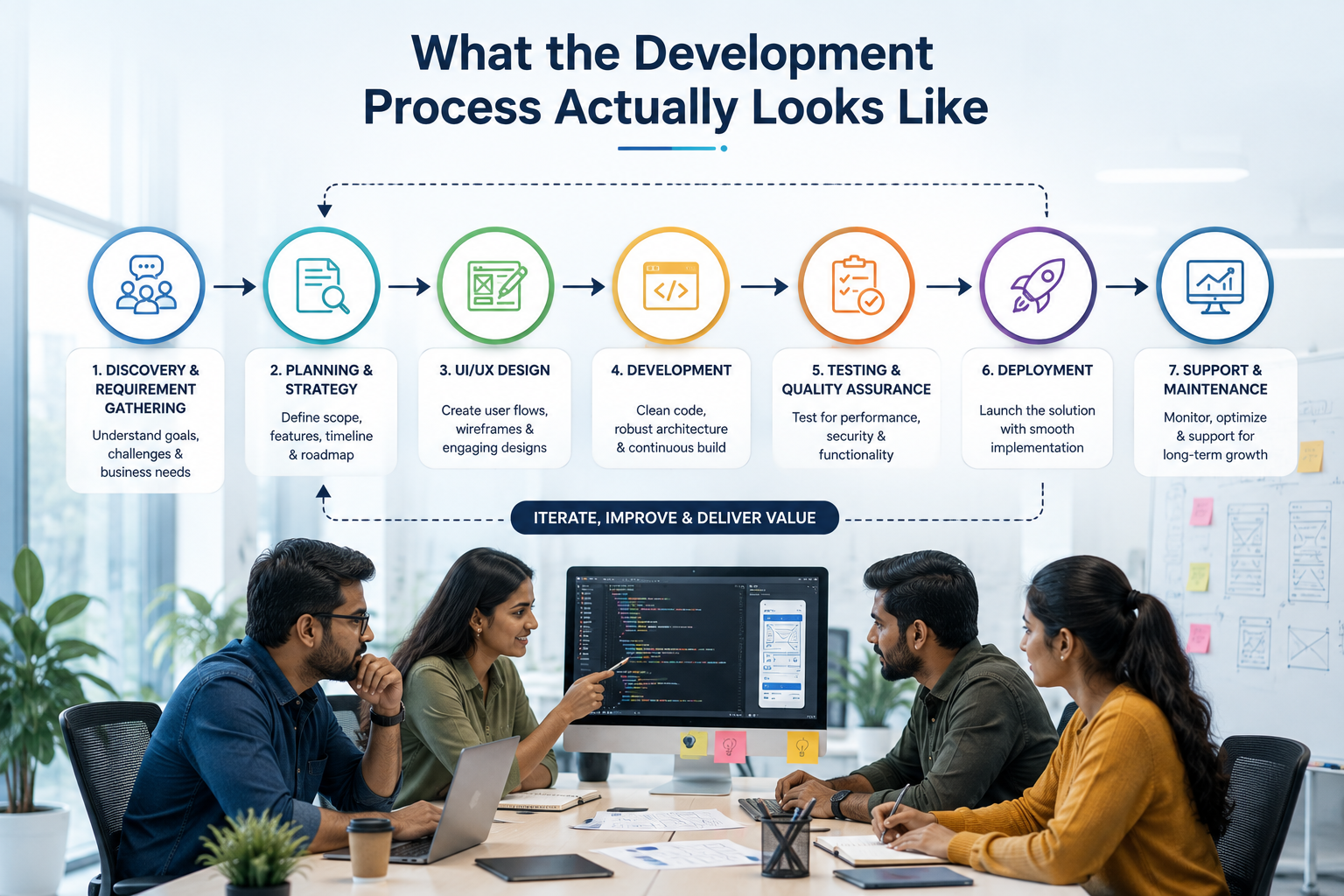
What the Development Process Actually Looks Like
One thing that often gets skipped in these guides is a clear picture of what actually happens once you decide to move forward. Here's a realistic breakdown of the typical process with a capable software development partner.
Step 1: Discovery and Requirement Mapping This is where the development team sits down with you — ideally in person or over a detailed video call — and maps out exactly how your business currently operates. What are the manual steps? Where do errors typically happen? What does your team actually need on a daily basis, as opposed to what sounds nice in theory? A good discovery process often uncovers requirements the business owner hadn't even thought to mention, simply because they've never had to describe their own process out loud before.
Step 2: Scoping and Proposal Based on discovery, the development company should come back with a clear scope document — what will be built, in what order, over what timeline, and at what cost. This is the stage to push for clarity. If anything in the proposal feels vague, ask for specifics before signing anything.
Step 3: Design and Architecture Before a single line of production code is written, the system's data structure and user interface should be planned out. For a business owner, this usually means reviewing wireframes or mockups of key screens — the billing screen, the dashboard, the reports view — and confirming that the flow makes sense before development begins in earnest.
Step 4: Development in Phases Rather than disappearing for months and returning with a finished product, a good development partner builds in phases and shows progress regularly — often in two-week cycles. This lets you catch misunderstandings early, when they're cheap to fix, rather than after the entire system is built.
Step 5: Testing Before launch, the system should go through structured testing — not just "does it work," but does it handle edge cases correctly: what happens with a returned order, a partial payment, a duplicate entry, a user who enters data incorrectly. This is where a lot of lower-quality vendors cut corners, and it's worth asking directly what testing process is used.
Step 6: Deployment and Training Launching the software is only useful if your team actually knows how to use it. A good partner will run training sessions, provide documentation, and be available during the first few weeks of live use when questions inevitably come up.
Step 7: Post-Launch Support and Iteration As covered earlier, this is where the real long-term value of a development partnership shows up — ongoing support, bug fixes, and the ability to add new features as your business grows and its needs change.
Realistic Cost and Timeline Expectations
The first question almost every business owner asks is some version of: "How much will this cost, and how long will it take?" It's a fair question, and the honest answer is that it depends heavily on complexity — but here's a realistic breakdown to set expectations.
A simple automation tool or internal dashboard (for example, a tool that automates inventory alerts or consolidates daily sales reports): typically 4–8 weeks, and generally the most budget-friendly starting point for a business testing the waters with custom software for the first time.
A mid-sized ERP or CRM system covering multiple connected functions — say, inventory plus billing plus basic reporting: typically 8–16 weeks, depending on how many modules and integrations are involved.
A full-scale, industry-specific solution, such as a school ERP covering admissions through fee management, or a multi-location restaurant POS rollout with centralized reporting: typically 3–6 months, particularly if multiple locations or user roles need to be configured and rolled out in a staggered manner.
Pricing scales in a similar way. Smaller automation projects can often start in the low lakhs, while full enterprise-grade custom systems represent a considerably larger investment — but one that's typically offset over time by eliminating recurring SaaS subscription costs and the hidden costs of manual error and inefficiency.
The most reliable way to get an accurate number for your specific situation is a discovery call, where your actual requirements are assessed in detail before any quote is given. Be genuinely wary of any company that offers a firm, specific price before understanding your workflow — that's usually a sign the quote will change significantly (upward) once real requirements surface, or that the "customization" on offer is more limited than it sounds.
It's also worth budgeting for ongoing costs beyond the initial build: hosting, periodic updates for compliance changes (GST rate changes, for instance), and a support arrangement for when something breaks or a new feature is needed. A transparent partner will lay these out clearly rather than letting them surface as surprises later.
Common Mistakes Businesses Make When Choosing a Software Partner
A few patterns show up repeatedly among businesses that end up unhappy with a software project, and they're worth calling out directly so you can avoid them.
Choosing purely on price. The lowest quote is rarely the lowest total cost. Cut corners in testing, support, or architecture almost always show up later as expensive fixes, lost data, or a system that simply can't scale when the business grows.
Not asking about compliance until after launch. GST invoicing requirements and data protection rules should be part of the initial conversation, not an afterthought discovered when an accountant or auditor flags a problem months later.
Skipping the discovery process. A vendor that's willing to quote a price and timeline without a serious discovery conversation is either working from a rigid template (fine if that's what you want, risky if you actually need something custom) or setting you up for scope creep later.
Underestimating the importance of training and change management. Even the best-built software fails if the team using it every day doesn't understand it or resists adopting it. A good partner treats rollout and training as seriously as the build itself.
Not clarifying who owns the code and data. Before signing anything, confirm explicitly that you retain full ownership of the source code and the data generated by the system. This matters enormously if you ever need to switch support providers down the line.
Why Mega Tech Bot Pvt. Ltd. Is the Right Choice for Growing Businesses in Haryana
Mega Tech Bot Pvt. Ltd. is an India-based technology company delivering custom software, cloud solutions, and end-to-end IT services — built specifically with Indian SMEs and B2B businesses in mind, rather than adapted from a generic, one-size-fits-all playbook.
Here's what sets the approach apart, mapped directly against the criteria covered earlier in this guide:
An India-first foundation. GST compliance, DPDP Act requirements, and integrations with tools like Razorpay and Tally are built into the development process from the start — not treated as an afterthought bolted on when a client asks for it.
Industry-specific products already in the market. The team has built niche, purpose-designed solutions like Zeanius, a school management ERP covering admissions through fee management, and Zilicius, a restaurant management and POS system built for single and multi-location operations. This means the team isn't approaching your industry for the first time — they've already solved similar problems in depth, which translates into a faster and more informed development process for you.
Architecture built for growth. Whether you're a 10-person startup or a 200-person manufacturing operation, the software is designed to scale alongside your business rather than becoming a constraint that has to be worked around a year later.
Transparent process and ongoing support. From the initial discovery call through deployment and post-launch maintenance, every step comes with clear communication and clear pricing, so there are no surprises buried in a contract you didn't fully read.
Flexibility between cloud and on-premise deployment. Depending on your business's specific needs — data sensitivity, budget, existing infrastructure — both options are available, helping you make smarter infrastructure decisions rather than being locked into whichever model is more convenient for the vendor.
If you're based in Haryana and running a business that's still held together by spreadsheets, WhatsApp threads, and disconnected tools, converting that into a single, custom-built system is one of the highest-leverage investments you can make for the next stage of growth — and Mega Tech Bot Pvt. Ltd. brings both the local context and the technical depth needed to do it right.
Ready to Build Software That Actually Fits Your Business?
If you're tired of forcing your business into the shape of a generic tool, and you're ready for a solution built specifically around how you actually operate, it's worth having a direct conversation with Mega Tech Bot Pvt. Ltd. Book a free discovery call and walk away with a clear roadmap for what custom software could realistically look like for your business — including honest expectations on timeline and cost, not just a sales pitch.
[Contact Mega Tech Bot Pvt. Ltd. today for a free consultation →]
Frequently Asked Questions
Q1. How much does custom software development cost in Haryana?
Custom software development cost in Haryana depends on the project's scope, number of modules, integrations, user requirements, technology, data migration, infrastructure and support needs. Smaller automation projects generally require a lower investment, while ERP, CRM and larger business applications may require a higher budget. A detailed cost estimate should be prepared after understanding the project's requirements and scope.
Q2. How long does custom software development take?
The development timeline depends on the project's complexity, features, integrations, data migration, testing and approval process. As an indicative range, smaller automation projects may take around 4–8 weeks, mid-sized ERP or CRM projects around 8–16 weeks, and larger software solutions may take several months. These are estimates, not guaranteed delivery timelines, and the actual schedule should be agreed according to the final project scope.
Q3. What is the difference between custom software and SaaS?
Custom software is developed around a business's specific workflows, requirements and integrations, while SaaS is generally a ready-made software product offered through a subscription or licensing model. Custom software can provide greater flexibility for complex or specialized processes, whereas SaaS can be more practical for standardized requirements and faster deployment. The right option depends on the business's needs, budget and long-term plans.
Q4. Should an SME build custom software or buy SaaS?
An SME should compare its workflow, budget, operational complexity and future requirements before choosing between custom software and SaaS. SaaS can be suitable when existing software already covers most business requirements. Custom development may be worth considering when a business has unique workflows, multiple integrations or requirements that existing SaaS products cannot adequately support. In some cases, a combination of SaaS and custom development may also be practical.
Q5. How do I choose a software development company in Haryana?
When choosing a software development company in Haryana, evaluate its relevant experience, portfolio, technical capabilities, understanding of your industry, integration expertise, security practices, pricing transparency, development process, support model and scalability approach. It is also useful to ask for examples of relevant products or projects and clearly document scope, deliverables, ownership, support, timelines and commercial terms before starting development.
Q6. Can you migrate data from Excel or existing software?
Data migration from Excel or an existing software system may be possible depending on the data format, structure, quality, volume and compatibility of the source system. A development team should first review the existing data, identify duplicates or inconsistencies, map fields to the new system and test the migration before moving production data. The exact migration scope should be confirmed during project planning.
Q7. Can custom software integrate with Tally, Razorpay or other APIs?
“Custom software can potentially integrate with third-party platforms such as accounting systems, payment gateways and other applications where suitable APIs or supported integration methods are available.”
Q8. Do you provide software maintenance after launch?
Software maintenance and post-launch support can be provided according to the agreed project scope and support arrangement. Maintenance may include bug fixes, security updates, performance improvements, technical assistance and changes required as the software evolves. The exact services, response times, fees and support period should be clearly defined in the applicable proposal or service agreement.
Q9. Can the software be hosted on cloud or on-premise?
Depending on the software architecture and project requirements, deployment can be planned for cloud infrastructure or an on-premise environment. The appropriate option depends on factors such as security requirements, infrastructure, accessibility, data management, scalability and operational preferences. The final hosting and deployment approach should be evaluated and agreed during the technical planning stage.
Q10. Can you develop ERP/CRM/POS software?
Yes, custom software can be developed for business applications such as ERP, CRM and POS systems, depending on the required functionality and project scope. Features can include workflows, user management, inventory, billing, reporting, customer management, integrations and other business-specific functions. Mega Tech Bot's existing product portfolio includes Zeanius, a school management platform, and Zilicius, a restaurant management and POS platform.
Also Read
Top Software Development Trends That Will Dominate 2026