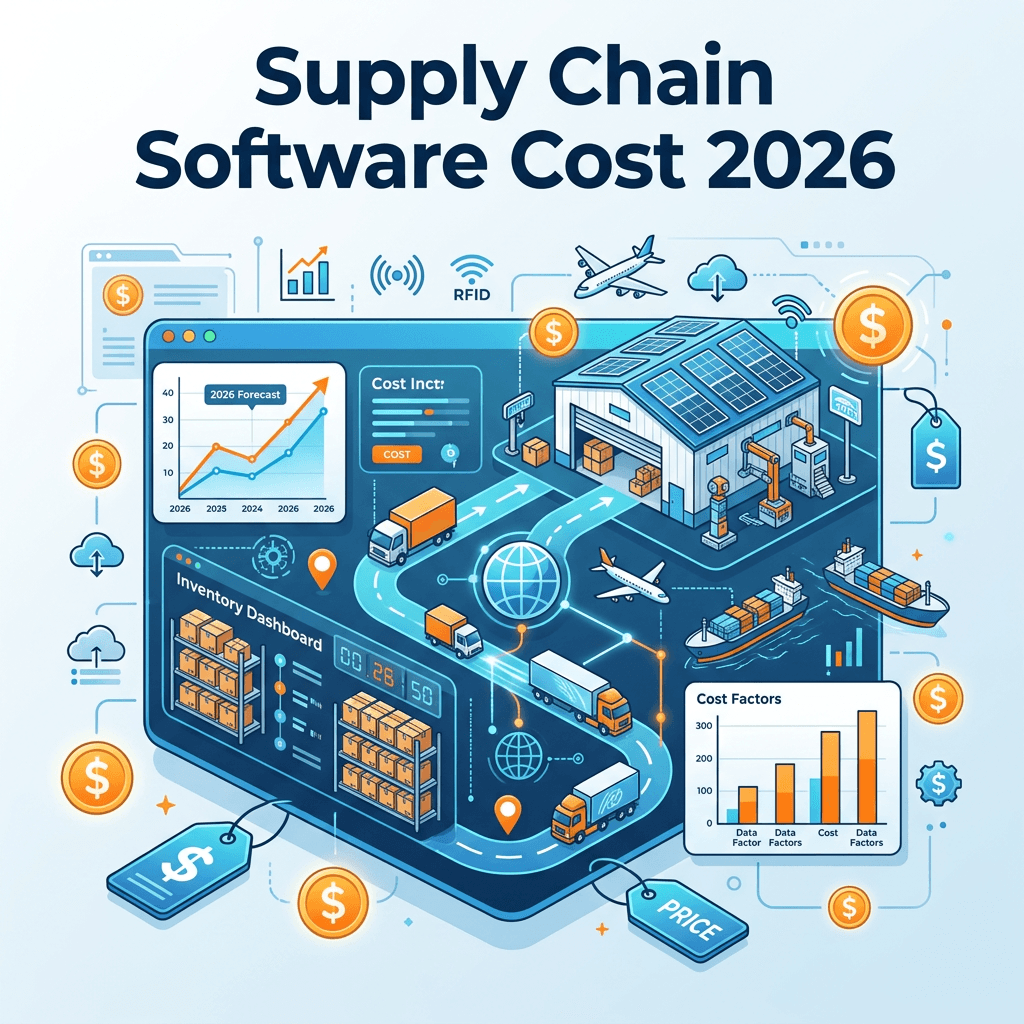

Overview
Introduction
If you’re planning to modernize your operations with a custom supply chain management (SCM) solution, you’re not alone. Businesses across industries are investing in tailored software to gain real-time visibility, automate workflows, and outpace competitors. The biggest question early in the project is often: what will it cost? In this guide, we break down the major cost drivers, typical price ranges, and how to optimize your investment, so you can plan a scalable, ROI-driven SCM platform.
Section 1: Why a custom SCM beats off-the-shelf tools (for some businesses)
Custom software offers tailored workflows, integrations, and data models that match your specific supply chain processes, which can reduce workarounds and improve accuracy. This alignment often leads to faster ROI as processes become more efficient and visible.
For companies with complex networks (multi-warehouse, multi-carrier, global trade), bespoke SCM can provide deeper analytics, better governance, and compliance controls, which are harder to achieve with generic solutions.
A well-executed custom build can scale with growth, add niche features (e.g., AI-driven demand sensing, advanced forecasting, or real-time risk scoring), and adapt to evolving regulatory requirements.
Section 2: What drives the cost of custom SCM software
Scope and complexity: MVPs with core modules (order management, inventory, procurement, shipping) cost less than full-featured, AI-enabled platforms with advanced analytics, optimization, and cross-border capabilities. Broadly, you’ll see a progression from basic to enterprise-grade systems with increasing price bands.
Number of users and roles: Pricing grows with user licenses, role-based access, and concurrency needs. Large teams and multi-entity support drive higher costs due to stricter security, auditing, and separated data domains.
Integrations and data connectivity: The more systems you connect (ERPs, WMS, TMS, e-commerce, carriers, customs), the higher the integration effort. Complex integrations, custom APIs, and data mapping increase both time and cost.
AI and advanced analytics: Forecasting, scenario planning, anomaly detection, and optimization solvers add substantial value but also add incrementally to the budget due to data science, model training, and governance requirements .
Compliance and security: For regulated industries (pharma, food, automotive) and global operations, you’ll invest in SOC 2, ISO-like processes, data residency, and audit trails, raising both cost and timeline.
Deployment model: Cloud-native, hybrid, or on-premises choices affect upfront capex and ongoing Opex. Cloud subscriptions offer flexibility and lower initial costs but over time can accumulate significant ongoing fees.
Change management and training: User adoption drives value. Budget for documentation, training sessions, and ongoing support to ensure teams use the system effectively.
Section 3: Typical cost ranges by project tier
MVP / basic SCM (essential modules, minimal automation): Approximately USD 10,000 to 30,000 for very small retailers or startups, with lean architectures and limited scope. Time-to-delivery is often 3–6 months, focusing on demonstrable value and market fit.
mid-complexity SCM (2–5 warehouses, growing distribution, moderate automation): Roughly USD 40,000 to 150,000. This tier typically includes deeper integrations (ERP, WMS, basic BI) and stronger data governance, with a 6–12 month timeline.
enterprise SCM (regional or national operations, multiple business units): USD 150,000 to 600,000+. Features may include multi-entity support, advanced analytics, optimization modules, and robust security. Timelines commonly span 12–24 months.
global / AI-heavy SCM (large multinational with complex regulatory overlays): USD 600,000 to 1.5 million+ (and higher for very large, AI-driven platforms). Expect comprehensive process reengineering, extensive integrations, and cutting-edge AI capabilities.
Note: Some market analyses report even higher figures for AI-first, end-to-end platforms with cross-border compliance, dynamic network design, and real-time optimization at global scale.
Section 4: Cost components to budget for
Discovery and product definition: Requirements gathering, process mapping, risk assessment, and technical feasibility studies. Often 5–15% of the total budget for substantial programs.
Software development and customization: Core build, modules, APIs, data models, and integration work. This is the largest share and highly variable based on scope.
Integrations and data migration: Connecting ERP, WMS, TMS, CRM, BI tools; data cleansing and migration can be a sizable effort.
Cloud infrastructure and licenses: Annual cloud hosting, security, monitoring, and database services. Cloud models can reduce upfront capex but add ongoing costs.
QA, testing, and compliance: Automated and manual testing, performance testing, security audits, and regulatory compliance work.
Training and change management: End-user training, admin training, and support materials; adoption drives ROI.
Support, maintenance, and future upgrades: Ongoing bug fixes, feature enhancements, and platform upgrades. Typical maintenance ranges from 15–20% of initial development cost annually.
Section 5: How to optimize cost without sacrificing value
Start with an MVP and validate the core ROI: Define specific, measurable outcomes (e.g., reduced stockouts by X%, improved on-time delivery by Y%) and tie funding to milestones.
Prioritize modular architecture: Build a scalable base with optional modules (advanced forecasting, transportation optimization, supplier portal) that can be added later as ROI materializes.
Leverage existing platforms and accelerators: Some aspects (inventory optimization or carrier rate shopping) can be implemented with proven components or APIs, reducing custom development time.
Focus on data strategy early: Clean, unified data models and governance reduce downstream rework and enable accurate analytics from day one.
Plan for change management: Invest in training, onboarding, and user engagement to maximize utilization and benefits, which improves overall ROI.
Section 6: Choosing the right partner for your custom SCM
Look for domain experience in your vertical and familiarity with your regulatory needs. A partner with successful SCM projects in your sector can shorten the path to value.
Evaluate technical depth across integrations, data architecture, security, and deployment options. Ask for real-world case studies and references.
Demand a transparent pricing model and a staged delivery plan. Fixed-price milestones or time-and-materials with clear scope boundaries reduce risk and align incentives.
Section 7: Roadmap example and rough timeline
Phase 1: Discovery and MVP (3–6 months) — core modules, essential integrations, and a working prototype to validate ROI
Phase 2: Core expansion (6–12 months) — additional modules, deeper analytics, more carriers and vendors, additional warehouses .
Phase 3: Optimization and AI (12–24 months) — predictive analytics, supply/demand optimization, scenario planning, and cross-border features if needed.
Phase 4: Scale and governance (ongoing) — security hardening, multi-region deployment, compliance, and platform upgrades.
Illustration: A simple cost curve
Visualization: Projected total cost by phase often starts with a modest MVP investment, followed by stepped increases as modules, integrations, and optimization features are added. This approach helps manage risk and demonstrates ROI milestones early.
Conclusion
Building a custom SCM solution is a substantial investment, but a well-scoped, modular approach can deliver meaningful ROI through improved visibility, efficiency, and resilience. By prioritizing MVP validation, modular growth, robust data governance, and a partner with deep domain experience, you can align costs with measurable business outcomes for your businesses.
SCM Software Cost Breakdown (2026)
Typical Cost by Project Type
Project Type | Cost Range | Timeline |
MVP SCM (Basic) | $10,000 – $30,000 | 3–6 months |
Mid-Level SCM | $40,000 – $150,000 | 6–12 months |
Enterprise SCM | $150,000 – $600,000+ | 12–24 months |
AI-Powered SCM | $600,000 – $1.5M+ | 18–36 months |
Cost depends heavily on features, integrations, and scale.
Custom SCM vs Ready Software
Factor | Custom SCM | Off-the-Shelf |
Flexibility | High | Limited |
Cost | High upfront | Subscription |
Scalability | Excellent | Limited |
Integration | Full control | Restricted |
ROI | Higher long-term | Faster start |
Custom SCM is ideal for growing or complex businesses.
Also Read
A Comprehensive Guide on Cloud Computing and Its Evolving Ecosystem