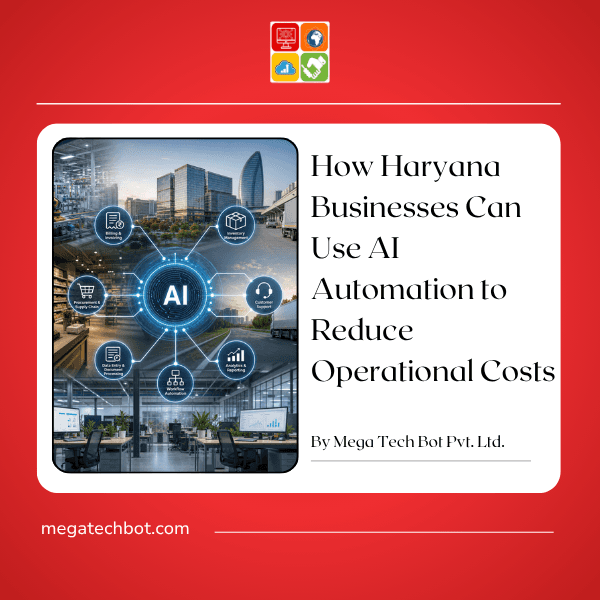

Overview
Haryana's business landscape is remarkably diverse. On one end, Gurugram's high-rise offices house IT and fintech companies; on the other, Panipat's textile units, Faridabad's auto-component manufacturers, and Sonipat-Rohtak's agri-processing and trading businesses form a completely different economic backbone. Every industry looks different on the surface, but they all share one common pain point: operational costs keep climbing while margins keep shrinking.
Raw material costs, labour, rent, compliance, and logistics are all getting more expensive. In this environment, businesses that are smartly automating their internal processes are the ones pulling ahead. And this isn't just a large-corporate strategy anymore — small and medium enterprises (SMEs) across Haryana are increasingly exploring AI automation to reduce repetitive work, improve efficiency, and control operational costs.
This article breaks down how Haryana businesses can practically apply AI automation — which departments to prioritize, what tools are available, and what kind of real cost savings to expect.
Haryana's Business Ecosystem: A Quick Snapshot
Before diving into automation, it helps to understand where operational costs typically bite hardest across Haryana:
Gurugram & Manesar: IT services, fintech, corporate offices — the biggest cost driver here is manpower and customer support operations
Faridabad: Auto-components and engineering goods manufacturing — costs concentrate in inventory management, quality control, and supply chain coordination
Panipat: Textile and handloom exports — costs come from order processing, vendor coordination, and export documentation
Sonipat & Rohtak: Agri-trading and FMCG distribution — costs are driven by logistics tracking and dealer/distributor communication
Ambala & Karnal: Trading and retail businesses — costs concentrate in accounting, GST compliance, and billing
Each sector faces cost pressure from a different direction, but the solution is largely similar: automate repetitive, manual, rule-based tasks with AI.
Where Operational Costs Actually Hide
Most business owners assume their biggest cost is raw material or rent. But if you dig deeper, hidden operational costs often cause more damage than either of those:
Employee time wasted on repetitive data entry
Manually responding to customer queries (and losing leads to slow response times)
Manually tracking inventory, leading to stockouts or overstocking
Manually following up on invoices and payments
Manually handling HR processes like attendance, payroll, and onboarding
Manually managing marketing content and social media
None of these tasks directly generate revenue, but they consume salary, time, and introduce errors. These are exactly the areas where AI automation delivers the most impact.
1. Customer Support Automation: AI Chatbots and Voice Bots
Customer support is a significant cost for small and medium businesses — especially in high-salary markets like Gurugram.
What can be automated:
AI chatbots on WhatsApp and websites to handle FAQs, order status, and basic queries
AI voice bots that triage incoming calls and route them to the right department
24/7 availability without hiring extra staff
Cost impact:
Hiring dedicated customer-support staff can represent a significant recurring cost for growing businesses, particularly as support volumes increase.
An AI chatbot can handle a significant share of routine queries, potentially reducing the amount of manual support work required.
Real scenario: Illustrative example:
A textile export business in Panipat could automate its WhatsApp order-status queries with a chatbot. For example, staff who previously spent several hours each day responding to order-status messages could instead focus on sales and customer relationships just replying to "where is my order" messages. Now the bot handles 80% of these queries, freeing staff time for actual sales conversations.
2. Accounting and GST Workflow Automation
In India, compliance is a continuous cost — GST filing, TDS, invoice reconciliation, and book-keeping. Doing this manually is both slow and error-prone.
What can be automated:
AI-powered invoice reading (OCR + AI) that automatically categorizes vendor bills
Automated invoice reconciliation and accounting workflows, with integration possibilities depending on the existing accounting system and available technical interfaces.
Automated payment reminders and follow-ups for outstanding invoices
AI-based expense categorization for faster monthly closing
Cost impact:
The time an accountant or bookkeeper spends manually entering monthly invoices can drop by up to 70% with automation. This directly shifts their billable hours toward higher-value work like financial planning.
3. Inventory and Supply Chain Automation
Whether it's Faridabad's manufacturing units or Sonipat's agri-traders, inventory mismanagement eats directly into profit.
What can be automated:
AI-based demand forecasting using historical sales data
Automated reorder alerts when stock falls below a threshold
Vendor performance tracking through AI dashboards
Barcode/RFID integration with AI-based stock reconciliation
Cost impact:
Overstocking blocks capital; understocking loses sales. AI-driven forecasting can help businesses optimize inventory levels, reduce overstocking, and improve purchasing decisions. The actual financial impact depends on the business, data quality, and implementation.
4. HR and Payroll Automation
Small business owners often handle HR themselves — attendance, leave approvals, payroll calculations — which eats into their strategic time.
What can be automated:
AI-based attendance tracking (face recognition/biometric integration)
Automated payroll calculations and workflows supporting applicable statutory requirements such as PF and ESI.
AI chatbots for employee queries (leave balance, salary slips, policy questions)
Automated onboarding workflows for new hires
Cost impact:
HR automation can reduce the amount of manual administrative work involved in routine HR processes especially for companies in the 10-50 employee range where a full-time HR team isn't financially viable.
5. Marketing and Content Automation
Digital marketing is an area where businesses heavily depend on agencies — which gets expensive fast.
What can be automated:
AI-generated social media content calendars
Automated email marketing sequences based on customer behavior
AI-powered ad copy generation and A/B testing
Chatbot-driven lead qualification before the sales team gets involved
Cost impact:
In-house content production with AI assistance and human oversight can help teams produce content more efficiently and increase their overall output allowing the same team to produce more output without adding headcount.
6. Sales and Lead Qualification Automation
Many Haryana businesses (especially B2B) waste significant sales-team time chasing cold leads.
What can be automated:
AI-based lead scoring that identifies which leads are "hot"
Automated follow-up sequences via WhatsApp/email
CRM integration that automatically categorizes and assigns leads
Cost impact:
Sales teams spend their time only on qualified leads, improving conversion rates and reducing cost-per-acquisition.
Comparison: Manual Process vs AI Automation
Business Function | Manual Process Cost/Time | With AI Automation | Approx. Savings |
Customer Support | 2 staff, 8 hrs/day | 1 staff + AI chatbot | Potential reduction in manual workload |
Invoice & GST Processing | 3-4 days/month manual entry | Same-day automated processing | Can significantly reduce manual processing time |
Inventory Management | Manual stock counts, frequent errors | Real-time AI tracking | Can help reduce overstocking and improve inventory efficiency |
HR & Payroll | Dedicated HR executive | HR software + minimal oversight | Can reduce routine administrative workload |
Marketing Content | Agency retainer ₹25,000-50,000/month | AI-assisted in-house production | Can increase content-production efficiency |
Lead Follow-up | Manual calling/messaging | Automated sequences + AI scoring | Potentially higher conversion efficiency and lower manual follow-up effort |
The potential benefits described above are illustrative and vary based on business size, process complexity, data quality, existing systems, and implementation approach. Actual results should be evaluated based on the specific business process and baseline performance.
Data Security and DPDP Act Compliance
Whenever AI automation is implemented, especially involving customer data (phone numbers, payment info, addresses), businesses that process personal data should consider applicable requirements under the Digital Personal Data Protection Act, 2023 and the Digital Personal Data Protection Rules, 2025, along with other applicable laws and contractual requirements.
Where and how personal data is stored and processed, including any applicable requirements relating to data transfers and third-party processing
Whether appropriate notice, consent, and other applicable legal requirements are addressed
Whether data-sharing agreements with third-party AI vendors are transparent
This is something businesses often overlook when using cheap, generic AI tools — but over time it can turn into a real legal risk.
How to Choose the Right AI Automation Partner
There are plenty of generic, off-the-shelf AI tools available — but every business's workflow is different. A textile exporter's process looks nothing like an IT consulting firm's. So simply "buying an AI tool" isn't enough — custom implementation is essential, one that can work with a business's existing systems, such as accounting software, ERP platforms, CRM systems, and other business tools, depending on their technical capabilities.
This is exactly where Mega Tech Bot Pvt. Ltd. comes in for Haryana businesses.
Implementing AI Automation with Mega Tech Bot
Mega Tech Bot Pvt. Ltd. provides custom software, cloud, and IT services built specifically around how Indian SME and B2B businesses actually operate. In the context of AI automation, Mega Tech Bot helps with:
Auditing your business processes to identify where automation will have the biggest cost-saving impact
Building custom AI and automation solutions around existing business systems, with third-party integrations explored where technically supported and appropriate.
Designing solutions with relevant Indian business, data-protection, and regulatory requirements considered from the outset.
Providing local support and ongoing maintenance, something generic international SaaS tools often can't offer
Whether you're a growing IT consulting firm in Gurugram, a manufacturing unit in Faridabad, or an export business in Panipat — Mega Tech Bot designs AI automation strategy around your specific operations, rather than forcing you into a generic template.
Getting Started: A Practical Road map
If you want to start implementing AI automation in your business, here's a simple approach:
Audit — Identify which tasks are repetitive and time-consuming
Prioritize — Start automating where the most time/cost is being wasted (usually customer support or accounting)
Pilot — Start small before a full-scale rol out
Train your team — AI tools deliver the most value when your team is comfortable using them
Measure — Track cost and time savings to establish clear ROI
Understanding where your business's operational costs are leaking — and using AI automation to plug those leaks — is no longer a luxury. It's becoming a necessity as competition intensifies across every industrial belt in Haryana.
Connect with Mega Tech Bot Pvt. Ltd. for a free process audit of your business, and identify where AI automation could reduce manual work, improve efficiency, and potentially lower operational costs across your specific business processes.
FAQs (AEO-Optimized)
Q1: What is AI automation and how does it reduce operational costs?
AI automation means using software to automatically perform repetitive, rule-based business tasks — like customer replies, data entry, or inventory tracking — reducing the need for manual labour and cutting time costs.
Q2: Can small businesses afford AI automation?
Yes. Modern AI automation tools are scalable — small businesses can start with a single process (like a WhatsApp chatbot or invoice automation) rather than overhauling their entire system at once.
Q3: How long does it take to implement AI automation?
Implementation timelines vary depending on the complexity of the workflow, integrations, data requirements, testing, and business requirements. Simple automations may take less time, while complex enterprise integrations can require significantly longer.
Q4: Will AI automation replace employees?
AI automation does not necessarily mean replacing employees. In many businesses, it can handle repetitive tasks and allow employees to focus on higher-value activities. The impact on roles depends on the type of work and how automation is implemented.
Q5: Which department should Haryana businesses automate first?
It depends on the business type — customer-facing businesses benefit most from support automation, manufacturers from inventory automation, and trading businesses from accounting/GST automation for the fastest ROI.
Disclaimer: The information provided in this article is for general informational purposes only and does not constitute legal, tax, accounting, or professional advice. AI automation benefits, cost savings, implementation timelines, and compliance requirements vary depending on the business, systems, data involved, and implementation approach. Businesses should obtain appropriate professional advice before making decisions involving statutory compliance, personal data, taxation, employment, or other regulated matters.