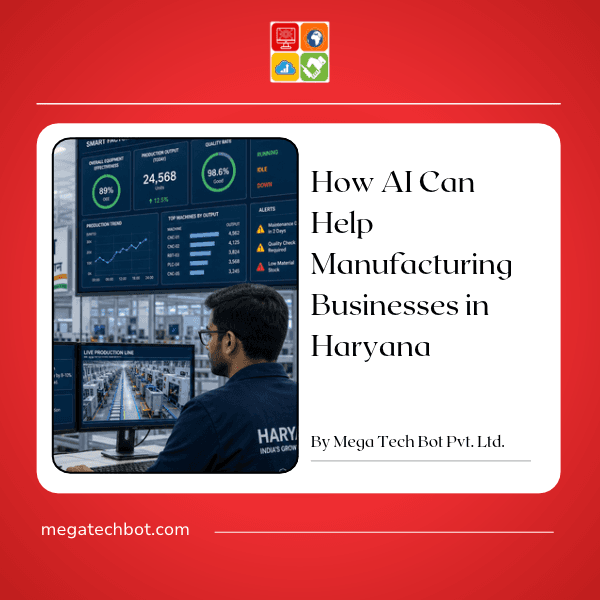

Overview
Manufacturing businesses in Haryana are operating in an increasingly competitive environment where production efficiency, quality, cost control, workforce productivity, and faster decision-making directly influence business growth. From automotive and auto components to textiles, food processing, engineering, electronics, pharmaceuticals, and other industrial sectors, manufacturers are looking for practical ways to improve operations without unnecessarily increasing costs.
One technology creating new opportunities for manufacturers is Artificial Intelligence (AI).
AI is no longer limited to large technology companies. Manufacturing businesses, including small and medium-sized enterprises, can use AI for predictive maintenance, quality inspection, production planning, inventory forecasting, demand prediction, process automation, customer support, data analysis, and decision-making.
For manufacturing companies in Haryana, AI can be particularly relevant because the state has a strong industrial and MSME ecosystem. The Directorate of MSME, Haryana identifies sectors such as auto and auto-components, light engineering, agro-based and food processing, textiles and apparel, electronics, defence and aerospace, renewable energy, pharmaceuticals, and chemicals among its focus or thrust sectors.
This creates significant opportunities for businesses to combine manufacturing expertise with modern technologies such as AI automation, machine learning, computer vision, predictive analytics, and intelligent business systems.
But what exactly can AI do for a manufacturing business?
Let's understand it step by step.
What Is AI in Manufacturing?
AI in manufacturing refers to the use of artificial intelligence technologies to analyse data, identify patterns, automate repetitive decisions, predict future outcomes, and improve manufacturing processes.
Traditional manufacturing systems generally work according to predefined rules.
For example:
A machine operates according to programmed instructions.
Inventory is reordered after reaching a predefined level.
Quality inspection may depend on manual checking.
Production planning may depend heavily on spreadsheets and experience.
Maintenance may happen according to a fixed schedule.
AI can make these processes more intelligent.
Instead of simply following predefined rules, an AI-powered system can analyse historical and real-time data to identify patterns and support better decisions.
For example, an AI system could analyse machine temperature, vibration, operating hours, and historical breakdown data to identify signs that a machine may require maintenance.
Similarly, AI-powered computer vision can inspect products and identify certain visible defects much faster and more consistently than manual inspection alone.
This is why AI for manufacturing companies is increasingly becoming a practical business tool rather than simply a futuristic concept.
Why Should Manufacturing Businesses in Haryana Consider AI?
Haryana has a diverse industrial ecosystem, including established manufacturing companies, MSMEs, engineering businesses, auto-component manufacturers, food-processing units, textile businesses, and emerging technology-oriented industries.
The Haryana Directorate of MSME states that its objectives include technology upgradation, innovation, research, cluster development, quality improvement, and helping MSMEs become more competitive.
The state's official MSME ecosystem also highlights manufacturing among its industry categories and reports a substantial MSME ecosystem across Haryana.
For manufacturers, this means technology adoption is not simply about buying new software. It is about improving how the business operates.
AI can help manufacturers address common operational challenges such as:
Production delays
Machine downtime
Manual data entry
Quality control issues
Excess inventory
Material shortages
Poor demand forecasting
Repetitive administrative work
Production planning challenges
High operational costs
Slow reporting
Inconsistent decision-making
Difficulty analysing large amounts of business data
The objective should not be to introduce AI everywhere.
The objective should be to identify where AI can create measurable business value.
10 Ways AI Can Help Manufacturing Businesses in Haryana
1. Predictive Maintenance
Unexpected machine breakdowns can disrupt an entire production line.
A machine failure may result in:
Production downtime
Delayed orders
Emergency repair costs
Labour idle time
Missed delivery schedules
Reduced production capacity
Traditional maintenance often follows a fixed schedule.
For example, a machine might be serviced every three months regardless of its actual condition.
With AI predictive maintenance, businesses can analyse machine-related data and identify patterns associated with potential failures.
Depending on the available infrastructure, data may include:
Machine temperature
Vibration
Operating hours
Energy consumption
Pressure
Speed
Error codes
Maintenance history
Production cycles
AI models can analyse these signals and identify unusual patterns.
Example
Suppose an industrial machine normally operates within a particular vibration range.
Over several days, the vibration gradually increases.
An AI-based predictive maintenance system can detect this change and alert the maintenance team before the machine reaches a critical failure condition.
This allows the business to schedule maintenance instead of reacting to an unexpected breakdown.
For Haryana manufacturers operating high-value machinery, this can make AI automation for manufacturing particularly useful.
2. AI-Powered Quality Control
Quality control is one of the most important applications of AI in manufacturing.
Manual inspection can be time-consuming, especially when employees need to inspect thousands of products.
Computer vision AI can analyse images or video from cameras installed on production lines.
The system can be trained or configured to identify certain visible characteristics such as:
Scratches
Cracks
Incorrect assembly
Surface defects
Missing components
Shape abnormalities
Colour inconsistencies
Packaging problems
Label placement issues
For example, an automotive component manufacturer can use AI-based visual inspection to identify visible defects before components move to the next stage of production.
AI does not necessarily replace human quality teams.
Instead, it can help them focus on exceptions, complex inspections, root-cause analysis, and quality improvement.
This combination of AI and human expertise can create a more efficient quality-control process.
3. Production Planning and Scheduling
Production planning becomes increasingly complex as the number of products, machines, employees, raw materials, and customer orders increases.
A manufacturing company may need to consider:
Available machines
Production capacity
Raw materials
Employee availability
Delivery deadlines
Product priorities
Machine maintenance
Existing orders
Production lead times
AI can analyse these variables and help generate more efficient production schedules.
For example, an AI-powered manufacturing system can analyse historical production data and current orders to identify possible scheduling conflicts.
It can help answer questions such as:
Which orders should be prioritised?
Which machine should handle a particular production job?
Where could a production bottleneck occur?
How could production be scheduled around planned maintenance?
This can support production managers in making data-driven decisions rather than relying only on spreadsheets or manual calculations.
4. Demand Forecasting
Producing too much can increase inventory and storage costs.
Producing too little can result in stockouts, delayed deliveries, and lost business.
Demand forecasting is therefore critical for manufacturers.
AI can analyse historical sales and operational data to identify demand patterns.
Depending on the business, the system may analyse:
Previous sales
Seasonal trends
Product demand
Customer orders
Regional demand
Historical production
Inventory levels
Market trends
Promotional activity
For example, a food-processing manufacturer may experience seasonal changes in demand.
An AI forecasting model can analyse historical demand patterns and help the company plan inventory and production accordingly.
AI-based demand forecasting should not be treated as a guaranteed prediction. It is a decision-support tool whose usefulness depends on data quality, business conditions, and model design.
5. Inventory Management
Inventory management is another area where AI can provide significant value.
Manufacturers need to maintain the right balance between availability and cost.
Too much inventory can tie up working capital.
Too little inventory can interrupt production.
AI can analyse historical consumption, purchasing patterns, production requirements, lead times, and demand data to support inventory planning.
An intelligent inventory system can help identify:
Fast-moving materials
Slow-moving inventory
Frequently used raw materials
Potential stockouts
Excess inventory
Reordering patterns
Supplier lead-time trends
For manufacturing companies in Haryana, this can be particularly useful where businesses manage large numbers of raw materials, components, finished goods, or suppliers.
AI can also work alongside existing inventory management software or ERP systems rather than requiring an organisation to completely replace its existing infrastructure.
6. AI Automation of Repetitive Office Tasks
AI is not limited to the factory floor.
A manufacturing company has many administrative processes that involve repetitive work.
Examples include:
Data entry
Invoice processing
Report generation
Document classification
Email categorisation
Purchase order processing
Customer enquiry handling
Internal reporting
Data extraction
Employee queries
These processes can consume valuable employee time.
AI automation can reduce repetitive manual work by connecting business applications and automating defined workflows.
For example:
Customer enquiry → AI classification → Sales team notification → CRM update → Follow-up task
Or:
Purchase invoice → Data extraction → Verification → Accounting system → Approval workflow
The goal is not simply automation for the sake of automation.
The goal is to allow employees to spend more time on activities that require human judgement, communication, problem-solving, and strategic thinking.
7. AI for Energy Management
Energy can be a significant operational cost for manufacturing businesses.
Factories may use electricity for:
Production machinery
HVAC systems
Compressors
Motors
Lighting
Cooling systems
Heating systems
Material handling equipment
AI can analyse energy consumption patterns and help businesses identify unusual usage or opportunities for efficiency improvements.
For example, if energy consumption increases significantly during a particular production period, AI-based analytics can help identify correlations between:
Machine usage
Production volume
Shift timings
Equipment performance
Energy consumption
This information can support better operational decisions.
AI can therefore contribute to smart manufacturing by connecting production data with energy data.
8. AI-Powered Employee and Workforce Support
Manufacturing businesses depend heavily on their workforce.
Employees may need information about:
Standard operating procedures
Machine instructions
Safety processes
Product specifications
Maintenance procedures
Quality standards
Internal policies
An AI-powered internal assistant can help employees find relevant information quickly from approved company documentation.
For example, an employee could ask:
"What is the inspection procedure for this product?"
The AI assistant can retrieve the relevant information from the company's approved knowledge base.
This can be especially useful for large organisations where information is distributed across documents, manuals, spreadsheets, and internal systems.
However, safety-critical information should always be controlled through appropriate procedures and verified documentation.
9. AI-Based Business Analytics
Manufacturing companies generate large amounts of data.
Data may come from:
Production systems
ERP software
Inventory systems
Sales systems
Accounting systems
Machines
Quality systems
Procurement systems
CRM platforms
The challenge is not always collecting data.
The challenge is understanding it.
AI-powered analytics can help convert raw data into useful business insights.
For example, management may want to know:
Which product has the highest production cost?
Which machine causes the most downtime?
Which raw material has the highest consumption variance?
Which customer orders generate the highest margins?
Where are production delays occurring?
Which products have increasing rejection rates?
Instead of manually analysing multiple spreadsheets, management can use dashboards and AI-assisted analytics to identify important patterns more quickly.
10. AI for Customer Service and Sales
Manufacturing companies often have complex customer enquiries.
Customers may ask about:
Product availability
Specifications
Pricing
Delivery timelines
Order status
Technical information
Product documentation
An AI chatbot or AI assistant can handle routine enquiries and provide information from approved business data.
For example:
Customer: "What is the status of my order?"
The system can retrieve the relevant order information from the connected business system and provide an appropriate response.
Sales teams can also use AI to:
Summarise customer interactions
Generate follow-up reminders
Draft emails
Analyse customer enquiries
Categorise leads
Identify frequently requested products
Prepare sales reports
This can improve response speed while allowing sales teams to focus on high-value customer interactions.
AI for Different Manufacturing Industries in Haryana
AI applications will differ depending on the industry.
Haryana's officially identified focus sectors include automotive and auto-components, light engineering, agro-based and food processing, textiles and apparel, electronics, defence and aerospace, renewable energy, pharmaceuticals, and chemicals.
AI for Automotive and Auto-Component Manufacturers
Possible applications include:
Computer vision quality inspection
Predictive maintenance
Production optimisation
Defect detection
Inventory forecasting
Supplier analytics
Production scheduling
Automotive manufacturing often involves high production volumes and strict quality requirements, making data-driven automation particularly relevant.
AI for Textile Manufacturing
AI can support:
Fabric defect detection
Production monitoring
Demand forecasting
Inventory planning
Quality inspection
Equipment maintenance
Computer vision can be particularly useful for detecting certain visible textile defects.
AI for Food Processing
AI can support:
Demand forecasting
Inventory planning
Quality monitoring
Production scheduling
Packaging inspection
Supply-chain analytics
Food-processing businesses can combine AI with existing production and inventory systems to improve planning and operational visibility.
AI for Engineering and Industrial Businesses
Engineering companies can use AI for:
Predictive maintenance
Quality inspection
Production planning
Inventory optimisation
Document processing
Business analytics
Customer support
Haryana's MSME ecosystem includes multiple engineering and manufacturing clusters, including engineering, sheet metal, fabrication, textile, apparel, auto, fasteners, foundry, and related clusters.
AI Automation vs Traditional Automation: What's the Difference?
Traditional automation follows predefined rules.
For example:
If inventory < 100 units → Generate purchase alert.
AI-based automation can analyse more variables.
For example:
Based on historical demand, current orders, supplier lead time, seasonal patterns, and inventory consumption, identify whether a purchase should be planned and flag the requirement for review.
The difference is important.
Traditional automation is generally rule-based.
AI systems can be data-driven and pattern-based.
However, AI does not replace traditional automation.
The two can work together.
A manufacturing business may use:
ERP + IoT + Automation + AI + Analytics
to create a connected digital manufacturing environment.
What Data Does a Manufacturing Company Need for AI?
AI requires data.
But businesses do not necessarily need massive amounts of data before starting.
Useful data can include:
Production records
Machine logs
Maintenance records
Quality inspection results
Inventory transactions
Sales history
Purchase history
Customer orders
Energy consumption
Employee or shift data
Supplier information
The quality and consistency of data are extremely important.
If business data is incomplete, duplicated, inconsistent, or inaccurate, AI results may also be unreliable.
This is why an AI implementation should normally begin with a data assessment.
How to Start AI Implementation in a Manufacturing Business
Manufacturers do not need to transform their entire factory overnight.
A phased approach is often more practical.
Step 1: Identify the Business Problem
Start with the problem, not the technology.
For example:
Machine downtime is increasing.
Quality inspection is slow.
Inventory is too high.
Production planning takes too long.
Employees spend too much time entering data.
Choose one measurable problem.
Step 2: Assess Available Data
Identify where the relevant information currently exists.
It may be stored in:
ERP software
Excel files
Production software
Machine systems
Databases
CRM
Accounting software
Step 3: Select the Right AI Use Case
Not every problem requires AI.
Some problems may be solved with traditional automation, workflow software, dashboards, or process improvements.
AI should be selected when it provides a meaningful advantage.
Step 4: Build a Pilot Project
Start small.
For example:
One production line + one quality problem + one AI vision system.
Or:
One machine category + predictive maintenance model.
A pilot allows the company to evaluate the technology before expanding it.
Step 5: Measure Results
Define measurable KPIs.
Examples include:
Downtime
Rejection rate
Production output
Inventory holding
Processing time
Labour hours spent on repetitive tasks
Energy consumption
Order-processing time
Step 6: Scale the Solution
If the pilot produces measurable value, the company can gradually expand the solution across additional machines, departments, production lines, or facilities.
Common Challenges of AI Adoption in Manufacturing
AI can create opportunities, but implementation also comes with challenges.
Poor Data Quality
AI depends on reliable data.
If historical data is incomplete or inconsistent, the resulting model may not perform as expected.
Integration With Existing Systems
Manufacturers may already use ERP, accounting, inventory, production, or machine-control systems.
AI solutions may need to integrate with these systems.
Employee Adoption
Employees need to understand how the new system works and how it affects their roles.
Training and communication are therefore important.
Cybersecurity
Connected machines, databases, APIs, cloud platforms, and AI systems increase the importance of cybersecurity.
Manufacturers should consider:
Access controls
Authentication
Data encryption
Network security
Backup procedures
Vendor security
Data governance
Cost
AI implementation costs vary significantly depending on the use case, infrastructure, data availability, integrations, hardware, and project scope.
Businesses should therefore evaluate AI based on measurable business value rather than simply choosing the most advanced technology available.
Is AI Only for Large Manufacturing Companies?
No.
Small and medium-sized manufacturing businesses can also adopt AI.
In fact, a smaller business can sometimes start with a narrowly defined use case.
For example:
Small manufacturer
AI-powered document processing for purchase invoices.
Medium-sized manufacturer
AI-powered inventory forecasting.
Larger manufacturer
Computer vision + predictive maintenance + production analytics across multiple production lines.
The appropriate starting point depends on the company's operational challenges, data availability, technology infrastructure, and budget.
Haryana's MSME ecosystem specifically places emphasis on technology upgradation, innovation, quality improvement, and competitiveness.
How Mega Tech Bot Pvt. Ltd. Can Help Manufacturing Businesses With AI
For a manufacturing company, implementing AI is not simply about adding an AI chatbot to a website.
A practical AI strategy should begin with the business process.
Mega Tech Bot Pvt. Ltd. software company in Hisar, can help businesses explore AI automation opportunities across their operations, including business process automation, intelligent software solutions, data-driven systems, and custom technology development.
A manufacturing AI project can potentially involve:
AI Automation
Automate repetitive business processes and reduce manual work.
Custom Software Development
Build software around the specific operational requirements of a manufacturing business.
AI-Powered Business Systems
Connect business data and workflows to create more intelligent decision-support systems.
Data Analytics
Convert business data into dashboards and actionable insights.
Workflow Automation
Connect departments and systems to reduce repetitive administrative processes.
AI Integration
Integrate AI capabilities with existing business applications where appropriate.
The exact solution should depend on the company's requirements rather than following a one-size-fits-all model.
For a manufacturing business in Haryana, the first step can be a technology and process assessment to identify where AI can realistically create measurable value.
AI and the Future of Manufacturing in Haryana
The future of manufacturing is increasingly connected, data-driven, and automated.
AI is one component of this transformation.
Other technologies include:
Internet of Things (IoT)
Robotics
Cloud computing
Computer vision
Industrial automation
Digital twins
Predictive analytics
ERP systems
Business intelligence
Cybersecurity
The real opportunity comes from combining these technologies.
For example:
Machine Sensors → Data Collection → Cloud/Database → AI Analysis → Alert → Human Decision → Automated Workflow
This creates a connected manufacturing environment where businesses can move from simply recording what happened to understanding why it happened and identifying what may happen next.
Haryana's industrial policies and MSME initiatives also place emphasis on technology, innovation, infrastructure, and competitiveness. The state's MSME Directorate highlights technology upgradation, research, innovation, market access, and integration into global value chains among its areas of support.
This makes digital transformation increasingly relevant for businesses looking to improve their operational capabilities.
Frequently Asked Questions About AI in Manufacturing
How can AI help manufacturing companies?
AI can help manufacturing companies analyse data, automate repetitive processes, predict equipment issues, improve quality inspection, forecast demand, optimise inventory, support production planning, and provide business insights.
What is AI automation in manufacturing?
AI automation combines artificial intelligence with automated workflows to perform or support tasks that traditionally require repetitive human effort or manual decision-making.
Examples include intelligent document processing, predictive maintenance alerts, automated reporting, quality inspection, and demand forecasting.
Can small manufacturing businesses use AI?
Yes. Small manufacturing businesses can start with focused AI use cases such as document automation, demand forecasting, inventory analysis, customer support, or quality inspection.
How does AI improve manufacturing quality?
AI-powered computer vision can analyse product images or video and identify predefined visual defects or abnormalities. This can support quality teams by making inspections faster and helping identify recurring defect patterns.
Can AI reduce machine downtime?
AI can support predictive maintenance by analysing machine and maintenance data to identify patterns associated with potential equipment problems. It does not guarantee that every failure will be predicted, but it can provide an additional layer of monitoring and decision support.
How much does AI implementation cost for a manufacturing company?
There is no single price. Cost depends on the AI use case, number of machines or processes involved, software requirements, data availability, integrations, hardware, infrastructure, and implementation scope.
A focused pilot is often a practical way to evaluate potential value before a larger investment.
Does AI replace manufacturing employees?
AI can automate or assist with specific tasks, but manufacturing still requires human expertise, supervision, engineering knowledge, quality judgement, maintenance skills, management, and decision-making.
In many applications, AI is best viewed as a tool that supports employees rather than simply replacing them.
What is predictive maintenance?
Predictive maintenance uses equipment data and analytical models to identify patterns that may indicate developing equipment problems. This can help maintenance teams plan interventions before some failures occur.
What is computer vision in manufacturing?
Computer vision uses cameras and AI-based image analysis to inspect products, components, packaging, or processes for defined visual characteristics or defects.
How can a manufacturing company start using AI?
Start by identifying one business problem with measurable impact. Assess the available data, select an appropriate AI or automation approach, run a pilot, measure the results, and then decide whether to scale the solution.
Conclusion
AI can provide manufacturing businesses in Haryana with practical opportunities to improve productivity, quality, maintenance, inventory planning, production visibility, and administrative efficiency.
The biggest mistake is to treat AI as a technology trend that must be adopted everywhere.
Instead, manufacturers should ask:
Where are we losing time?
Where are we losing money?
Where are employees performing repetitive work?
Where do we have valuable data but limited visibility?
Where could better predictions improve decisions?
Those questions can reveal the right opportunities for AI.
Whether it is predictive maintenance, AI quality inspection, demand forecasting, inventory optimisation, production analytics, document automation, or intelligent workflow automation, the right AI solution should be connected to a real business objective.
For manufacturing companies across Gurugram, Faridabad, Manesar, Panipat, Sonipat, Rohtak, Rewari, Hisar, Ambala, Karnal, and other industrial areas of Haryana, AI can become part of a broader digital transformation strategy.
Mega Tech Bot Pvt. Ltd. software company in Hisar, helps businesses explore technology solutions based on their specific operational requirements. If your manufacturing business is looking to identify suitable AI automation opportunities, the process should begin with understanding your existing workflows, data, systems, and business goals.
AI is not about making manufacturing complicated. The goal is to make business operations more intelligent, measurable, and efficient.
Also Read
How Haryana Businesses Can Use AI Automation to Reduce Operational Costs