Overview
For many years, businesses in Hisar have relied on familiar ways of working: registers, spreadsheets, phone calls, WhatsApp messages, paper files, and manually prepared reports. These methods may work when a business is small, but as operations grow, managing everything manually becomes increasingly difficult.
Today, businesses are handling more customers, larger teams, higher transaction volumes, multiple locations, online enquiries, digital payments, inventory, employee data, customer communication, and reporting. Managing all of this through disconnected manual processes can create delays, duplicate work, data errors, and unnecessary operational costs.
This is one of the reasons businesses are increasingly exploring technology and custom software solutions that are designed around their actual workflows.
Hisar is an important and growing urban centre in Haryana, serving not only the local population but also businesses and customers from surrounding areas. The district's official administration itself highlights the city's growing importance as an urban centre and its role in serving adjoining areas of Rajasthan and Punjab.
At the same time, technology adoption is becoming a more visible part of business operations. The District Information Technology Society, Hisar, has an explicit objective of promoting the IT ecosystem and supporting implementation of e-governance and digital service delivery.
For local businesses, the question is no longer simply whether they should use technology. The more practical question is:
What technology can actually solve the operational problems that are slowing the business down?
This is where a software company in Hisar can play an important role—not simply by building software, but by understanding a business's processes and converting repetitive manual work into connected digital workflows.
What Is Driving Businesses Away from Manual Processes?
The transition from manual operations to software does not usually happen because a business suddenly wants "new technology."
It happens because the existing process starts becoming difficult to manage.
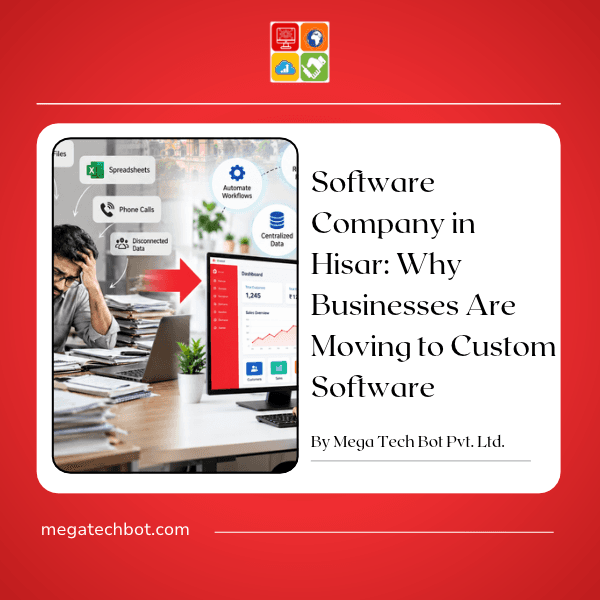
A business may begin with one employee maintaining customer records in a notebook. Later, the same information may be moved to Excel. Another employee may keep a separate spreadsheet for payments. Sales enquiries may remain in WhatsApp. Inventory information may be stored somewhere else.
Individually, each method appears manageable.
Together, they create an operational problem.
As the business grows, employees spend more time:
Entering the same information multiple times
Searching for customer records
Preparing reports manually
Following up with customers
Checking inventory
Reconciling payments
Updating spreadsheets
Sharing information between departments
Tracking employee activities
Correcting data-entry mistakes
The business may continue functioning, but the cost of manual work quietly increases.
This is often the point where companies begin looking for a software development company in Hisar that can create a solution around their specific requirements.
1. Manual Data Entry Takes More Time as Businesses Grow
One of the biggest problems with manual processes is repetitive data entry.
Consider a simple customer enquiry.
A customer contacts a business through a phone call or website.
The employee may record the customer's information in a notebook.
Later, the same information may be entered into Excel.
When the customer makes a purchase, the details may be entered again into accounting software.
If the customer contacts the business again, an employee may need to search through previous records to understand the history.
This creates unnecessary duplication.
A custom software solution can bring these activities into one connected workflow.
For example:
Customer Enquiry → Customer Record → Follow-Up → Quotation → Order → Payment → Customer History
Instead of entering the same information repeatedly, the relevant data can move through the workflow.
This does not mean every business needs a complicated ERP system.
Sometimes a simple custom application that solves one specific operational problem can create a significant improvement.
That is one of the advantages of working with a software company in Hisar that first studies the business process instead of immediately recommending a generic product.
2. Excel Is Useful—Until the Business Outgrows It
Excel remains an extremely useful business tool.
It is flexible, affordable, and familiar.
The problem begins when businesses start using multiple spreadsheets for processes that require real-time coordination.
For example, a company may have separate Excel files for:
Customers
Leads
Sales
Inventory
Employees
Payments
Expenses
Suppliers
Orders
Reports
Now imagine five employees updating different files.
One employee changes a customer's phone number.
Another employee still has the old number.
The sales team updates an order.
The accounts team does not know about the change.
The inventory team has another version of the data.
This creates what can be called a data consistency problem.
Custom business software can provide a centralized database where authorized users work with the same information.
Instead of asking:
"Which Excel file is the latest?"
the organization can work from a centralized system.
3. Businesses Need Faster Access to Information
Business decisions often depend on information.
How many enquiries came this week?
Which products are selling?
Which customers need follow-up?
How much inventory is available?
Which invoices are pending?
How much revenue was generated?
Which employees are handling the most tasks?
When these answers require manually collecting information from different files, reports can take hours.
A well-designed software system can turn operational data into dashboards and reports.
For example, a sales dashboard could display:
Total enquiries
New customers
Follow-ups pending
Orders generated
Revenue
Outstanding payments
Conversion trends
This changes the role of data.
Instead of being something employees simply record, data becomes something management can use for decision-making.
4. Customer Expectations Are Changing
Customers increasingly expect businesses to respond quickly.
Whether they are contacting a retailer, service provider, manufacturer, education business, healthcare organization, or professional service company, customers generally do not want to repeatedly provide the same information.
They expect businesses to know:
Who they are
What they previously purchased
What issue they reported
What enquiry they made
Whether someone has followed up
What payment is pending
What service they requested
This is difficult when customer information exists across notebooks, WhatsApp conversations, spreadsheets, and different employee devices.
A CRM or custom customer-management system can centralize this information.
The objective is not simply to "digitize" customer data.
The objective is to create a better customer workflow.
5. Business Automation Reduces Repetitive Work
Automation is becoming one of the major reasons businesses invest in custom software.
But automation does not necessarily mean artificial intelligence or complex robotics.
Sometimes automation means something as simple as:
When an enquiry is received → create a lead automatically.
Or:
When an order is confirmed → update inventory automatically.
Or:
When an invoice becomes overdue → create a follow-up reminder.
Or:
When a customer submits a form → send the information to the appropriate team.
These small automations can remove repetitive administrative work.
Over time, dozens of small improvements can significantly change how a business operates.
This is where business automation software becomes valuable.
Instead of employees remembering every step, the system can execute predefined workflows.
6. Custom Software Can Match the Way a Business Actually Works
Generic software is designed for a broad audience.
Custom software is designed around a particular business process.
This distinction matters.
Imagine two businesses in the same industry.
Both may sell products.
But one may operate through distributors while another sells directly to consumers.
One may require multiple approval levels.
The other may need delivery scheduling.
One may operate from a single location.
The other may manage multiple branches.
A generic software package may force both businesses into the same workflow.
A custom application can be designed around their actual requirements.
This is why businesses searching for custom software development in Hisar often begin by documenting their current workflow.
The first question should not be:
"Which software should we buy?"
It should be:
"Which business problem are we trying to solve?"
7. Custom Software Can Connect Different Departments
Businesses often operate in departments, but customers experience the organization as one company.
Consider a typical sales process.
The sales team receives an enquiry.
The quotation is prepared.
The customer confirms the order.
The accounts team receives payment information.
The operations team prepares the order.
The inventory team updates stock.
Management wants the final report.
If every department works independently, employees need to communicate manually at every stage.
A connected system can create a workflow such as:
Lead → Sales → Order → Accounts → Operations → Inventory → Delivery → Reporting
Each department receives the information it needs.
This reduces unnecessary communication gaps and makes responsibilities easier to track.
8. Mobile Apps Are Becoming Part of Business Operations
Business software is no longer limited to desktop computers.
Employees may work from offices, stores, warehouses, customer locations, or field sites.
A mobile application can allow employees to:
Check customer information
Update leads
Record attendance
Submit expenses
Track tasks
Update orders
Upload documents
Check inventory
Receive notifications
Communicate with teams
For businesses with field employees, mobile applications can be especially useful.
Instead of waiting for employees to return to the office and update records, information can be captured closer to the point where the activity happens.
A mobile app development company in Hisar can help businesses design applications around these specific operational requirements.
9. Websites Are No Longer Just Digital Brochures
For many businesses, the website is now part of the sales and customer-service process.
A modern business website can:
Generate enquiries
Accept bookings
Display products
Collect customer information
Process payments
Integrate CRM systems
Connect with WhatsApp
Support customer accounts
Provide self-service options
For example, instead of a customer calling a business to ask whether a service is available, the website could provide the relevant information and collect an enquiry automatically.
This reduces the workload on employees while making it easier for customers to interact with the company.
Businesses looking for web development services in Hisar should therefore consider the website as part of the broader business workflow rather than as an isolated marketing asset.
10. AI Is Adding Another Layer of Business Automation
Artificial intelligence is increasingly becoming part of business software.
However, businesses do not necessarily need AI everywhere.
The useful approach is to identify processes where AI can provide practical value.
Examples include:
Automated customer-support responses
Lead classification
Document processing
Data extraction
Content generation
Sales insights
Customer communication
Internal knowledge search
Report summarization
Predictive analysis
For example, a company receiving hundreds of customer enquiries could use AI to categorize enquiries before sending them to the appropriate employee.
The objective should be simple:
Use AI where it removes meaningful work or improves decision-making.
A technology partner can help identify where AI automation makes business sense rather than adding AI simply because it is trending.
11. Better Security and Access Control
Manual systems also create security challenges.
A physical file can be misplaced.
An Excel sheet can be accidentally deleted.
A shared password can be passed between employees.
Sensitive customer or employee information may be accessible to people who do not need it.
Business software can introduce structured access controls.
For example:
Administrator → Full Access
Manager → Department-Level Access
Employee → Assigned Tasks and Records
Accounts Team → Financial Information
The exact structure depends on the business.
The goal is to make sure employees can access the information required for their work while sensitive information remains controlled.
Data backup, authentication, access permissions, activity logs, and secure infrastructure should also be considered when implementing business software.
12. Reporting Becomes Easier
Management needs visibility.
Without accurate reporting, business decisions can become dependent on assumptions.
A software solution can automatically generate reports based on operational data.
Examples include:
Sales Reports
Daily sales
Monthly revenue
Sales by employee
Sales by product
Customer acquisition
Financial Reports
Receivables
Payments
Expenses
Outstanding invoices
Revenue trends
Inventory Reports
Current stock
Low-stock items
Fast-moving products
Slow-moving products
Stock movement
Employee Reports
Attendance
Tasks
Productivity metrics
Leave
Work allocation
The exact reports should be determined by the business's decision-making requirements.
13. Manual Processes Become More Expensive as a Business Scales
A manual process that works for ten customers may become difficult with 1,000 customers.
A spreadsheet that works for one location may become difficult when a company has five branches.
One employee may be able to manage a small inventory manually.
But as the number of products increases, tracking every movement becomes more difficult.
This creates an important principle:
The problem with manual processes is not always that they are bad. The problem is that they often do not scale efficiently.
Technology becomes valuable when business complexity increases.
The purpose of software is therefore not to replace every manual activity.
It is to identify repetitive, error-prone, time-consuming processes that can be handled more efficiently.
14. What Types of Businesses Can Benefit from Custom Software?
Custom software is not limited to large corporations.
Businesses of different sizes can use software solutions when they have specific operational requirements.
Retail Businesses
Retailers may benefit from:
Inventory management
Billing
Customer management
Supplier management
Sales reports
Multi-location management
Manufacturing Businesses
Manufacturers may require:
Production tracking
Inventory
Purchase management
Order management
Quality control
Employee workflows
Reporting
Service Businesses
Service organizations can use software for:
Customer management
Appointment scheduling
Service requests
Employee allocation
Billing
Follow-ups
Educational Organizations
Schools, coaching institutes, and educational businesses may require:
Student management
Attendance
Fees
Communication
Examination
Staff management
Reports
Healthcare Businesses
Healthcare organizations may need:
Appointment management
Patient records
Billing
Staff management
Notifications
Reporting
Professional Services
Consultants, agencies, and professional firms can benefit from:
Lead management
Client management
Task tracking
Project management
Billing
Document management
The right software depends on the organization's workflow rather than simply its industry.
15. Why Local Businesses May Consider a Software Company in Hisar
When choosing a technology partner, businesses have several options.
They can work with an overseas provider, a large national company, a remote development team, or a local technology company.
A local software company in Hisar can offer an additional advantage: proximity.
Business owners can discuss requirements directly, understand the development process, explain local operational challenges, and receive support without dealing with significant geographic or communication barriers.
For many organizations, technology implementation involves more than writing code.
It involves understanding:
How the business operates
How employees currently work
What customers expect
Where information is lost
Which processes are repetitive
What management needs to see
What should be automated
Which integrations are necessary
A local technology partner can therefore act as a technology consultant as well as a development partner.
16. What Should Businesses Look for in a Software Development Partner?
Choosing a software provider should not be based only on price.
Businesses should evaluate the entire development and support process.
1. Requirement Understanding
Can the company understand your workflow before suggesting a solution?
2. Development Capability
Does it have experience building web applications, mobile apps, APIs, dashboards, or business software?
3. Scalability
Can the solution support future growth?
4. Security
How will user access, authentication, backups, and sensitive information be handled?
5. Integration
Can the software connect with existing tools and services where required?
6. User Experience
Can employees actually use the system easily?
7. Support
What happens after deployment?
8. Customization
Can the system evolve as the business changes?
These questions can help businesses evaluate technology partners based on long-term requirements rather than simply initial development cost.
17. Custom Software Does Not Mean Building Everything from Scratch
There is a common misconception that custom software means developing every component from zero.
That is not necessarily the case.
Modern software development can combine:
Custom application development
APIs
Cloud infrastructure
Third-party integrations
Payment gateways
Communication platforms
AI services
Authentication systems
Analytics tools
The development team can build the parts that are unique to the business while integrating reliable external services where appropriate.
This can make the solution more practical and cost-effective.
18. The Right Way to Start a Software Project
Businesses should avoid starting with a long list of features.
Instead, begin with the problem.
For example:
Problem: Sales employees are losing track of follow-ups.
Then identify the workflow:
Enquiry → Lead → Follow-Up → Reminder → Quotation → Conversion
Then identify the software requirement:
CRM + Follow-Up Automation + Dashboard
This approach prevents businesses from spending money on unnecessary features.
A structured software project usually follows steps such as:
Step 1: Understand the Business
Document the current workflow.
Step 2: Identify Bottlenecks
Find where time, money, or information is being lost.
Step 3: Define Requirements
Decide what the software must actually accomplish.
Step 4: Design the User Experience
Make the system simple for employees to use.
Step 5: Develop the Solution
Build the required functionality and integrations.
Step 6: Test
Check functionality, security, usability, and performance.
Step 7: Deploy
Launch the software in the required environment.
Step 8: Train Users
Employees should understand how and why to use the new system.
Step 9: Improve
Software should evolve as business requirements change.
19. The Goal Is Not "Going Digital"—It Is Working Better
Digital transformation is sometimes reduced to purchasing software.
But buying software does not automatically improve a business.
If the software does not match the workflow, employees may continue using spreadsheets and WhatsApp alongside it.
The real objective should be operational improvement.
That means:
Less repetitive work.
Fewer information gaps.
Faster access to data.
Better visibility.
More consistent processes.
Easier communication.
Better customer experience.
More informed decision-making.
Technology should support the business—not make the business adapt unnecessarily to technology.
Why Mega Tech Bot Pvt. Ltd.?
Mega Tech Bot Pvt. Ltd. works with businesses that want to use technology to solve practical business problems.
Instead of treating software development as simply a coding exercise, the focus can be placed on understanding the business requirement, identifying the workflow, and designing an appropriate digital solution.
Depending on the requirement, businesses may explore solutions such as:
Custom Software Development
Web Application Development
Mobile App Development
Website Development
UI/UX Design
CRM Solutions
Business Automation
AI Automation
API Integration
Business Management Systems
The right solution will always depend on the specific business process.
For one company, the biggest requirement may be a CRM.
For another, it may be a mobile application.
Another business may need an internal management dashboard.
A growing company may need several systems integrated into one workflow.
The important thing is to start with the business problem.
Frequently Asked Questions
What does a software company in Hisar do?
A software company in Hisar can provide services such as custom software development, website development, mobile application development, business automation, CRM development, AI solutions, UI/UX design, API integration, and other technology services.
The exact services depend on the company's expertise and the client's requirements.
Why should a business consider custom software?
Businesses may consider custom software when existing tools do not adequately support their workflows. Custom software can be designed around specific operational requirements, helping businesses manage processes, data, users, and integrations according to their needs.
Is custom software suitable for small businesses?
Yes. Custom software can be useful for small businesses when they have a specific problem that generic software does not solve efficiently. However, the scope should be appropriate to the business's current and expected requirements.
Is custom software better than ready-made software?
There is no universal answer. Ready-made software can be suitable when its features closely match the business requirements. Custom software may be useful when a business has unique workflows, integration requirements, or specialized operational needs.
How much does custom software development cost in Hisar?
The cost depends on factors such as the project's scope, number of users, features, platforms, integrations, UI/UX requirements, security requirements, development time, and ongoing support.
A reliable estimate should be prepared after understanding the business requirements rather than using a single fixed price.
Can custom software integrate with existing systems?
Yes, depending on the systems involved and the APIs or integration options available. Custom applications can often be connected with existing software, payment systems, communication platforms, databases, or other business tools.
Can businesses automate repetitive tasks?
Yes. Automation can be used for workflows such as lead assignment, notifications, reminders, order processing, reporting, data synchronization, customer communication, and other repetitive processes.
Do businesses need AI in their software?
Not necessarily. AI should be used when it solves a meaningful business problem. Businesses can first identify repetitive or data-heavy processes and then determine whether AI can improve those workflows.
How long does it take to develop custom software?
Development time varies significantly depending on the project's complexity. A simple internal application may require considerably less time than a multi-module business platform involving mobile applications, integrations, dashboards, and complex workflows.
What should I discuss with a software development company?
Businesses should discuss their current workflow, problems, users, required features, integrations, security requirements, expected growth, budget, timeline, deployment requirements, and post-launch support.
The Future of Business Software in Hisar
Businesses in Hisar are operating in an environment where customers expect faster communication, employees work across multiple channels, and management needs access to information quickly.
At the same time, digital infrastructure and technology adoption continue to become more important across organizations. Hisar's government infrastructure already includes multiple digital services, e-governance initiatives, and IT-focused institutional mechanisms.
For local businesses, this creates an opportunity to rethink how everyday operations are managed.
The transition does not have to happen overnight.
A company can start with one process.
Automate customer enquiries.
Digitize inventory.
Create a centralized CRM.
Build a mobile application.
Connect sales and accounts.
Automate reporting.
Then expand the system as the business grows.
The important shift is from asking:
"Do we need software?"
to asking:
"Which part of our business should software improve first?"
That question leads to more practical technology decisions.
Conclusion
The movement from manual processes to custom software solutions is not simply about adopting new technology.
It is about removing operational friction.
As businesses grow, notebooks, spreadsheets, disconnected applications, and repetitive manual processes can become increasingly difficult to manage. Custom software provides an opportunity to connect workflows, centralize information, automate repetitive activities, improve reporting, and create systems that are designed around the way a business actually operates.
For businesses looking for a software company in Hisar, the most important consideration should therefore be more than development capability.
Look for a technology partner that understands the business problem first.
Because the goal of software should not be to add another system to the organization.
The goal should be to make the organization work better.
Mega Tech Bot Pvt. Ltd. helps businesses explore practical technology solutions across custom software development, web development, mobile applications, UI/UX, AI automation, and business automation.
If your business is still spending significant time on repetitive manual processes, it may be time to identify which workflow should be digitized first.
Also Read
How to Choose the Right Software Company in Hisar for Your Business Needs