Overview
Managing schools with traditional systems often leads to inefficiencies, delays, and increased administrative workload. To overcome these challenges, schools are now adopting school management software , ERP systems and digital learning platforms to streamline operations and improve student outcomes.
By automating repetitive tasks, centralizing data, and enabling real‑time collaboration, the right software can free up teachers, admins, and parents to focus on what truly matters: teaching and learning.
In this blog, we’ll explore practical ways schools can use software to increase operational efficiency, reduce administrative workload, and enhance communication and student performance and why adopting a school ERP system is becoming essential for schools in 2026.
1. Automate Routine Administrative Tasks with ERP Software
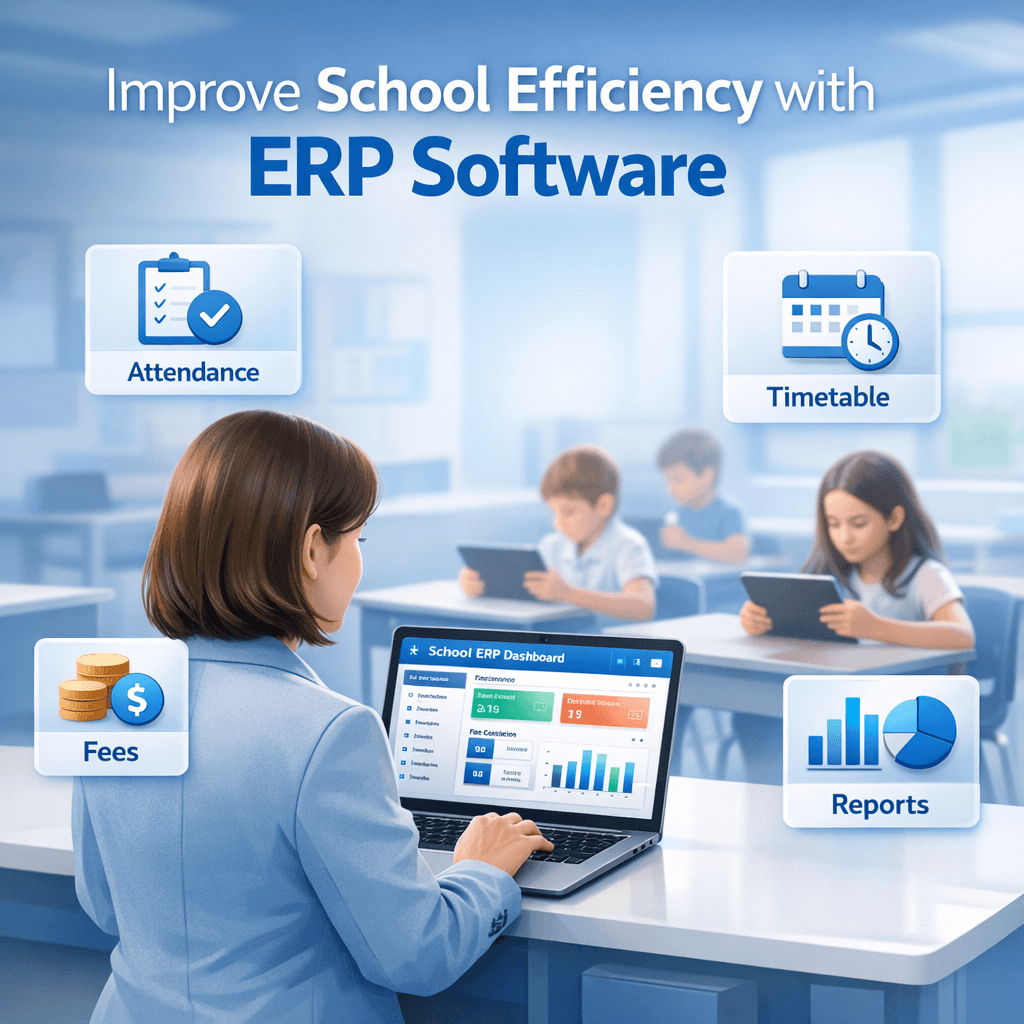
One of the biggest benefits of school management software is the ability to automate everyday operations that previously took hours or days to complete manually. Tasks such as student enrollment, attendance tracking, timetable creation, fee management, and report‑card generation can all be handled through a centralized school ERP system.
When schools adopt cloud‑based school management platforms, staff no longer need to chase paper registers, fill out spreadsheets, or manually update records. Instead, the system:
Capture attendance in real time via biometric devices or teacher apps
Automatically calculate attendance percentages and identify absentee trends
Send fee‑due reminders and maintain digital payment records.
This automation of school administration reduces human error, speeds up workflows, and allows principals and coordinators to make data‑driven decisions instead of reacting to missing paperwork.
2. Centralize School Operations with an ERP System
A school ERP system(Enterprise Resource Planning) is specialized software designed to manage all school operations from a single, unified dashboard.
Instead of using separate tools and registers, an ERP integrates all core functions, including:
Student Management: admissions, profiles, medical records
Academic Management: timetables, exams, grading, report cards
Finance & Fees: invoices, payments, refunds, concessions
Human Resources: staff attendance, leaves, payroll
Communication Tools: parent portals, notifications, announcements
By bringing all these functions under one school management system, schools eliminate data silos, reduce duplicated efforts, and ensure that every department—front‑office, academics, finance, and leadership—works from the same accurate information.
For example, when a student is transferred to a new class, the ERP automatically updates their timetable, class teacher, and fee records instead of requiring separate updates in multiple registers and spreadsheets.
Solutions like Zeanius School ERP provide a fully centralized platform where schools can manage academics, finance, staff, and communication seamlessly from one place.
3. Simplify Attendance and Student Behavior Tracking
Traditional attendance registers are time‑consuming and hard to analyze. Modern school attendance software and student management systems simplify this process by automating tracking and reporting.
With digital systems, schools can:
Bulk attendance marking for each period.
Integration with biometric devices or mobile apps for automatic log‑ins.
Generate real-time attendance reports for students and classes.
Beyond attendance, many school ERP solutions also track student behavior, discipline records, and extracurricular activities.
This centralized data helps schools:
Identify absenteeism patterns early
Detect behavioral issues before they escalate
Provide targeted counseling and academic support
Support teachers with real‑time insight into which students may need extra help.
By transforming raw attendance and behavior data into actionable insights, schools can significantly improve student performance and overall discipline management.
With solutions like Zeanius School ERP, schools can track attendance, behavior, and performance from a single dashboard—making monitoring simple, accurate, and efficient.
4. Streamline Fee Management and Financial Operations
Managing fee collection, scholarships, concessions, and refunds manually is one of the most time‑ intensive parts of school administration that often leads to errors, delays, and lack of transparency. Modern school ERP systems with fee management modules help schools to simplify and automate the entire financial workflow.
With digital fee management, schools can:
Generate automated fee invoices and digital receipts.
Send SMS, WhatsApp, or email reminders before due dates
Track pending payments and generate overdue reports.
Integrate with bank gateways for online fee payments.
This digital fee management reduces queues at the admin office, minimizes cash handling, and improves transparency for parents.
Most importantly, it gives the management a clear view of cash flow, enabling better budgeting, planning, and financial decision-making.
With platforms like Zeanius School ERP, schools can collect fees online, automate reminders, and manage finances from a single dashboard—making fee management faster, smarter, and more secure.
5. Optimize Timetables and Resource Allocation
Creating and adjusting timetables manually is a complex task that can consume weeks every academic year. Modern school ERP systems with timetable management software automate this process using smart rules and constraints.
With digital timetable systems, schools can:
Automatically assign teachers, subjects, and classes.
Prevent scheduling conflicts between teachers and shared resources
Adjust timetables for leaves, events, and holidays instantly
Once the timetable is in place, the system can also track how classrooms, labs, and equipment are used. This resource utilization data helps schools optimize schedules, reduce idle time, and save costs over time.
For example, a school ERP system might show that If certain labs or classrooms are underutilized on specific days, the system highlights these gaps—allowing schools to reorganize schedules and maximize resource usage efficiently.
With solutions like Zeanius School ERP, schools can generate conflict-free timetables in minutes and optimize resource usage with real-time insights.
6. Improve Parent Communication with School ERP Systems
Effective school‑parent communication is crucial for student success and school reputation. Instead of relying solely on notice boards, circulars, and random calls, schools can use Modern school ERP systems with integrated communication tools enable seamless, real-time interaction between schools and parents.
With digital communication platforms, schools can:
Use parent-teacher communication apps for instant messaging and updates
Send automated SMS, WhatsApp, or email alerts for attendance, exams, events, and fees
Provide access to parent portals for report cards, fee receipts, and announcements
These tools help schools:
Reduce repetitive calls and front-office workload
Keep parents informed in real time, building trust and transparency
Enable teachers to share feedback, updates, and performance insights efficiently
Strengthen parent-school relationships through continuous engagement
For schools aiming to build strong parent‑school partnerships, digital communication platforms are a powerful efficiency booster.
With platforms like Zeanius School ERP, schools can connect with parents instantly through mobile apps, notifications, and portals—ensuring transparent and real-time communication.
7. Empower Teachers with Digital Lesson Planning and Assessment Tools
Modern school management software often includes tools for teachers, such as:
Digital lesson planning templates and curriculum mapping.
Assignment management features (uploading tasks, setting deadlines, tracking submissions).
Online grading and feedback tools that auto‑generate marks and comments.
With these features, teachers can:
Avoid loss or misplacement of physical assignment registers.
Provide faster, more consistent feedback using saved comment banks.
Access performance dashboards that show how each student is progressing.
Additionally, integration with Learning Management Systems (LMS) or student portals allows teachers to upload notes, videos, and activities, enabling students to revisit lessons anytime and reducing repeat explanations in class.
8.Simplify Examination and Report Card Management
Exams and report card preparation are among the most time-consuming and high-pressure tasks for schools. Manual processes often lead to errors, delays, and inconsistencies. Modern school ERP systems with examination management modules automate and streamline the entire process.
With digital exam management, schools can:
Schedule exams and generate seating arrangements automatically
Process results quickly and generate mark sheets instantly
Auto-rank students and identify grading inconsistencies
After exams, the system can:
Generate report cards and progress reports automatically
Create class-wise and subject-wise performance analytics
Highlight trends such as weak areas and top-performing students
After exams, the system can pull data from multiple assessments and automatically:
Generate report cards and progress reports.
Create class‑wise and subject‑wise performance summaries.
Highlight trends such as common weak areas or exceptional performance.
This automated exam and reporting system reduces manual workload, minimizes errors, and allows leadership to focus on instructional improvement rather than paperwork.
With platforms like Zeanius School ERP, schools can generate report cards in multiple formats, automate result processing, and gain deep academic insights—all from a single system.
9. Enable Data‑Driven Decision Making with ERP Analytics
Many schools still rely on intuition rather than data to make decisions about staffing, budgets, and academic programs. Modern school ERP systems with advanced analytics and reporting tools empower schools to make informed, data-driven decisions.
With integrated analytics, schools can:
Track attendance, academic performance, behavior, and resource utilization
Providing dashboards and analytics that show trends over time.
Generating customizable reports for different stakeholders (board, principals, teachers, parents).
These insights help school leaders to:
Identify subjects or classes with consistently low performance
Improve teaching strategies and staff training
Analyze fee collection trends and optimize financial planning
Make better decisions on infrastructure, staffing, and expansion
Example:
A principal can instantly identify weak-performing subjects and take corrective action, while management can use financial data to plan future investments or adjust fee structures.
Transforming raw school data into actionable insights is one of the most powerful ways software improves long‑term efficiency.
With Zeanius School ERP, schools get powerful dashboards and real-time analytics that turn everyday data into strategic insights for smarter decision-making.
10. Empower Mobility with Mobile Apps
Modern school ERP systems with mobile applications allow schools to manage operations anytime, anywhere—without being limited to desktop systems.
With mobile apps, different users can perform tasks on the go:
Admins & Coordinators: monitor operations, access reports, and manage school activities remotely
Teachers: mark attendance, update grades, check timetables, and share updates instantly
Parents: view attendance, track fees, access report cards, and receive important announcements
These school mobile apps break the dependency on physical registers and desktop systems and allow users to perform critical tasks from anywhere, at any time. Example:
Teachers can mark attendance during assemblies, admins can send urgent notifications instantly, and parents can stay updated about their child’s progress—all from their smartphones.
By enabling mobility, schools create a connected, flexible, and always-accessible ecosystem.
11. Strengthen Security and Data Backup
Schools manage highly sensitive data related to students, staff, academics, and finances—making security and data protection a critical priority.
Modern school ERP systems with advanced security features ensure that all information is protected, accessible only to authorized users, and safely backed up.
With secure school management platforms, institutions benefit from:
Role-based access control: Different access levels for admins, teachers, parents, and students
Data encryption: Protection of sensitive data during storage and transmission
Secure login systems: Multi-layer authentication and controlled access
Automated cloud backups: Regular data backups with disaster recovery support
By using secure school software, institutions reduce the risk of data leaks, lost records, or unauthorized access. This not only protects privacy but also ensures that operations can continue smoothly even if hardware fails.
By implementing a secure ERP system, schools can operate with confidence, knowing that their data is protected, compliant, and always available when needed.
With Zeanius School ERP, schools benefit from secure cloud infrastructure, role-based access, and automatic backups—ensuring complete data safety and reliability.
12. Reduce Costs and Improve Resource Efficiency
While implementing a school ERP system requires an initial investment, the long-term cost savings and operational efficiency gains are significant.
With digital school management systems, institutions can:
Reducing the need for paper registers and physical storage.
Cutting down on manual labor and overtime.
Optimizing fee collection and financial planning.
Schools can lower operational costs and redirect funds toward better teaching resources, infrastructure, or staff development. In many cases, the return on investment (ROI) of a good school ERP system becomes visible within a few academic years.
13. How to Choose the Right Software for Your School
Not every school management system or school ERP is equally suited to all institutions. When selecting software, schools should consider:
Before selecting a school ERP system, institutions should evaluate:
School Type & Size: Primary, secondary, K-12, or higher secondary institutions have different requirements
Budget & Pricing Model: One-time cost vs subscription-based plans
Integration Capabilities: Compatibility with payment gateways, email systems, and LMS platforms
Language & Accessibility: Multi-language support and mobile app availability
Vendor Reliability: Customer support, training, and long-term service commitment
Additionally, schools should look for:
Easy-to-use interface for staff and teachers
Scalability to support future growth
Customization options based on school needs
Popular options in the market include school management software for Indian schools, cloud‑based school ERP platforms, and global school management systems that cater to different school types and curricula.
14. Implementing Software Successfully
Implementing a school ERP system is not just about installing software—it requires a well-planned strategy to ensure smooth adoption and maximum impact.
To successfully implement school management software, institutions should follow these key steps:
Clear communication with staff and parents about the changes.
Training for teachers, admins, and office staff on how to use the system.
Phased rollout rather than sudden, full‑scale replacement of old processes.
Regular feedback collection and system optimization.
A well‑planned rollout ensures adoption, reduces resistance, and maximizes the benefits of the software.
With Zeanius School ERP, schools receive complete onboarding support, training, and step-by-step implementation guidance—ensuring a smooth and hassle-free transition.
15. The Future of School Management with AI and Analytics
As artificial intelligence (AI) and predictive analytics become more common in school management platforms
Modern school ERP platforms are moving beyond basic automation to intelligent systems that can:
Provide AI‑powered attendance insights that predict absenteeism risks.
Personal learning dashboards that recommend resources for struggling students.
Automated enrollment and admission workflows that guide parents through the process.
The future of school management lies in smart, connected, and AI-powered ecosystems—where data is not just stored, but actively used to guide better outcomes.
Conclusion: Transforming School Efficiency with Smart Technology
From school management software and school ERP systems to mobile communication apps and online assessment tools, digital solutions are reshaping how schools operate. By automating administrative tasks, centralizing data, and enhancing communication, schools can significantly improve efficiency, reduce workload, and create a more focused, student‑centric environment.
Whether you’re running a small private school or a large K‑12 institution, investing in the right software can transform everyday operations, boost staff satisfaction, and ultimately lead to better learning outcomes for students.
In today’s competitive and fast-evolving education landscape, investing in a modern school ERP system is no longer optional—it’s essential for growth, efficiency, and long-term success.
For More Details