
Overview
Many businesses lose customers every day because their website looks outdated, loads slowly, or feels identical to competitors. You’ve probably seen websites that look almost exactly the same except for the logo and colors — customers notice that too.
“Today, people judge your business within seconds of opening your website. If the site feels slow, outdated, or confusing, most visitors simply leave and check your competitor instead.”
This is where one major question comes in: custom vs template websites—which is truly better for driving growth? “Custom websites give businesses more freedom because the design and features are built specifically for their workflow and customers.” while templates offer speed and affordability. For businesses , startups, or enterprises in Haryana, or beyond, choosing wrong can cost time, money, and conversions.
This guide breaks it down with pros, cons, real-world examples, and key factors to decide. By the end, you’ll clearly understand whether a custom website vs template is the right investment for your business growth in 2026. —optimized for SEO, user experience, and ROI.
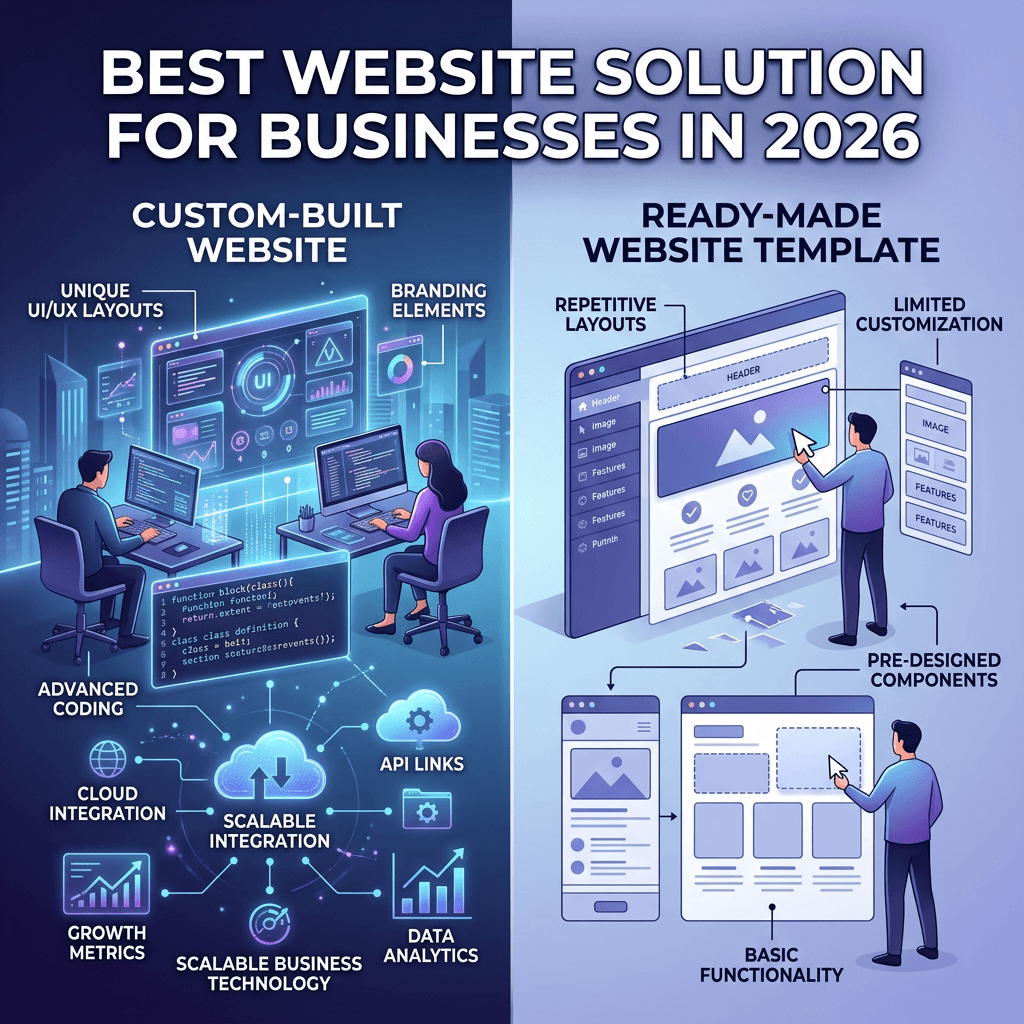
What Are Template Websites?
Template websites use pre-designed layouts from platforms like WordPress, Wix, Squarespace, or Shopify. Instead of building everything from scratch, businesses simply choose a design, update the content, change colors or images, and launch much faster.
For many startups and small businesses, template websites are often the easiest way to get online quickly without spending a huge amount on development.
Pros of Template Websites
Faster Setup: A website can go live within days instead of weeks or months. This is useful for startups, local businesses, cafés, freelancers, and small online stores.
Lower Cost: Template websites are usually much more affordable than custom-built websites, making them a practical option for businesses with limited budgets.
Easy to Manage: Most platforms offer drag-and-drop editing, so business owners can update content, images, blogs, or products without technical knowledge.
Mobile-Friendly: Most modern templates already work well on mobiles, tablets, and desktops, which also helps with SEO.
Plugins & Ready-Made Features: Businesses can easily add contact forms, payment gateways, WhatsApp chat, SEO tools, booking systems, and e-commerce features without custom coding.
For example, a local café in Haryana could use a Shopify template to start accepting online orders within a weekend without hiring a full development team.
Cons of Template Websites
Limited Customization: Businesses often have to adjust according to the template layout instead of building exactly what they want.
Slower Performance: Many templates include extra code and features that can slow down the website, especially on mobile devices.
Generic Design: Many template websites look similar, making it harder for businesses to create a unique brand identity.
Scalability Issues: Templates work well initially, but growing businesses may face limitations with advanced features, integrations, or high traffic.
Security Risks: Since thousands of websites use the same themes and plugins, common vulnerabilities are easier for hackers to target.
Template websites are a great option for businesses that need a quick and affordable online presence, but growing businesses often move to custom development later for better flexibility and scalability.
What Are Custom Websites?
Custom websites are built specifically for a business instead of using ready-made templates. Developers create them from scratch using technologies like HTML, CSS, JavaScript, React, Laravel, or other modern frameworks.
This gives businesses complete flexibility in design, features, performance, and scalability based on their actual requirements.
Pros of Custom Websites
Total Uniqueness: Pixel-perfect design reflecting your brand. No "cookie-cutter" vibes.
Superior Performance: Optimized code means faster speeds, better SEO, and higher conversions (e.g., 7% lift per second saved).
Scalability: Handles high traffic, complex features like AI chatbots or custom CRMs effortlessly.
SEO Mastery: Built-in schema markup, clean URLs, and fast indexing from day one.
Future-Proof Security: Bespoke code with enterprise-grade protections.
Take Mega Tech Bot Pvt. Ltd.: Our custom sites for Haryana tech firms integrate AI analytics, scaling from 1K to 100K users seamlessly. A template couldn't match that.
Cons of Custom Websites
Higher Upfront Cost: $5,000–50,000+, depending on complexity.
Longer Timeline: 4–12 weeks for development and testing.
Maintenance Needs: Requires ongoing developer support (though tools like GitHub ease this).
Skill Barrier: Can't DIY; hire pros like those at Mega Tech Bot.
Custom wins for growing businesses in competitive fields like SaaS or e-commerce.
Custom vs Template Websites: Head-to-Head Comparison
Feature | Template Websites | Custom Websites |
Cost | Low ($100–5K initial) | High ($5K–100K+) |
Build Time | 1–7 days | 1–3 months |
Customization | Medium (themes/plugins) | Fully customizable |
Performance | Average (can bloat) | Excellent (optimized code) |
SEO Potential | Good (with plugins) | Superior (bespoke) |
Scalability | Limited | Unlimited |
Maintenance | Easy (self-manage) | Pro-needed |
Best For | Startups, portfolios | Enterprises, high-traffic brands |
Data from sources like BuiltWith shows 40% of top sites are custom-built for performance edge.
When Should You Choose a Template Website for Your Business?
Template websites are usually the better option when businesses need a fast and affordable online presence without complex functionality.
Opt for templates if:
You're bootstrapping a small business (e.g., local services in Charkhi Dadri).
Speed trumps perfection—launch now, iterate later.
Budget < $5K and features are basic (blog, contact form).
You handle updates yourself.
For businesses like:
local services
coaching institutes
cafés
salons
freelancers
portfolio websites
templates are often enough in the beginning.
Real Example: A freelance graphic designer uses Wix templates to showcase portfolios. Cost: $200/year. Result: Clients booked in weeks.
Templates save 70–80% on costs but limit branding.
When Custom Websites Are the Smart Investment
Custom websites become a smarter choice when businesses start focusing on long-term growth, branding, scalability, and advanced functionality.
Go custom if:
Your business scales fast (e.g., e-commerce hitting 10K orders/month).
Brand identity is key—think unique UX like Netflix's seamless streams.
You need integrations (ERP, custom APIs).
Long-term ROI matters: Custom sites recoup costs via 20–30% higher conversions.
Custom websites are commonly used for:
SaaS platforms
ERP systems
restaurant chains
large e-commerce stores
school management systems
enterprise businesses
Real Example: A Haryana manufacturing firm chose custom development. Result: Integrated inventory system cut errors by 50%, boosting revenue 3x.
Studies from Forrester confirm custom sites yield 2–5x ROI over 3 years.
Cost Breakdown: Custom vs Template Websites
Template Website : $100–500 theme + $10–100/month hosting + $0–2K plugins = $1K–5K/year.
Custom Website : $10K–50K build + $1K–5K/year maintenance/hosting.
Pro Tip: Hybrid approach—start with template, migrate to custom later (tools like Elementor help).
SEO and Performance: Why It Matters for Business Growth
Google favors fast, unique sites. Templates often hit Core Web Vitals snags; custom ones ace them.
Custom Edge: Lazy loading, CDNs, AMP-ready.
Template Hack: Minify code, good hosting (e.g., SiteGround).
For custom website vs template for small business, prioritize mobile-first indexing.
Future-Proofing: Hybrid Options and Trends
No need for extremes. Use:
Headless CMS: WordPress backend + custom frontend (e.g., Next.js).
No-Code Tools: Webflow for "custom-lite" at template speeds.
AI Builders: Tools like Framer generate semi-custom sites.
By 2026, 60% of sites will blend both (Gartner prediction).
Making the Right Choice for Your Business
Custom vs template websites boils down to stage and goals:
Early-Stage/Small Business: Template for speed.
Growth/Mid-Size: Custom for edge.
Enterprise: Always custom.
Audit your needs: Traffic? Budget? Tech stack? Test with a free template prototype.
At Mega Tech Bot Private Limited, we specialize in both template-based and custom website development for Indian as well as international businesses.
We help businesses build:
SEO-optimized websites
scalable web platforms
custom business systems
modern and high-performance websites tailored to their growth goals
Whether you need a fast business website or a fully custom platform, our team helps you choose the right solution based on your actual business requirements.
Also Read
Why Speed & UX Matter More Than Design in Modern Websites