Overview
"Your business isn't slow because your team isn't working hard. It's slow because your software wasn't built for the way your business actually works."
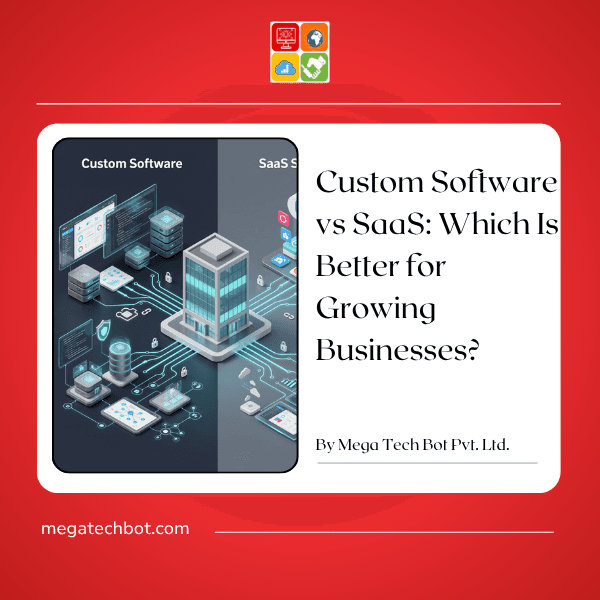
Every growing business eventually hits the same wall: the spreadsheets and off-the-shelf tools that worked fine at 10 employees start to creak at 50, and by 100 they're actively slowing the business down. At that point, a critical decision lands on the founder's or CTO's desk — do we buy a SaaS subscription, or do we build custom software? The bigger question isn't just "Which is cheaper?" It's "Which solution will still support your business when you've doubled your customers, expanded your team, and introduced new services?"
Choosing the wrong software today can lead to higher operational costs, disconnected systems, frustrated employees, and expensive migrations tomorrow. That's why understanding the difference between SaaS and custom software is essential before making a technology investment.
It's one of the most consequential technology decisions a growing business makes, and there's no universal right answer. The right choice depends on your budget, your timeline, how unique your workflows are, and where you expect to be in three years. This guide breaks down the real differences between custom software vs SaaS, when each makes sense, and how to make the decision with confidence.
What Is SaaS?
Software-as-a-Service (SaaS) is pre-built software hosted in the cloud and offered on a subscription basis — think Zoho, Salesforce, Freshworks, or industry-specific tools you pay for monthly or annually. You don't own the software; you rent access to it, and the vendor handles hosting, maintenance, updates, and security.
What Is Custom Software?
Custom software is built specifically for your business — its workflows, its data structures, its integrations, and its scale requirements — either in-house or by a development partner. You own the code, the architecture decisions, and the roadmap entirely.
Why This Decision Matters More Than Ever in 2026
Businesses today rely on software for almost every operation—from customer acquisition and sales to inventory, finance, HR, and support. As digital transformation accelerates, selecting software that aligns with your long-term business strategy has become a competitive necessity rather than just an IT decision.
Custom Software vs SaaS: The Core Comparison
Factor | SaaS | Custom Software |
Upfront Cost | Low to none | High (development investment) |
Time to Launch | Immediate to a few weeks | Weeks to several months |
Ongoing Cost | Recurring subscription, often per-user | Maintenance and hosting, no per-user fee |
Customization | Limited to vendor's feature set | Fully tailored to your workflows |
Scalability | Bound by vendor's plans and limits | Built to scale with your exact needs |
Data Ownership | Vendor-controlled, exportable | Fully owned by your business |
Integration Flexibility | Limited to available APIs/plugins | Unlimited, built to your exact stack |
Maintenance Responsibility | Handled by vendor | Handled by you or your dev partner |
Competitive Differentiation | None — same tool as competitors | Potential unique advantage |
Long-Term Cost (5+ years, at scale) | Often higher due to per-user pricing growth | Often lower once development cost is amortized |
Quick Decision Guide
If you... | Choose |
Need software this week | SaaS |
Have limited budget | SaaS |
Have unique workflows | Custom Software |
Want long-term scalability | Custom Software |
Need complete ownership | Custom Software |
Need basic functionality | SaaS |
The Case for SaaS
1. Speed to Value
SaaS tools are built to get you up and running fast. For a growing business that needs a CRM, accounting tool, or helpdesk system this quarter — not this year — SaaS is almost always the right starting point.
2. Lower Upfront Investment
There's no development cost, no hiring a dev team, and no six-month build cycle. You pay a subscription and start using the tool immediately, which preserves capital for other growth priorities.
3. Vendor-Managed Security and Updates
Reputable SaaS vendors handle security patching, uptime, compliance certifications, and feature updates as part of the subscription — work your team doesn't have to think about.
4. Proven, Battle-Tested Workflows
Established SaaS products have been refined across thousands of customers, meaning common workflows (invoicing, lead tracking, ticketing) are already well thought out and unlikely to have major usability gaps.
5. Predictable Budgeting
Subscription pricing is easy to forecast and budget for on a monthly or annual basis, which is valuable for finance teams at growing companies watching cash flow closely.
The Limits of SaaS as You Scale
SaaS starts to show cracks as businesses grow past a certain complexity threshold:
Per-user pricing compounds fast. A tool that costs ₹500/user/month feels trivial at 10 users and painful at 200.
Feature limitations become workflow constraints. You end up adapting your business processes to fit the software, instead of the other way around.
Integration gaps force manual workarounds. When your SaaS stack doesn't talk to your other systems, someone on your team becomes the human API, manually re-entering data.
Data portability concerns. Your business data lives inside someone else's platform, subject to their pricing changes, feature deprecations, or — in rare cases — the vendor shutting down entirely.
No competitive differentiation. If your biggest competitor uses the same SaaS tool with the same limitations, it can't become a source of advantage for either of you.
The Case for Custom Software
1. Built Around Your Exact Workflow
Custom software is designed around how your business actually operates, not a generic template that assumes every company in your industry works the same way. For businesses with unique processes — a specific manufacturing workflow, a proprietary pricing model, a multi-step approval chain — this alone can justify the investment.
2. Full Ownership and Control
You own the code, the data, and the roadmap. No vendor can raise prices unexpectedly, discontinue a feature you depend on, or change their terms of service in ways that disrupt your operations.
3. Scales Exactly the Way You Need
Custom software is architected for your specific growth trajectory — whether that means handling a spike in transaction volume, supporting a new business unit, or expanding into new markets — without hitting artificial plan-tier limits.
4. Deep, Native Integrations
Instead of working around API limitations from third-party SaaS vendors, custom software can integrate natively and deeply with your existing systems, from your ERP to your payment gateway to your internal reporting tools.
5. A Genuine Competitive Advantage
When your software is purpose-built for how you operate, it can become a real differentiator — faster operations, better customer experience, or capabilities your SaaS-dependent competitors simply can't replicate.
6. Better Long-Term Economics at Scale
While the upfront cost is higher, custom software doesn't carry the same escalating per-user subscription costs. For a business scaling from 50 to 500 employees, the total cost of ownership over five-plus years often favors custom-built solutions once the initial investment is amortized.
The Trade-Offs of Custom Software
Custom software isn't automatically the better choice — it comes with real trade-offs businesses need to plan for:
Higher upfront cost and longer timeline. Development takes weeks to months, and requires real budget commitment before any value is realized.
Ongoing maintenance responsibility. Unlike SaaS, you (or your development partner) are responsible for security patches, bug fixes, and infrastructure management.
Requires clear requirements and good scoping. Poorly scoped custom projects can run over budget and timeline — this is where choosing an experienced development partner matters enormously.
Not ideal for standard, well-solved problems. If your accounting needs are genuinely standard, there's little reason to custom-build.
How to Decide: A Practical Framework
Ask these questions to figure out where your business falls:
1. Is this workflow core to your competitive advantage, or is it a commodity function? Commodity functions (payroll, basic accounting, email) are usually better served by SaaS. Core differentiators (your unique service delivery model, proprietary processes) are strong candidates for custom software.
2. How fast do you need this live? If you need something running next week, SaaS wins by default. If you have a 2–4 month runway to plan and build, custom software becomes viable.
3. What does your growth curve look like over the next 3–5 years? If you expect to scale users, transaction volume, or complexity significantly, model out SaaS per-user costs at that future scale — the math often shifts in favor of custom software sooner than expected.
4. How many SaaS tools are you already stitching together? If your business runs on six different SaaS subscriptions that don't talk to each other cleanly, a custom platform that unifies those workflows can eliminate both cost and operational friction.
5. Does off-the-shelf software force you to change how you work? If you're constantly building manual workarounds around a SaaS tool's limitations, that's a strong signal the tool doesn't fit your business — and never fully will.
The Hybrid Approach: What Most Growing Businesses Actually Do
In practice, the smartest growing businesses rarely choose one path exclusively. They run SaaS for commodity functions — accounting, email, basic HR — while investing in custom software for the systems that are core to how they operate and compete: customer-facing platforms, internal operational tools, or industry-specific workflows that off-the-shelf software simply wasn't built to handle.
This hybrid model lets businesses move fast where speed matters and invest deeply where differentiation matters, without over-committing to either approach.
How Mega Tech Bot Helps Growing Businesses Make This Call
At Mega Tech Bot Pvt. Ltd., we work with growing Indian businesses navigating exactly this decision — and we don't come in with a one-size-fits-all answer. Our approach starts with understanding your operational reality before recommending a build.
Technology and workflow audits: We assess your current stack, identify where SaaS tools are creating friction, and pinpoint where custom development would deliver real ROI.
Custom software development: From internal operations platforms to customer-facing applications, our development team builds cloud-native, scalable software architected specifically around your business logic — not a generic template.
Cloud infrastructure and managed services: Whether you choose SaaS, custom-built software, or a hybrid stack, our cloud monitoring and managed security services ensure everything runs securely and reliably, with uptime and data protection built in from day one.
Seamless integrations: We connect custom-built systems with your existing SaaS tools — Tally, Razorpay, UPI payment gateways, and more — so you're not forced into an all-or-nothing decision.
Scalable architecture from the start: Every system we build is designed with your 3–5 year growth trajectory in mind, so you're not rebuilding from scratch the moment you outgrow version one.
Data security and compliance: Our development practices are built around India's DPDP Act requirements and industry-standard security frameworks, so custom software never means compromising on compliance.
Whether the right answer for your business is SaaS, custom software, or a hybrid of both, our job is to help you make that decision with clear-eyed cost and scalability analysis — not vendor bias.
Our Development Process
Every successful software project begins with understanding your business—not writing code.
Our process includes:
Business Process Analysis
Requirement Discovery Workshops
Solution Architecture Planning
UI/UX Design
Agile Software Development
Testing & Quality Assurance
Deployment & Cloud Setup
Ongoing Maintenance & Feature Enhancements
Final Thoughts
There's no universally "better" option in the custom software vs SaaS debate — only the option that's better for your business, at your current stage, given your growth trajectory and how central a given workflow is to your competitive advantage. SaaS wins on speed and low upfront cost for standard, commodity functions. Custom software wins on control, scalability, and long-term economics for the workflows that define how your business actually operates and competes.
The businesses that scale most efficiently aren't the ones that pick a side dogmatically — they're the ones that make this call function by function, with a clear framework and the right technology partner to execute on it.
Not sure which path fits your business?
Book a free consultation with Mega Tech Bot and get a clear-eyed cost and scalability assessment before you commit either way.
Frequently Asked Questions
Q1. Is custom software more expensive than SaaS?
Custom software has a higher upfront development cost than SaaS, but SaaS subscriptions often become more expensive over time as per-user pricing scales with your team size, meaning custom software can be more cost-effective in the long run for larger, fast-growing businesses.
Q2. When should a growing business choose SaaS over custom software? SaaS is the better choice when a business needs a standard, well-solved function like accounting or email running quickly, without the time or budget for a custom build, and when the workflow isn't core to the business's competitive advantage.
Q3. Can custom software integrate with existing SaaS tools?
Yes, custom software can be built with native integrations to existing SaaS tools like Tally, Razorpay, or CRM platforms, allowing businesses to combine custom-built systems with their current software stack rather than replacing everything at once.
Q4. How long does it take to build custom software?
Custom software development timelines typically range from a few weeks for a focused internal tool to several months for a full-scale platform, depending on complexity, integrations required, and how clearly the requirements are scoped upfront.
Q5. Is SaaS less secure than custom software?
Not inherently — reputable SaaS vendors invest heavily in security and compliance, but with custom software a business has full control over its security architecture and data ownership, which can be an advantage for businesses with strict compliance or data residency requirements.
Q6. What is the biggest risk of relying entirely on SaaS as a business grows?
The biggest risk is escalating per-user subscription costs combined with feature and integration limitations that force a growing business to adapt its operations around the software instead of the software adapting to the business.
Also Read
Best Web Development Frameworks in 2026: Which One Should Your Business Choose?